Category: Product Updates

  • Star Micronics Introduces Easy Deployment for Cloud Printing with StarIO.Online

    Star Micronics Introduces Easy Deployment for Cloud Printing with StarIO.Online

    New serial-based onboarding dramatically simplifies CloudPRNT printer setup for ISVs and merchants using the StarIO.Online service.

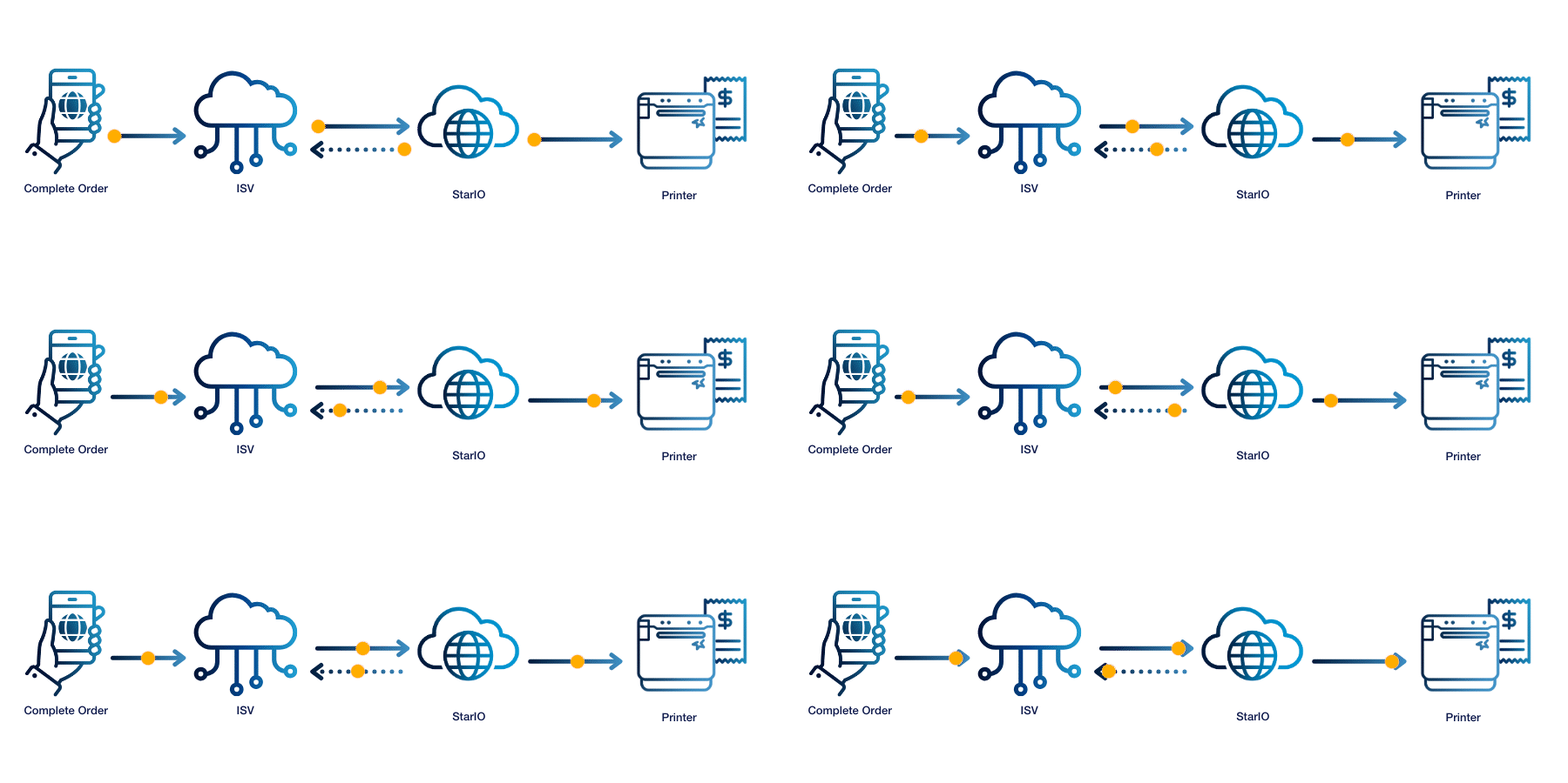
    Somerset, NJ – February 3, 2026 – Star Micronics, a global leader in point-of-sale (POS) hardware and cloud printing technology, today announced a new Easy Deployment method for cloud printing using StarIO.Online, its fully managed CloudPRNT service. This new deployment approach significantly reduces setup time and complexity by eliminating traditional server configuration and manual printer settings.

    With Easy Deployment, supported Star printers can now be connected to StarIO.Online using a streamlined, serial-number-based onboarding process. Once the printer is on the network, users simply enter the printer serial number into their application, perform a brief printer operation, and the device automatically connects to Star’s cloud infrastructure. A confirmation printout verifies successful enrollment.

    This marks a major improvement over traditional self-hosted CloudPRNT deployments, which typically require logging into a printer web interface or utility application, manually enabling CloudPRNT, entering server URLs, rebooting the device, and then completing application-side configuration.

    “Easy Deployment removes unnecessary friction from cloud printing. By shifting infrastructure management to Star and simplifying onboarding to just a few steps, ISVs can deploy faster, merchants can get up and running with minimal effort, and support teams can spend less time troubleshooting setup issues.”

    Key Benefits of Easy Deployment Include:

    • Dramatically reduced setup steps compared to traditional CloudPRNT deployments
    • No server hosting or URL configuration required
    • Faster, more consistent installations across multiple locations
    • Lower risk of setup errors and misconfiguration
    • Immediate confirmation of successful connection via printer output

    Easy Deployment is designed specifically for use with StarIO.Online, Star’s fully managed cloud printing service, which handles server infrastructure, device communication, and monitoring on behalf of the customer. This approach allows ISVs to focus on core application development while Star manages the complexities of cloud printing at scale. Star offers a 90-day free trial for StarIO.Online.

    The new deployment method further reinforces Star Micronics’ commitment to simplifying POS integration and delivering future-ready solutions for modern, cloud-based retail and hospitality environments.

    For more information about StarIO.Online and Easy Deployment, contact Star’s Integration Team at integrations@starmicronics.com.
    Can’t get enough industry news?

    Star Micronics logo, point-of-sale (POS) hardware and technology company.

    Star Micronics is a global leader in POS hardware and transaction technology, providing printers, secure cash management, and connected peripherals for retail and hospitality environments. Known for reliability and developer-friendly integration, Star solutions work seamlessly with Android™, iOS, Windows®, and web-based POS platforms to power receipt, label, ticket, and order printing across modern commerce environments.

    Star’s cloud technologies extend printing beyond the counter. CloudPRNT Next enables scalable direct cloud printing, while StarIO.Online is Star’s fully managed cloud printing service that removes the need for server infrastructure and simplifies remote printer management across distributed locations. Star also offers a broad portfolio of POS peripherals, including barcode scanners, scales, and tablet stands, designed to work together as a complete hardware solution.

    Learn more at starmicronics.com or follow Star on LinkedIn, YouTube, Facebook, Instagram, and X.
    Media Contact:

    Christin Dorner
    Star Micronics America, Inc.
    cdorner@starmicronics.com
    848-216-3318

  • Star Micronics Expands ESC/POS Printer Compatibility Across Thermal and Impact Printing Solutions

    Star Micronics Expands ESC/POS Printer Compatibility Across Thermal and Impact Printing Solutions

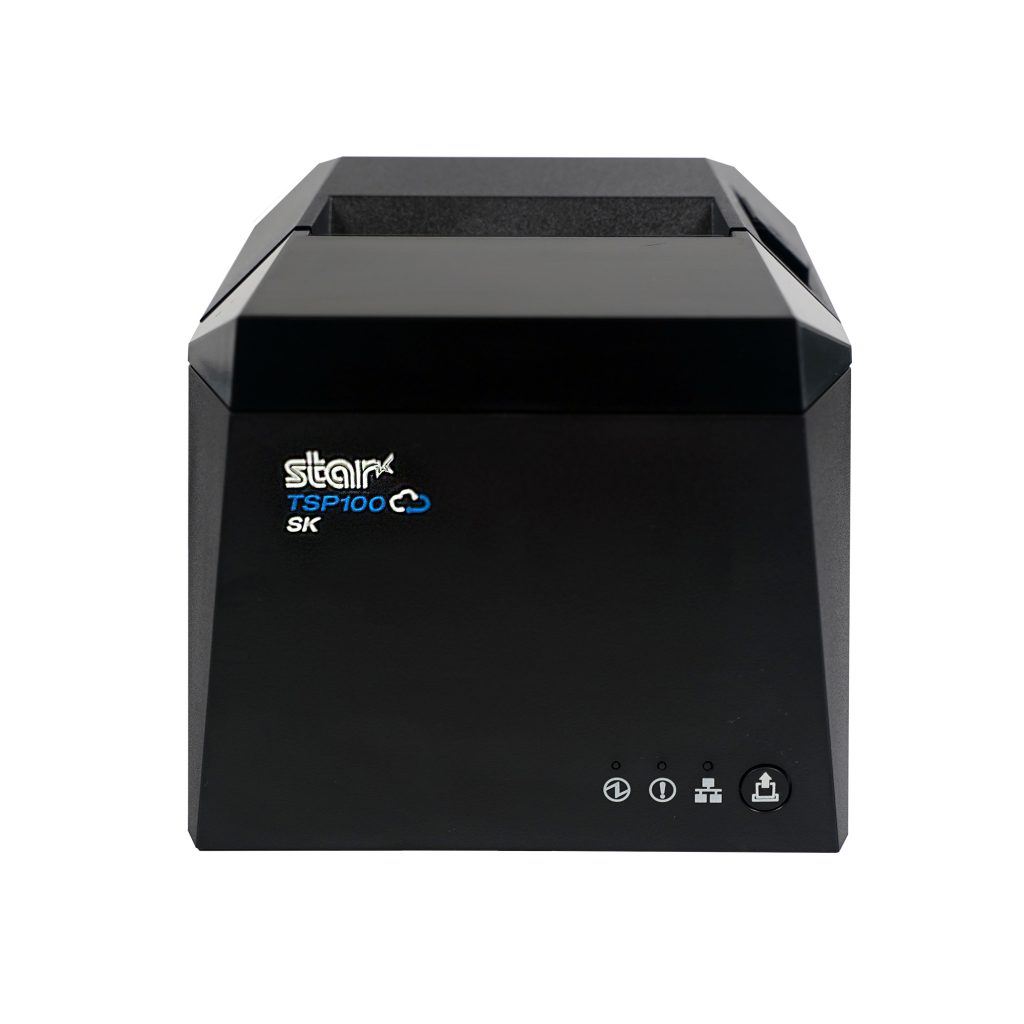
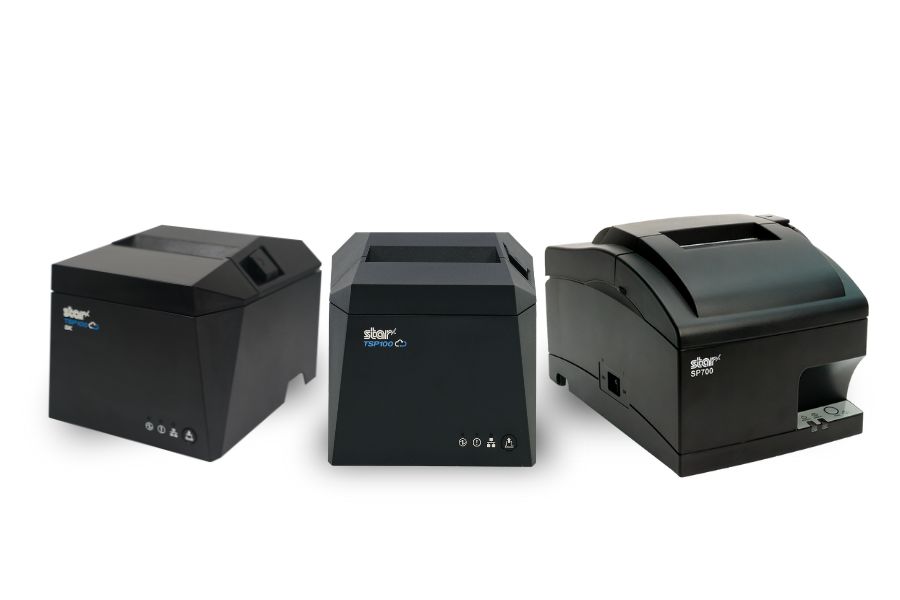
    New ESC/POS printer support includes the TSP100IV series, including SK models, and LAN-based ESC/POS emulation for the SP742 impact printer.

    Somerset, NJ – January 30, 2026 – Star Micronics today announced expanded ESC/POS printer support for the TSP100IV thermal printer series, including TSP100IV SK models, and added LAN-based ESC/POS emulation for the SP742 impact printer. This update extends across the UE and X4 models, including both receipt and linerless sticky label printers. It gives retailers, resellers, and software developers the flexibility to expand their Star hardware portfolio or move to Star, even when their current applications rely on ESC/POS support.

    TSP143IV Series with ESC/POS: Compact & Connected

    The TSP143IV UE (thermal receipt) and TSP143IV UE SK (linerless sticky label) provide a balance of compact design and versatile connectivity. Both models feature USB-C, LAN, CloudPRNT, and Android Open Accessory (AOA) support. With the addition of ESC/POS emulation, integration with legacy systems is even simpler.

    TSP143IV X4 Series with ESC/POS: Future-Proof Versatility

    The TSP143IV X4 (thermal receipt) and TSP143IV SK X4 (linerless sticky label) printers bring four interfaces in one device — “Ultra-C” USB-C, LAN, WLAN, and Bluetooth — along with CloudPRNT Next for faster, more reliable cloud-based printing. Now with ESC/POS emulation, the X4 series ensures maximum compatibility while maintaining industry-leading performance and connectivity.

    Shared Features Across All Models

    • ESC/POS emulation for broader software support
    • High-speed thermal printing (up to 250mm/s on receipt models, 180mm/s on SK label models)
    • Built-in guillotine auto-cutters
    • Compact, space-saving design with internal power supply
    • EnergyStar certification and eco-friendly packaging with minimal plastic

    SP742 Impact Printer Adds ESC/POS Support via LAN

    Star Micronics has also expanded ESC/POS™ emulation support to its SP742 impact printer with the LAN interface. This update enables broader compatibility with legacy POS systems that rely on ESC/POS while continuing to support environments that require durable, impact-printed output. The SP742 remains well suited for kitchens, back-office operations, and other applications where impact printing is preferred.

    Supporting Retail & Hospitality Innovation

    “By adding ESC/POS emulation to all four models in the TSP100IV series, we’re giving businesses and ISVs greater flexibility without compromising the advanced performance that defines Star. Whether for receipts or linerless sticky labels, the UE and X4 models deliver the connectivity, reliability, and sustainability today’s businesses need.”

    For more details on the new ESC/POS-enabled models, visit starmicronics.com or contact sales@starmicronics.com.

    Can’t get enough industry news?

    Star Micronics logo, point-of-sale (POS) hardware and technology company.

    Star Micronics is a global leader in POS hardware and transaction technology, providing printers, secure cash management, and connected peripherals for retail and hospitality environments. Known for reliability and developer-friendly integration, Star solutions work seamlessly with Android™, iOS, Windows®, and web-based POS platforms to power receipt, label, ticket, and order printing across modern commerce environments.

    Star’s cloud technologies extend printing beyond the counter. CloudPRNT Next enables scalable direct cloud printing, while StarIO.Online is Star’s fully managed cloud printing service that removes the need for server infrastructure and simplifies remote printer management across distributed locations. Star also offers a broad portfolio of POS peripherals, including barcode scanners, scales, and tablet stands, designed to work together as a complete hardware solution.

    Learn more at starmicronics.com or follow Star on LinkedIn, YouTube, Facebook, Instagram, and X.

    Media Contact:

    Christin Dorner
    Star Micronics America, Inc.
    cdorner@starmicronics.com
    848-216-3318

  • Star Micronics Brings Scalable Retail POS, Labeling, and Cloud Printing to NRF 2026

    Star Micronics Brings Scalable Retail POS, Labeling, and Cloud Printing to NRF 2026

    Visit Booth 5757 to see how Star’s hardware and cloud tools support omnichannel retail workflows, enterprise deployments, and cloud POS platforms.

    New York, NY – January 11-13, 2026 – Star Micronics, a global leader in point-of-sale (POS), labeling, and cloud technology, is excited to announce its participation in NRF 2026: Retail’s Big Show, taking place January 11–13, 2026, at the Jacob K. Javits Convention Center in New York City. Attendees are invited to visit Booth 5757 to experience Star’s latest retail-ready hardware and cloud printing solutions.

    At NRF 2026, Star Micronics will demonstrate how enterprise retailers, omnichannel brands, and retail technology providers can improve order accuracy, simplify deployments, and scale printing across complex environments using Star’s customer-first solutions.

    Attendees can explore live demonstrations of Star’s retail technology and cloud tools, including:

    • The mC-Label Series (mC-Label2 and mC-Label3): Cloud-ready, multifunction printers designed for modern retail environments. The mC-Label series supports receipts, linerless labels, die-cut labels, and continuous media, enabling on-demand labeling for BOPIS, curbside pickup, third-party delivery, and in-store fulfillment. X4 models offer USB, LAN, Bluetooth, and Wi-Fi connectivity, along with advanced wireless features and cross-platform support.
    • StarIO.Online: A fully managed cloud printing service that removes the need for local servers or custom infrastructure. Developers and ISVs can use a single dashboard to monitor device health, push remote updates, and manage printers across multiple locations, improving visibility and control.
    • CD5 Max Series Cash Drawers: Star’s most durable cash drawer line, built for cash-heavy retail. With all-steel construction, dual printer-driven and USB interfaces, a five-year warranty, and optional accessories, the CD5 Max Series provides secure, long-lasting cash handling for high-volume environments.
    • LED Cash Drawer (CD4 Choice Series with LED Status): A Star first, this cash drawer features built-in LED indicators that provide instant visual confirmation of drawer status, helping staff quickly identify open or closed drawers in busy checkout environments and improving speed and accuracy at the point of sale.
    • mC-Connect™ Drawer: Another Star first and an industry milestone, this compact connectivity hub brings Ethernet, USB, wireless LAN, and Bluetooth® LE together in one device, unlocking true flexibility for cash drawer deployments. Built for modern, tablet-driven POS environments, it bridges traditional cash management with next-gen retail infrastructure, so retailers can evolve their systems without replacing what already works.
    • Star Eco and Star Blue Eco Paper & Labels: Star’s expanded media line offers value-focused and premium eco-forward options, including BPA/BPS-free and Prop 65-compliant formulations and recyclable thermal receipt paper. Engineered for consistent thermal performance and guaranteed compatibility with Star printers, these solutions help retailers support sustainability initiatives without compromising print clarity or reliability.

    At NRF 2026, Star Micronics will be joined in the booth by technology partners ImageHolders, Logic Controls, and Lenovo InstoreScreen to highlight how browser-based POS, kitchen, and printing workflows are shaping modern retail and foodservice environments. The show also marks a new partnership between Star Micronics and Logic Controls, bringing KDS software and labeling together to improve order accuracy and accountability across in-store, kiosk, BOPIS, delivery, and catering workflows. 

    In addition, Star will feature kiosk and drive-thru applications in the Food Service Innovation Zone alongside MicroTouch, highlighting scalable self-service and high-throughput ordering environments. 

    Star Micronics will also host an exclusive partner appreciation event during NRF 2026, offering invited guests the opportunity to connect with peers and industry leaders in a relaxed setting above the city. “Night Above NYC,” Star’s NRF rooftop gathering, will take place on Sunday, January 11, at the Sandbar Rooftop (23rd floor of the Hilton), featuring skyline views, refreshments, and networking. Attendance is limited, and advance registration is required.

    Retailers, ISVs, and solution providers are encouraged to visit Booth 5757 to see Star’s solutions in action and schedule one-on-one meetings with the Star team.

    To book a demo or for more information, contact sales@starmicronics.com. 

    Can’t get enough industry news?

    Star Micronics logo, point-of-sale (POS) hardware and technology company.

    Star Micronics, a world leader in point-of-sale (POS), has designated a portfolio of printing, secure cash management, self-service, and customer engagement solutions for any retail or hospitality establishment. Embracing the mPOS wave, Star’s SDKs allow developers to utilize Star printers in tandem with Android™, iOS, iPad®, and iPhone® devices to generate receipts, labels, chit, and tickets. Star Micronics is always leading and always innovating, creating cloud-based printing solutions, including CloudPRNT Next, StarIO.Online, and Star Cloud Services, with AOA support and MFi connectivity. Star also has a wealth of peripherals, including 2D barcode scanners, scales, tablet display stands, and more. Visit starmicronics.com or follow us on Facebook, X, YouTube, or LinkedIn to learn more. 

    Media Contact:

    Christin Trilone
    Star Micronics America, Inc.
    ctrilone@starmicronics.com
    848-216-3318

  • Star Micronics and Logic Controls Strengthen Online Ordering Accuracy Through Strategic KDS and Labeling Partnership

    Star Micronics and Logic Controls Strengthen Online Ordering Accuracy Through Strategic KDS and Labeling Partnership

    The partnership brings labeling and KDS together to improve order accuracy, accountability, and fulfillment across modern restaurant and retail workflows.

    Somerset, NJ – January 9, 2026 – Star Micronics, a global leader in POS hardware, labeling, and cloud printing technology, today announced a strategic partnership with Logic Controls, the original creator of the kitchen display system (KDS). The collaboration strengthens restaurant and retail order workflows by combining Logic Controls’ industry-leading KDS software with Star’s high-performance labeling solutions to improve order accuracy, operational accountability, and customer experience. 

    As online ordering expands across both restaurant and retail environments, operators face growing pressure to deliver speed, security, and simplicity while controlling costs. Star Micronics and Logic Controls are both Chrome Certified Partners, ensuring seamless compatibility with modern, browser-based POS and ordering platforms. This certification makes it easier for operators to deploy scalable, cloud-first workflows without added IT complexity. 

    Strengthening Orders From Screen to Handoff

    Logic Controls’ Kitchen GO platform has long been trusted by restaurants, retailers, and self-service operators to organize and route orders across prep and expo stations. By pairing real-time order visibility with Star’s labeling technology, operators gain a physical verification layer that extends accuracy beyond the screen and into packaging, pickup, and delivery. 

    Each item is clearly labeled, verified, and traceable, reducing missed items, eliminating confusion at handoff, and helping order fulfillment teams consistently deliver the right order to the right customer. 

    Designed for Modern Ordering Channels

    As ordering expands across dine-in, kiosk, BOPIS, curbside, and third-party delivery, retailers and restaurants must manage more complexity with less margin for error. The Star Micronics and Logic Controls partnership supports: 

    • Third-party delivery and BOPIS by clearly labeling orders for correct pickup and handoff 
    • Kiosk and in-store ordering by maintaining item identification through prep and expo 
    • Multi-brand environments by routing orders to separate kitchens and accurately reassembling them 

    A More Connected Kitchen Workflow for Restaurants and Retailers

    Together, Star Micronics and Logic Controls are helping operators achieve consistent, secure, and reliable order fulfillment that supports operational efficiency, stronger margins, and lasting customer trust across every ordering channel. 

    For more information about Star Micronics solutions, visit starmicronics.com. 
    To learn more about Logic Controls and Kitchen GO, visit logiccontrols.com. 

    Can’t get enough industry news?

    About Star Micronics 

    Star Micronics is a world leader in point-of-sale (POS) hardware, offering a portfolio of printing, secure cash management, self-service, and customer engagement solutions for retail and hospitality environments. Star’s technologies support Android, iOS, Windows, and web-based platforms, as well as cloud printing solutions, including CloudPRNT Next and StarIO.Online. 

    About Logic Controls 

    Logic Controls is the original creator of the kitchen display system and a global leader in kitchen automation technology. With more than 40 years of experience and over 500,000 stations deployed worldwide, Logic Controls delivers durable hardware and advanced KDS software designed to improve kitchen speed, accuracy, and performance. 

    Media Contacts:

    Christin Trilone 

    Star Micronics America, Inc. 

    ctrilone@starmicronics.com 

    848-216-3318 

    Bridget Belcher 

    Logic Controls 

    bridget.belcher@logiccontrols.com 

    407-401-9706 

  • How to Balance Cash Drawers Quickly and Accurately

    How to Balance Cash Drawers Quickly and Accurately

    Balancing a cash drawer is a critical daily task for businesses that handle cash transactions. Knowing how to balance cash drawers accurately helps reduce shrinkage, improve accountability, and keep end-of-shift operations running smoothly. This guide explains why cash drawer balancing still matters and how to do it quickly and correctly.

    Table of Contents

    What Does It Mean to Balance a Cash Drawer?

    To balance a cash drawer means reconciling the physical cash in a register with the expected total recorded by the point-of-sale (POS) system. This process confirms that cash sales, refunds, and starting cash amounts are accurately reflected. Any difference between the expected and actual amount indicates a discrepancy that must be investigated.

    Why Cash Drawer Balancing Still Matters

    Despite the continued growth of digital payments, cash remains an essential part of daily operations for many businesses. Knowing how to balance a cash drawer is still a foundational skill for retailers, restaurants, and service-based organizations that handle physical currency.

    Because cash is vulnerable to errors, loss, and misuse, balancing cash drawers is not just an administrative task—it is a core operational safeguard. When performed consistently and correctly, cash drawer balancing ensures sufficient funds are available, supports uninterrupted service, and helps businesses quickly identify discrepancies.

    Effective cash drawer management also plays a direct role in profitability. Regular reconciliation—ideally at the end of each shift or at least daily—improves accuracy, strengthens accountability, and reduces shrinkage. With a clear process and the right tools, balancing a cash drawer quickly and accurately is a skill any business can master.

    How To Balance A Cash Drawer

    How to Balance a Cash Drawer

    1. Assign One Person to Each Cash Drawer

    Assigning a single employee to each cash drawer is one of the most effective ways to balance a cash drawer accurately and consistently. This approach creates clear accountability and simplifies cash tracking at the end of each shift.

    When only one person is responsible for a drawer, it becomes much easier to identify discrepancies, resolve errors, and prevent loss. Even in high-trust environments, shared drawers increase the likelihood of mistakes and make reconciliation more time-consuming.

    When one employee is assigned to each drawer, cash balancing becomes more accurate and more consistent, helping businesses reduce shrinkage and maintain dependable cash handling practices.

    2. Count Cash at the Beginning of the Day

    Every shift should start with an accurate count of the opening cash balance. Knowing exactly how much cash is in each drawer creates a clear baseline for tracking sales and identifying discrepancies later in the day.

    Maintaining the correct starting amount is important for both efficiency and security. Too little cash can slow transactions and frustrate customers, while excess cash increases exposure to loss. Setting up each drawer with a balanced mix of bills and coins, based on expected transaction volume, helps ensure smoother operations throughout the day.

    3. Deposit Cash Throughout Shifts

    Keeping cash drawers organized during the day makes end-of-shift balancing faster and more accurate. Making regular deposits during slower periods helps prevent drawers from becoming overfilled and maintains a practical mix of bills and coins for transactions.

    These mid-shift check-ins reduce the chance of counting mistakes later and support more consistent cash handling overall. When possible, having a second employee present for interim deposits adds an extra layer of accountability and reinforces best practices for cash management.


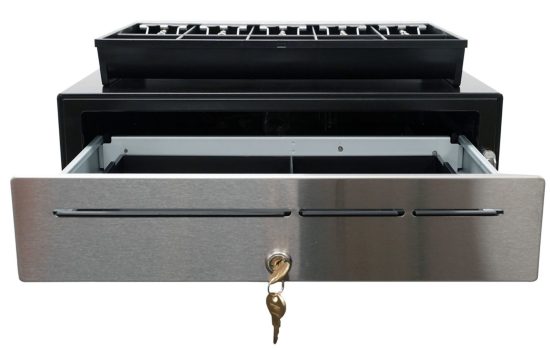
    The CD5-1918 Max Series cash drawer by Star Micronics is ideal for high-cash volume environments.
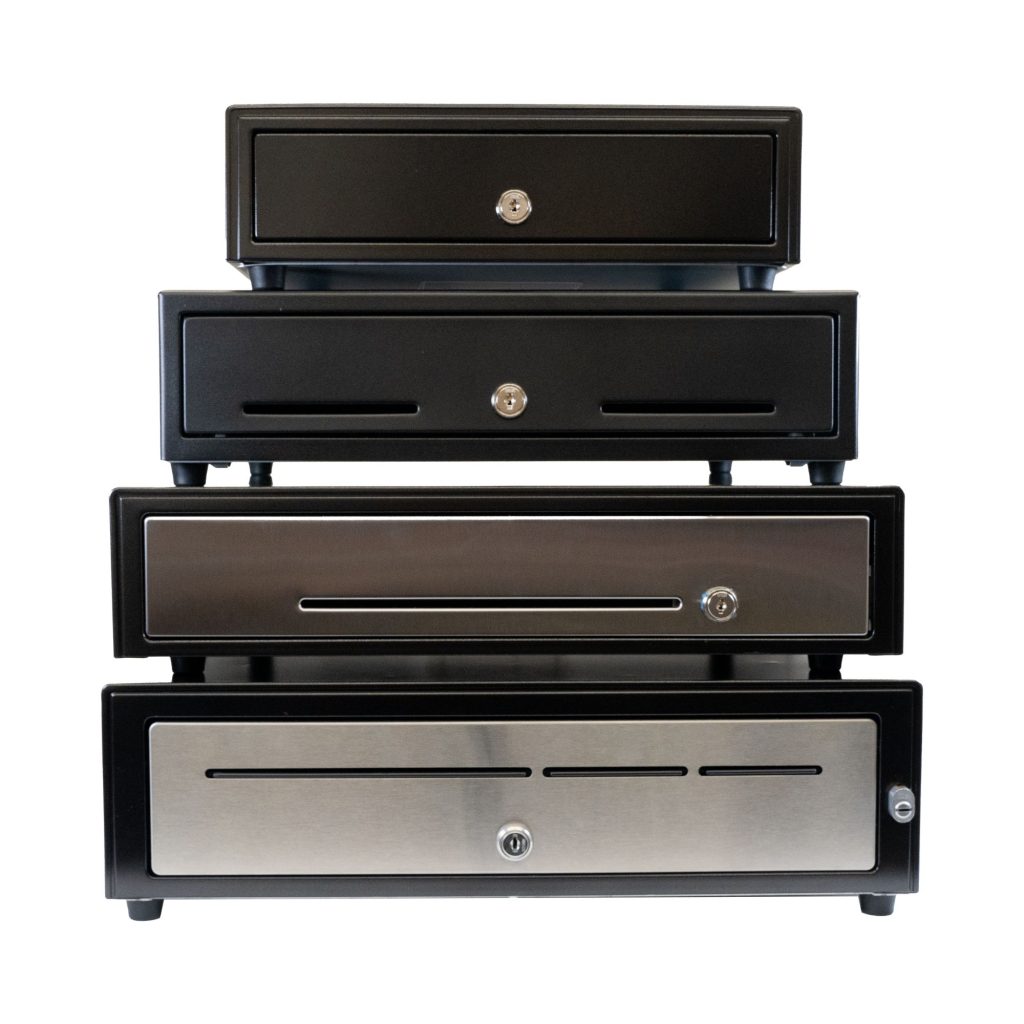
    Star Micronics has a wide range of cash drawers to fit any business environments.

    4. Pull the POS Report for Each Drawer Afterward

    Balancing a cash drawer starts with having the right data. At the end of each shift or business day, pull the POS report associated with each drawer to establish an accurate reference point. This report shows exactly what the system recorded and provides the benchmark for your cash count.

    For best results, complete this step in a quiet, controlled environment. Fewer distractions make it easier to spot discrepancies, verify totals, and ensure the drawer is balanced correctly before closing it out.

    5. Count the Cash from Each Drawer in a Discreet Location

    Cash counting should always be done carefully and away from customer-facing areas. In a secure, private space, count all bills, coins, and receipts, then compare the total against the POS report for that drawer. This controlled environment reduces distractions and helps ensure accuracy.

    If a discrepancy appears, perform a second count before drawing conclusions. Many variances are resolved through a careful recount. Taking the time to verify totals builds confidence in your cash handling process and supports consistent, reliable drawer balancing.

    6. Identify and Solve Discrepancies

    When a cash drawer does not balance, start by reviewing the POS data in detail. Most shortages or overages are the result of simple errors, such as incorrect change given or a transaction entered incorrectly, rather than intentional misuse.

    Compare the POS report against receipts, refunds, and cash totals to pinpoint where the variance occurred. If discrepancies happen regularly, it may be a sign that additional training or clearer procedures are needed. For unresolved issues, inspect the cash drawer area and review recent transactions to check for missing receipts or unrecorded sales. Addressing discrepancies promptly helps protect revenue and reinforces strong cash handling habits.

    7. Record Cash Drawer Transactions

    Accurate record keeping is essential to closing out the cash balancing process. Document the starting and ending balances for each drawer, along with totals for cash, cards, and any other payment types. Be sure to note any overages or shortages clearly and consistently.

    Maintaining detailed records supports accurate accounting, helps resolve questions later, and creates a clear audit trail if issues arise. Over time, these records also make it easier to spot patterns, improve procedures, and strengthen overall cash handling accuracy.

    Tools That Make It Easier to Balance a Cash Drawer

    Balancing a cash drawer is faster and more consistent when the right tools are in place. Clear POS reporting, secure cash drawers, and standardized hardware help reduce counting errors and simplify end-of-shift reconciliation.

    Cash drawers designed for frequent opening, secure storage, and smooth operation support better accountability across shifts. When combined with accurate reporting and consistent procedures, the right tools help businesses balance cash drawers more efficiently and with greater confidence.

    Balance Cash Drawers with Ease

    By adhering to these steps and maintaining a consistent approach, businesses can ensure that their cash drawers are balanced quickly and accurately. Cash management efficiency is a skill every business should acquire, as it contributes to the overall smooth operation and profitability.

    CD5 Max Series Cash Drawers

    Designed for high-cash volume businesses, the CD5 Max Series cash drawers deliver durability, security, and sleek design. With all-steel construction, dual lock mechanisms, and under-till compartments for added organization, these drawers are ideal for grocery stores, cannabis dispensaries, and other busy retail settings. Available in multiple sizes and with dual DK and USB interface options, the CD5 Max Series integrates seamlessly into any POS system.

    Explore More >

    Conquering Omnichannel Order Management with Cloud-Based Technology Solutions

    Consumers have spoken! The future of retail and hospitality is omnichannel, cloud-based, and connected. Is your business prepared?

    Looking for secure cash drawers to balance?

    Cash Drawer Balancing FAQs

    How often should you balance a cash drawer?

    Most businesses should balance each cash drawer at the end of every shift. High-volume locations may also benefit from mid-shift checks to catch errors early and reduce end-of-day discrepancies.

    What does it mean to balance a cash drawer?

    To balance a cash drawer means comparing the physical cash in the drawer to the expected total shown in the POS system. When the numbers match, the drawer is balanced. Any difference results in an overage or shortage that must be investigated.

    What is an acceptable cash drawer shortage or overage?

    Acceptable thresholds vary by business, but many retailers allow a small variance such as $1–$5. Consistent discrepancies, even small ones, should be addressed through process review or staff training.

    What causes cash drawers to be out of balance?

    Most issues are caused by simple mistakes, such as incorrect change given, cash sales entered incorrectly, or skipped transactions. Fewer discrepancies occur when one person is assigned per drawer and cash is counted consistently.

    Can POS systems help balance cash drawers more accurately?

    Yes. Modern POS systems generate detailed drawer reports that make it easier to compare expected totals against physical cash. Accurate reporting is essential for identifying where errors may have occurred.

    Is it better to balance cash drawers manually or digitally?

    Both methods work best together. POS reports provide the expected totals, while manual counting confirms the actual cash on hand. Combining the two ensures accuracy and accountability.

    What should you do if a cash drawer does not balance?

    Start with a second count to rule out counting errors. Then review the POS report for voids, refunds, or missed entries. If discrepancies continue, additional training or process adjustments may be needed.

    How can businesses reduce cash drawer discrepancies over time?

    Clear ownership of drawers, consistent counting procedures, regular audits, and proper POS training all help reduce errors. Reliable hardware, secure cash drawers, and accurate reporting tools also play an important role.

    Original article written by Brianna Moriarty and published September 8, 2020.

  • Airport Food Label Printers: How to Improve Safety, Speed, and Compliance

    Airport Food Label Printers: How to Improve Safety, Speed, and Compliance

    Airports depend on clear, accurate labeling to keep food safe, compliant, and fast-moving. Learn how modern airport food label printers support rotation, grab-and-go, allergen, and traceability workflows across terminal restaurants, QSRs, and retail operators.

    What Is an Airport Food Label Printer?

    An airport food label printer is any reliable label printer used within airport restaurants, QSRs, lounges, and grab-and-go retailers to produce rotation labels, allergen and nutritional labels, traceability labels, and barcode/QR labels. While not a specialized hardware category, these printers must support high-volume workflows, fast labeling, multiple media types, and strong connectivity options to meet the speed, safety, and compliance requirements of airport foodservice environments.

    Table of Contents

    The Rising Demand for Food Labeling in Airports

    Several trends are driving the growing need for reliable airport food labeling solutions. Passenger volume continues to rise, with FAA data showing U.S. airports surpassing pre-pandemic levels and reaching 1.1 billion travelers in 2024. As dwell times increase, so does demand for meals, snacks, and grab-and-go options across airport terminals and lounges.

    With this expansion comes a higher standard for freshness, safety, and transparency. Airport foodservice providers must label items clearly to meet consumer expectations, support accurate allergen disclosures, and comply with regulations such as the FDA’s Food Safety Modernization Act (FSMA). Many airports also maintain their own elevated safety and traceability standards to protect travelers and manage brand reputation.

    Airport food label printers are also essential tools for fast casual and QSR environments where orders come in through kiosks or mobile devices. Clear, accurate labels keep kitchens organized, speed up prep, and reduce errors—especially when menu items or ingredients change frequently. A reliable airport food label printer becomes critical for both food safety and operational speed.

    Key Label Types Used in Airport Restaurants & Grab-and-Go

    Operators must configure airport food label printers for different purposes so that they clearly communicate vital information. Key airport food label types include: 

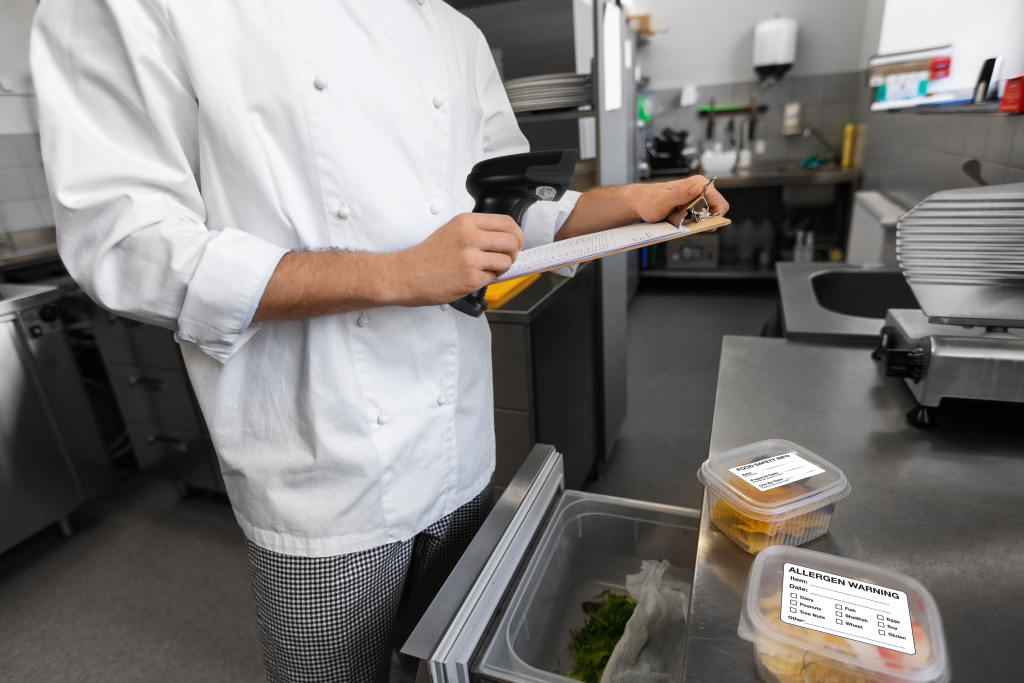
    • Allergen Labels: These labels protect travelers with dietary restrictions and are required in many regions. They are essential for prepackaged items. 
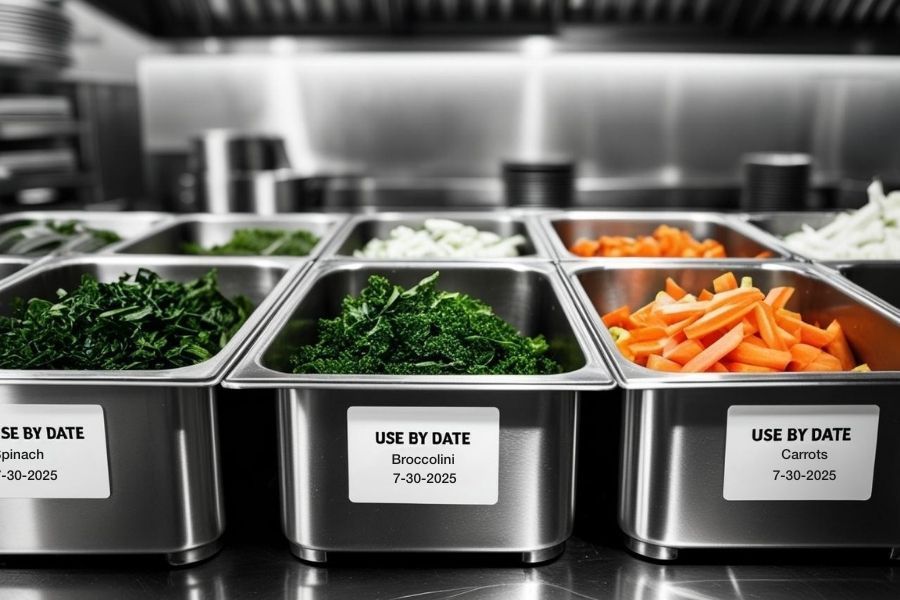
    • Freshness/Rotation Labels: Staff can easily apply freshness labels even when preparing foods at peak volume. The timestamp on the label ensures food safety and helps to minimize food waste. 
    • Grab-and-Go Labels: Labels ensure consumers have vital information about prepackaged prepared foods like sandwiches, salads, and packaged meals. Labels can include ingredient lists, timestamps, and allergen information. Grab-and-go labels also communicate the restaurant’s brand. 
    • Nutritional Labels: These labels allow airports and their food vendors to comply with related laws in the countries where they operate. Consumers also expect nutrition labels to help them make informed food choices.  
    • Traceability Labels: Data on airport food labeling allows staff to track preparation time, batch number, and information from food prep processes. These labels are critical for multi-vendor terminals and lounge catering teams to ensure consumers receive the right orders.
    • Barcode/QR Labels: Barcodes and QR codes allow operators to automate inventory tracking, food prep progress, and update digital systems. These labels are vital to large food services with centralized kitchens.

    Star Micronics Has The Multifunction Printers Perfect For Industries That Need Versatility And User Friendliness
    The mC-Label2 multifunction label printer is ideal for airport environments.

    What Airports Need in a High-Performance Food Label Printer

    Because a range of airport food label printing is necessary to optimize food service safety, accuracy, and service, operators must choose an airport food label printer with these key features: 

    1. Versatile Media Compatibility

    Airport food label printers should create all common label types. The ability for one model to print sustainable linerless, sticky linerless, die-cut, and continuous labels reduces the food service operation’s IT equipment footprint and SKU count. 

    2. Fast, Reliable Throughput

    High-volume airport terminals can’t tolerate lag or downtime. Airport food label printers with fast printing speeds keep lines moving, even during rush periods. 

    3. Compact, Durable Hardware

    Airport food label printers with space-saving designs allow staff to use them where there’s limited counter space. Compact printers benefit QSRs and lounges and can easily integrate with kiosks. Airports shouldn’t trade compact design for durability, however. Printers must meet size and configuration requirements in addition to delivering top performance during non-stop daily use. 

    4. Easy Connectivity

    Airport networks vary, and staff may need printers in a variety of locations. Airport food label printers must support a range of connectivity options, including Ethernet, Wi-Fi, USB-C, and Bluetooth. 

    5. Centralized Management

    Airports rely on consistent oversight across multiple vendors, kiosks, and foodservice stations. Airport food label printers should support centralized monitoring and management to ensure consistency and control.

    How Star Micronics Supports Airport Food Labeling

    Star Micronics provides a full suite of airport food labeling solutions designed for speed, safety, and operational consistency. Star printers support all common media types used in airport foodservice, including linerless, die-cut, and continuous labels. They also handle sticky linerless labels ideal for grab-and-go packaging, as well as labels for freshness rotation, allergens, nutrition, and traceability. Multiple connectivity options ensure printers can be deployed wherever airport teams need them.

    Star also supports airport food labeling workflows with essential cloud and device management services:

    • CloudPRNT Next enables direct-to-server, enterprise-level cloud printing for labeling workflows across airport operations.
    • StarIO.Online provides a fully managed cloud printing service for ISVs that want Star to host the printing infrastructure, eliminating the need for local servers or middleware.
    • Star Micronics Cloud Services offers remote monitoring, device status visibility, and configuration tools, allowing IT teams to oversee printers across terminals without on-site intervention.

    Together, these services give airports flexible ways to standardize printing, reduce maintenance, and support large-scale foodservice operations from a central point of control.

    Recommended Airport Food Label Printers

    Printer Model Connectivity Label Support Best For
    mC-Label3 Ethernet, Wi-Fi, Bluetooth, USB-C Linerless, Die-Cut, Continuous Multi-station labeling, high-volume terminals
    mC-Label2 Ethernet, Wi-Fi, Bluetooth, USB-C Linerless, Die-Cut, Continuous Compact prep stations, lounges, barcoding
    TSP143IV SK X4 Ethernet, Wi-Fi, USB-C, Bluetooth Sticky Linerless Labels Grab-and-go labeling, takeout, packaging

    mC-Label2 Multifunction Printer

    The mC-Label2 packs powerful features into a compact, front-loading design, including 300 dpi resolution, support for linerless, die-cut, receipt, and continuous media, and connectivity options like USB-C, LAN, WLAN, Bluetooth, and Apple MFi-certified pairing (X4 models only).

    Explore the mC-Label2 >

    mC-Label3 Multifunction Printer

    The Star Micronics mC-Label3 is a versatile multifunction printer that prints a wide range of labels and receipts, including both permanent and repositionable sticky linerless. It features cloud connectivity and innovative technologies like SteadyLAN and TetherLAN for enhanced printing convenience.

    Discover the mC-Label3 >

    TSP143IV SK Sticky Label Printer

    The TSP143IV SK by Star Micronics sets a new standard for compact, eco-friendly thermal linerless label printing, offering advanced connectivity options like Wi-Fi and AOA, and efficient, residue-free labels for diverse business needs.

    Find out more >

    Reliable Labeling Keeps Airport Operations Moving

    As airport traffic and the demand for food service in airports grow, operations will see more demand for prepackaged and restaurant foods for hungry travelers. However, with this increased demand, airports will also need to find ways to stay organized, operate efficiently, serve accurate orders, and comply with food safety and transparency laws. 

    Operations need highly reliable, high-speed airport food label printing solutions for the full range of labeling needs, from sustainable linerless labels for QSR and lounge orders to sticky labels for nutrition information and branding. Airports also need printing services for centralized management across multiple terminals and cloud-based oversight for auditing and traceability. 

    Star Micronics’ printer line delivers the versatility and performance airports require. Star also offers services, including CloudPRNT Next and StarIO.Online, to streamline label printing management and even versatile label media like Star Blue Eco.

    Why the Right Airport Food Label Printer Matters

    Airport foodservice operations move fast, and consistent food label compliance is essential for keeping travelers safe and maintaining smooth workflows. The right airport food label printer supports freshness and rotation labeling, allergen visibility, grab-and-go packaging, and traceability across every terminal.

    With versatile media support, reliable throughput, and centralized cloud management, modern label printers help airport operators reduce errors, meet regulatory requirements, and keep high-volume service running without interruption.

    How VARs and ISVs Can Maximize ROI with Advanced Kiosk Printing Technology

    This ebook reveals how ISVs and VARs can harness the transformative potential of kiosk printing technology to maximize ROI for both their clients and their own businesses.

    Frequently Asked Questions (FAQ)

    What is an airport food label printer?

    An airport food label printer is any label printer capable of producing rotation, allergen, nutrition, grab-and-go, and traceability labels in fast-paced airport foodservice environments. It does not need to be a specialized device — it simply needs to meet airport requirements for speed, durability, and media flexibility.

    Why do airports need specialized labeling workflows?

    Airports operate at high volume with strict food safety, traceability, and allergen-compliance requirements. Consistent labeling helps maintain freshness, reduce waste, support transparency, and ensure operational accuracy across multiple vendors and terminals.

    Can one label printer support multiple airport food label types?

    Yes. Star printers like the mC-Label3 and mC-Label2 are designed to handle a wide range of media types — including linerless, die-cut, and continuous labels — giving operators the versatility to support different labeling needs across the airport. Each printer is loaded with the label type needed for its station, and operators can easily dedicate identical models to different tasks to simplify training, reduce SKUs, and maintain consistent workflows. Software integration determines which label formats and layouts can be produced.

    Do airport food label printers need Wi-Fi to operate?

    No. While Wi-Fi is common in airport environments, Star printers also support Ethernet, Bluetooth, and USB-C. This ensures reliable operation even in congested wireless environments.

    Are linerless labels suitable for airport foodservice?

    Yes. Linerless labels are widely used in airports because they reduce waste, offer flexible sizing, and work well for grab-and-go items, rotation labeling, and order accuracy. Sticky linerless labels are especially useful for sealing to-go packaging.

    What is the best type of printer for grab-and-go airport items?

    Sticky linerless-capable printers like the TSP143IV SK X4 and media-flexible models like the multifunction mC-Label3 are ideal for grab-and-go packaging, nutritional labels, and branding stickers due to their speed, adhesion options, and compact footprint.

    Learn more about Star’s label printer lineup and get the right solution for airport restaurants and grab-and-go operations:

  • The Power of a Fully Managed Cloud Printing Service

    The Power of a Fully Managed Cloud Printing Service

    Modern software applications are increasingly expected to support printing, whether it’s order tickets for a restaurant, labels for a retailer, or receipts for a kiosk environment. Yet for developers, enabling reliable printing across multiple locations is rarely simple.

    Traditional systems rely on local servers, complex firewalls, and manual setup, creating delays for developers and friction for end users.

    A fully managed cloud printing service changes that. It provides a way for independent software vendors (ISVs) and developers to build printing directly into their applications without managing the infrastructure behind it.

    That’s exactly what StarIO.Online was built for.

    Table of Contents

    What Is a Cloud Printing Service?

    A cloud printing service allows applications to send print jobs securely to networked printers over the internet without relying on local servers or middleware.

    For software developers and ISVs, this means print functionality can be built directly into web or mobile applications through APIs rather than through local drivers or complex network configurations.

    In a typical cloud printing setup, the application communicates with a secure, centralized platform that manages print requests, job delivery, and device status across multiple locations. This architecture eliminates the need for local hosting, simplifies deployment, and enables global scalability while reducing the time and resources needed to manage print infrastructure.

    In short, cloud printing makes it easier for developers to integrate, monitor, and scale printing across distributed environments without worrying about on-site systems.

    Why “Fully Managed” Matters for Developers

    Not all cloud printing solutions are created equal. Many require developers to host their own infrastructure or manage external dependencies. A fully managed cloud printing service removes that responsibility entirely.

    In a managed model, the service provider handles the hosting, uptime, and security for the entire print environment. Developers can focus on building applications instead of maintaining servers, configuring networks, or handling firmware and API updates.

    This approach results in:

    • Simplified integration – Build faster with minimal backend setup.
    • Consistent reliability – Reduce downtime and failed print jobs.
    • Lower maintenance overhead – No need for server patches or manual monitoring.

    Meet StarIO.Online

    StarIO.Online is Star Micronics’ fully managed cloud printing service built specifically for ISVs and software developers. It gives developers a ready-to-use infrastructure to connect web and cloud-based applications to Star printers securely and reliably without the cost or complexity of maintaining print servers.

    With StarIO.Online, there are no servers, no firewalls, and no local installations. Developers can print to any CloudPRNT or CloudPRNT Next-compatible device through a simple REST-style API call. The platform handles job delivery, device status, and job queuing automatically, so print data is never lost, even if a printer is temporarily offline.

    Developers and IT teams can monitor every device through a centralized cloud dashboard that offers real-time visibility into printer health, job history, and error states. Webhook notifications make it easy to stay informed about device events and print results without custom polling or complex monitoring scripts.

    StarIO.Online takes the infrastructure burden off your team so you can focus on building features, not maintaining printers.

    The Benefits of Star’s Fully Managed Cloud Printing Service

    StarIO.Online was designed to simplify cloud printing for developers building connected platforms at scale.

    Key advantages include:

    • No server infrastructure – Star hosts and maintains the environment on secure cloud servers.
    • REST-style API integration – Developers can send print jobs or retrieve device data with minimal code.
    • Webhook notifications – Receive instant updates on print status, device events, and barcode scans.
    • Unified dashboard – Manage, monitor, and configure printers across all locations from one interface.
    • Scalable architecture – Deploy cloud printing for one store or thousands without changing your backend.
    • Secure communication – All print data is transmitted through Star-hosted, securely managed cloud servers.
    • Consistent performance – Reliable print delivery with automatic job retry and status confirmation.
    • No software installs – 100 % cloud-based operation, accessible anywhere.

    StarIO.Online is a fully managed cloud printing service by Star Micronics.

    When Developers Choose Cloud Printing

    A cloud printing service streamlines deployment and maintenance for any developer building connected applications:

    • Restaurant and QSR platforms – Send online orders directly to kitchen or counter printers through the cloud.
    • Retail and labeling software – Print receipts, tags, and labels remotely without local drivers.
    • Kiosk and ticketing solutions – Configure and monitor unattended devices from a central location.
    • Enterprise or multi-location platforms – Standardize printing workflows across hundreds or thousands of sites.

    For ISVs creating scalable ecosystems, cloud printing ensures dependable performance and reduces the time spent on network management, support calls, and manual configuration.

    StarIO.Online vs. Developer-Hosted Printing

    Feature Developer-Hosted Printing StarIO.Online
    Server Hosting Developer maintains servers Fully hosted by Star
    Integration Custom code and setup required REST-style API integration
    Monitoring Manual or limited Real-time dashboard and webhooks
    Maintenance Developer-managed Star-managed
    Scalability Tied to server capacity Enterprise-grade scalability
    Uptime and Support Varies by host Backed by Star Micronics

    StarIO.Online removes the complexity of maintaining custom print infrastructure, giving developers a faster, more reliable path from code to printed output.

    The Future of Cloud Printing for Developers

    As software continues to move to the cloud, developers need infrastructure that matches that flexibility. Printing should be just as simple, with no local servers, complex networks, or maintenance overhead.

    A fully managed cloud printing service offers a cleaner, more scalable way to add printing to any application. It lets developers focus on innovation while ensuring every print job, whether a receipt, ticket, or label, reaches its destination accurately and on time.

    With StarIO.Online, developers can integrate once, deploy anywhere, and rely on a print environment that grows with their software.

    Ready to find out more about Star’s fully managed cloud printing services?

  • Compliant Cannabis Labels: Print Small, Accurate, and Legible Every Time

    Compliant Cannabis Labels: Print Small, Accurate, and Legible Every Time

    Labeling in the cannabis industry is not just a matter of branding—it’s a legal requirement. Dispensaries and cannabis retailers must ensure that every package includes detailed information such as THC and CBD content, batch numbers, manufacturer info, warning symbols, and expiration dates. 

    While branded packaging typically uses colorful labels for visual appeal, most operations rely on a second, white regulatory label for compliance (required information varies by state). These compliance cannabis labels are often small, and printing them clearly is critical for both legal adherence and customer trust.

    5 Best Practices for Printing Small Cannabis Labels

    Cannabis packaging labels can be very small, which can make printing clear, compliant labels difficult. To print small labels for cannabis products, following these best practices is a good place to start: 

    1. Use Simple, Readable Label Designs

    Regulatory cannabis labels should prioritize legibility over aesthetics. Use clear, sans-serif fonts and maintain enough spacing between text and label edges. Even when printing on labels under 1 inch, clarity is non-negotiable. In some jurisdictions, font types and minimum sizes are specified by law.

    2. Choose a High-Resolution Label Printer

    To ensure every letter, number, and barcode scans cleanly, you need a printer that delivers high resolution. A label printer with a resolution of at least 300 DPI is ideal for printing small cannabis labels that require dense amounts of information. Lower-resolution printers can blur or distort critical details, potentially putting compliance at risk.

    Compliant Cannabis Labels

    3. Select the Right Label Media

    The label type impacts both durability and legibility. Choose white die-cut labels with a matte finish for optimal scan quality and text contrast. For improved workflow and less waste, consider linerless labels with permanent adhesive for tamper-evident applications. These can be applied directly over colorful branded packaging.

    4. Centralize Label Design and Printing

    Cannabis businesses often operate across multiple stations or locations, making consistency a challenge. With Star’s CloudPRNT Next and Label Builder, you can centrally manage and deploy approved cannabis label designs to any connected printer. Paired with a cloud-enabled printer like the mC-Label2, this setup ensures version control, prevents unauthorized edits, and delivers consistent, compliant output at every touchpoint.

    5. Review and Refresh Regularly

    Compliance rules change frequently. Conduct routine reviews to ensure your labels meet current state regulations and visual standards. Also, inspect print quality regularly to identify issues early, such as fading, misalignment, or worn printheads.

    Why the mC-Label2 Is Ideal for Cannabis Compliance Labels

    The Star Micronics mC-Label2 is a compact, front-loading 2-inch label printer that excels in tight spaces, like dispensary counters and prep stations. With ultra-sharp 300 DPI resolution, it prints small cannabis labels with exceptional clarity, perfect for overlaying compliance data on branded packaging.

    It supports multiple media types, including white die-cut labels, linerless adhesive labels, receipts, and continuous rolls. The LBL models print die-cut labels and receipts only for focused use cases.

    mC-Label2 Multifunction Printer

    The mC-Label2 packs powerful features into a compact, front-loading design, including 300 dpi resolution, support for linerless, die-cut, receipt, and continuous media, and connectivity options like USB-C, LAN, WLAN, Bluetooth, and Apple MFi-certified pairing (X4 models only).

    Explore the mC-Label2 >

    The printer’s One Touch Label feature allows users to store and print up to three pre-approved label designs without needing a network connection, speeding up repetitive labeling tasks. This helps budtenders or staff rapidly apply consistent labels during high-traffic hours—no need to access software or re-enter data for common label types.

    Connectivity is seamless with support for USB-C, LAN, Bluetooth, and Wi-Fi. And because it integrates with CloudPRNT Next, StarIO.Online, and Star’s Label Builder, it’s easy to manage label templates and ensure accuracy across every location.

    Start Printing Smarter Compliance Labels

    Meeting cannabis labeling regulations doesn’t require oversized printers or complicated workflows. With the right cannabis label printer and a thoughtful process, you can create accurate, compliant, and professional labels that support your business and satisfy state requirements.

    Mastering Label Compliance in the U.S.

    From food and beverages to pharmaceuticals and consumer goods, this ebook provides the necessary tools to ensure your labeling meets legal standards and enhances customer engagement.

    Want to see how the mC-Label2 can support your cannabis operations?

  • Star Micronics Introduces the mC-Label2: High-Res Printing in a Compact Format

    Star Micronics Introduces the mC-Label2: High-Res Printing in a Compact Format

    A space-saving, cloud-connected printer that supports linerless, die-cut, and receipt media, perfect for retail, cannabis, pharmacy, jewelers, and more.

    Somerset, NJ – July 23, 2025 – Star Micronics, a global leader in point-of-sale (POS) and labeling solutions, is pleased to announce the launch of the mC-Label2, a 2-inch multifunction printer built for sharp, small-format labeling in space-constrained environments. Designed for retailers, QSRs, dispensaries, and more, the mC-Label2 combines high-resolution 300 dpi printing, front-loading design, and multi-media compatibility into one sleek device.

    With a compact footprint and front-exit paper path, the mC-Label2 can be installed under shelves or flush against walls, making it ideal for locations where space is at a premium. Businesses can choose between two models: an all-media version that supports linerless, die-cut, continuous labels and receipts, or an LBL model dedicated to die-cut label and receipt printing.

    Key Features of the mC-Label2 include:

    • 300 dpi Resolution: Crisp, detailed text, barcodes, and logos, even on small labels.
    • Front-Loading, Front-Exit Design: Ideal for tight spaces, such as counters and shelves. Devices can even be mounted on top of the printer for added versatility.
    • Two Model Options:
      All Media Model – Supports linerless, die-cut, continuous labels, and receipts
      LBL Model – Optimized for die-cut labels and receipts only
    • Flexible Connectivity Options: The X4 models feature USB, LAN, WLAN, and MFi-certified Bluetooth for full wireless and wired connectivity, while the Ci models offer a streamlined, wired-only configuration with USB-C, LAN, and USB-A ports.
    • Cloud & App Support: Compatible with CloudPRNT Next, StarIO.Online, and Star’s Label Builder app for template-based label creation and One Touch Label printing.

    Like the mC-Label3, the mC-Label2 is part of Star’s growing lineup of multimedia printers designed to simplify operations across retail and hospitality. It’s built on the same developer-friendly platform, with native SDKs for iOS, macOS, Android, Linux, and Windows, and supports Star’s incredibly easy BLE-assisted wireless setup.

    “The mC-Label2 brings the power of our labeling technology into an even smaller footprint. With 300 dpi resolution, support for multiple media types, and all communication interfaces, this printer meets the super precision needs of our customers without taking up valuable counter space.”

    To learn more about the mC-Label2, visit https://starmicronics.com.

    Love industry news? Explore our podcast:

    Star Micronics logo, point-of-sale (POS) hardware and technology company.

    Star Micronics, a world leader in point-of-sale (POS), has designated a portfolio of printing, secure cash management, self-service, and customer engagement solutions for any retail or hospitality establishment. Embracing the mPOS wave, Star’s SDKs allow developers to utilize Star printers in tandem with Android™, iOS, iPad®, and iPhone® devices to generate receipts, labels, Chit, and tickets. Star Micronics is always leading and always innovating, creating cloud-based printing solutions, including CloudPRNT Next and Star Cloud Services, with AOA support and MFi connectivity. Star also has a wealth of peripherals, including 2D barcode scanners, scales, tablet display stands, and more. Visit starmicronics.com or follow us on Facebook, X, YouTube, or LinkedIn to learn more.

    Media Contact:

    Christin Dorner
    Star Micronics America, Inc.
    cdorner@starmicronics.com
    848-216-3318

  • How Inventory Labels Improve Traceability and Reduce Shrink

    How Inventory Labels Improve Traceability and Reduce Shrink

    Inventory is one of the most valuable and vulnerable assets in any retail or foodservice business. From stock miscounts to expired goods and theft, shrink can quietly chip away at profits. And with tighter regulations and growing customer expectations, traceability and compliance are more important than ever.

    That’s where smart inventory labeling makes a real difference.

    Inventory labels don’t just keep shelves organized. They’re the foundation for traceability, food safety, regulatory compliance, and operational control. With the right labeling system in place, businesses can track every item, meet inspection requirements, and reduce waste across the board.

    Why Traceability and Compliance Matter More Than Ever

    Today’s restaurants, QSRs, and retailers are under growing pressure to track every product through its full lifecycle. Whether it’s a local health inspection or a national recall, regulators expect clear labeling, real-time tracking, and accurate records.

    Without proper labeling, operators risk:

    • Product misidentification and stock confusion
    • Poor FIFO (first in, first out) rotation
    • Delays during recalls or health inspections
    • Missed expiration dates leading to spoilage
    • Lost items or manual tracking errors
    • Increased shrink from theft or disorganization
    • Fines or violations due to noncompliance

    The solution? Smarter inventory labels and reliable hardware that make printing those labels easy.

    Kitchen Labels for food label compliance

    Types of Labels That Improve Inventory Control

    Not all labels are created equal. Here are some of the most impactful types of inventory labels that help reduce shrink and support compliance:

    >Inventory Labels

    Used to tag incoming products, backroom stock, or bulk ingredients with SKUs, storage instructions, or shelf life details. These labels make stock easy to locate and manage from receiving to removal.

    >Traceability Labels

    Include supplier info, batch numbers, and lot codes. Essential for tracking high-risk or perishable items through the supply chain and required documentation in case of a recall or audit.

    >Barcode Labels

    Enable fast, accurate scanning for receiving, transfers, and counts. Barcode inventory labels eliminate manual entry errors and ensure that digital systems reflect physical stock.

    >Rotation & Expiration Labels

    Support FIFO systems and help staff use the oldest items first. These labels often include prep dates, expiration times, or storage instructions, reducing spoilage and keeping inventory compliant with health regulations.

    How Inventory Labels Reduce Shrink

    Shrink often occurs because of inconsistent labeling, poor visibility, or reliance on manual tracking.

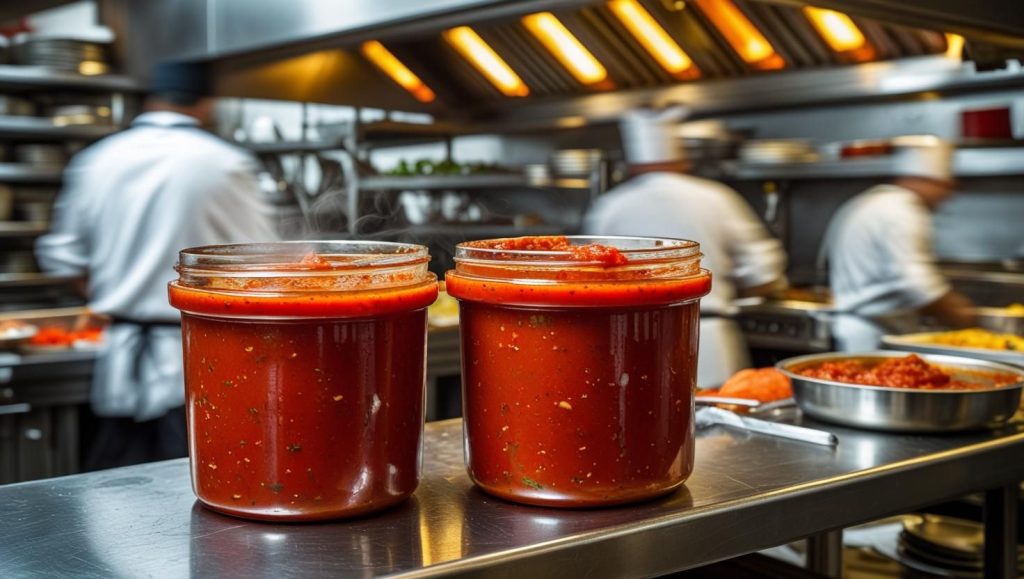
    Imagine a hectic kitchen during the lunch rush: staff members are reaching for ingredients, prepping items, and trying to move quickly, only to discover two opened containers of the same product, both unlabeled, one of which may be expired. Or, picture a back stock area where boxes are marked by hand, and no one’s quite sure when each arrived or how much is left.

    How Inventory Labels Improve Traceability and Reduce Shrink - blog article by Star Micronics.

    These moments may seem minor, but they add up to lost product, potential health risks, and unnecessary waste.

    Inventory labels directly address these challenges by:

    • Improving shelf visibility and product identification
    • Supporting better rotation with expiration labeling
    • Speeding up audits, receiving, and restocking
    • Helping prevent overordering, underordering, or missed use-by dates
    • Creating accountability and traceable paper trails
    • Ensuring compliance with food safety and storage regulations

    In foodservice especially, date-based inventory labels play a critical role in meeting health code requirements and reducing the risk of contamination, spoilage, or noncompliance penalties.

    Inventory Labeling Tools from Star Micronics

    Star Micronics provides flexible, compact, and high-performance labeling solutions to support smarter inventory workflows in any environment—from retail stockrooms to restaurant kitchens.

    > All-in-One Labeling: Star’s mC-Label series of multifunction printers handle die-cut, linerless, and continuous labels (receipts, too), making them ideal for receiving, prep, storage, and inventory tracking. With One Touch Label, you can store up to three static label designs directly on the printers and print them instantly using the multifunction button. No internet needed!

    > Compact, Flexible Designs: These space-saving printers install easily at any workstation. One model supports multiple labeling applications, reducing hardware SKUs and simplifying training and support.

    mC-Label3 Multifunction Printer

    The Star Micronics mC-Label3 is a versatile multimedia printer that prints a wide range of labels and receipts, including both permanent and repositionable sticky linerless. It features cloud connectivity and innovative technologies like SteadyLAN and TetherLAN for enhanced printing convenience.

    Discover the mC-Label3 >

    mC-Label2 Multifunction Printer

    The mC-Label2 packs powerful features into a compact, front-loading design, including 300 dpi resolution, support for linerless, die-cut, receipt, and continuous media, and connectivity options like USB-C, LAN, WLAN, Bluetooth, and Apple MFi-certified pairing (X4 models only).

    Explore the mC-Label2 >

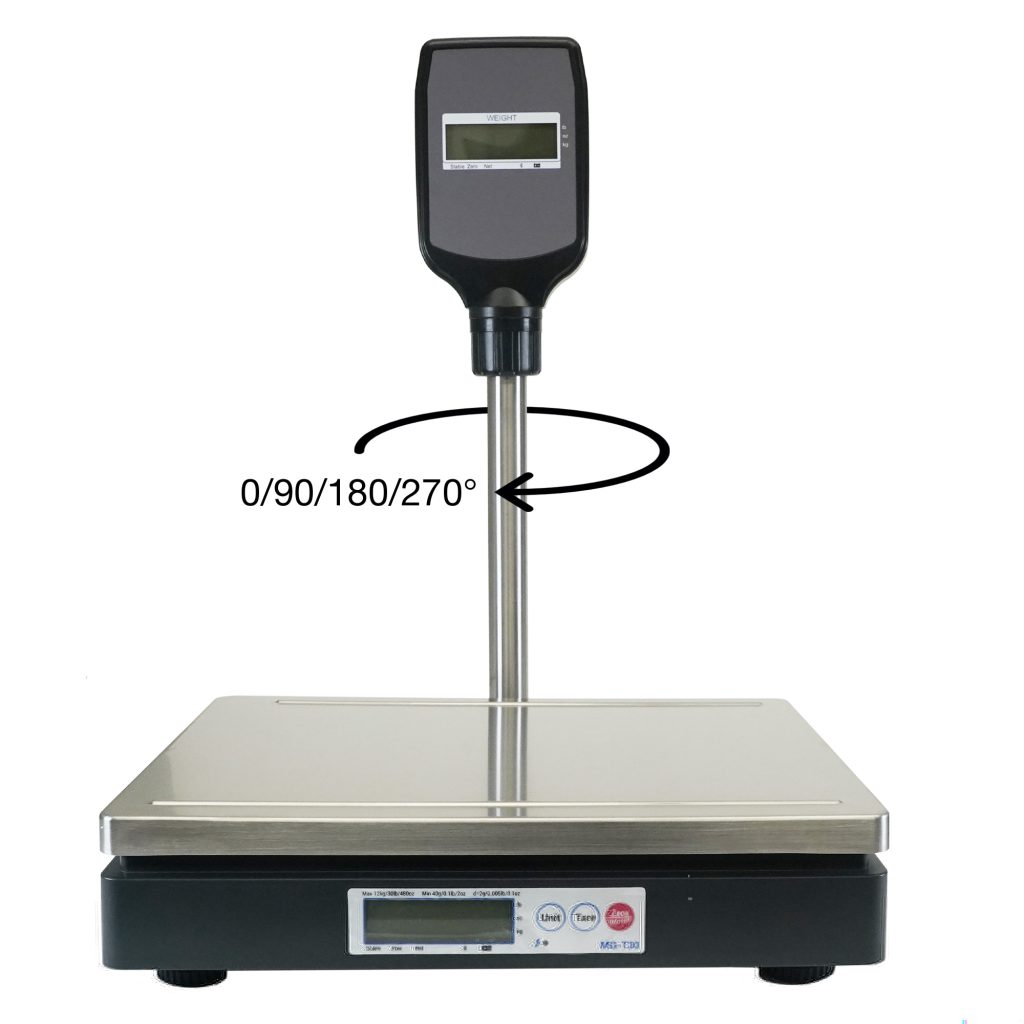
    > Scales for Accuracy: Pair Star printers with mG-T series POS scales for accurate weight-based labeling. Ideal for portioning, serving size tracking, and receiving by weight.

    mG-TUDB Scales

    Designed for precision and versatility, the mG-TUDB scales are a perfect fit for grocery self-checkout stations, produce sections and bulk item sales. With trade-legal certification for the U.S. and Canada, these scales offer Class III accuracy and seamless connectivity via Bluetooth, serial, or USB-C. Their large platter and optional pole display accessory ensure effortless setup with your POS system, making them ideal for a wide range of applications, from delis to farmer’s markets.

    Find Out More >

    > Software Compatibility: Star printers work with modern cloud-based and legacy inventory systems via USB, Bluetooth, Ethernet, Wi-Fi, CloudPRNT Next, and fully-managed cloud printing with StarIO.Online. Easy to integrate, easy to scale.

    Inventory Labels: The Bottom Line

    Inventory shrink may feel like an unavoidable cost, but with the right inventory labels and strategy, it’s entirely manageable. Whether you’re dodging spoilage, staying on top of compliance, or just trying to make it through the lunch rush without losing your mind, smart labeling gives you one less thing to stress about.

    The Smart QSR Delivery Playbook: Labeling, Accuracy & Efficiency Done Right

    Learn how leading QSRs are using smart labeling and scalable POS technology to reduce errors, cut costs, and deliver a better guest experience.

    Ready to boost your inventory labeling workflow?