Tag: Retail

  • VARs: Build Success with Driver’s License Barcode Parsing

    VARs: Build Success with Driver’s License Barcode Parsing

    In this episode of the Rising Stars Podcast, “VARs: Build Success with Driver’s License Barcode Parsing,” host Kate Orara discusses the benefits of driver’s license barcode parsing for value-added resellers (VARs). With her extensive experience in the retail technology industry, Kate provides valuable insights into how this technology can streamline client operations, enhance customer service, and help ensure regulatory compliance.

    This quick episode focuses on the practical applications and advantages of incorporating barcode parsing into your offerings. Kate explains how this technology works, eliminating manual data entry, reducing errors, and speeding up processes for clients. This episode also highlights how driver’s license barcode parsing can boost security and safeguard against potential fraud.

    Boost Business with Driver’s License Barcode Parsing Technology

    Listeners will discover how incorporating barcode parsing can elevate customer experience in various industries, including retail, hospitality, healthcare, and financial services. Kate also emphasizes the importance of choosing a flexible, high-value solution that pairs easily with existing systems to maximize business potential.

    Whether you’re looking to enhance your service offerings or stay on top of industry trends, this episode offers actionable advice on how to leverage barcode parsing technology effectively. Kate’s insights are geared towards helping VARs build success and stand out in a competitive market.

    Subscribe and listen now to learn how driver’s license barcode parsing can elevate your business.

    Read the blog post, “How Driver’s License Barcode Parsing Can Transform Your VAR Offerings” here >

    Loving the podcast? Subscribe now, and let us know what you think by leaving a review!

    Stay up-to-date on all things Star, don’t forget to follow us on X, LinkedIn, Facebook, Instagram, and YouTube.

    The Rising Stars Podcast

    Immerse yourself in the world of point-of-sale (POS) with the Rising Stars Podcast by Star Micronics, hosted by industry pro, Kate Orara. Twice a month, we explore the fascinating journeys of innovators and businesses navigating the challenges of POS technology’s rapid pace.

    In every episode, Kate Orara, Star Micronics’ Partner Development Manager, discusses emerging retail technology trends and strategies with global industry giants. She’s spent her entire career meeting all the right people, and now listeners everywhere can benefit from this vast network of channel gurus.

    Always leading and always innovating, Star Micronics, a pioneer in POS and customer experience technology for over 60 years, welcomes you to join us in shaping a brighter future in the retail, hospitality, and cannabis industries.

    Want more industry news?

    Episode Transcript

    Kate Orara: [Music] Hey there, retail tech enthusiasts. Welcome to the Rising Stars podcast, your go-to source for all things retail technology and the ever-evolving world of point of sale. I’m your host, Kate Orara, Partner Development Manager at Star Micronics, and I am thrilled to be your guide on this exciting journey. Here at Rising Stars, we’re not just keeping up with the trends, we’re setting them. We dive deep into the tech landscape with global industry leaders, unpacking strategies, and discussing the latest innovations that shape the future of retail IT. Whether you’re a tech aficionado, business owner, or just curious about the dynamic world of retail, this podcast is your backstage pass to insider knowledge. And hey, it’s not just about the tech, it’s about the community. Join me and the Star Micronics team as we lead and innovate, shaping a brighter future for the retail, hospitality, and cannabis industries, as well as beyond. Together, we rise. So hit that subscribe button, stay in the loop, and let’s make waves in the retail tech space. This is the Rising Stars podcast, where innovation meets inspiration. Let’s rise together.

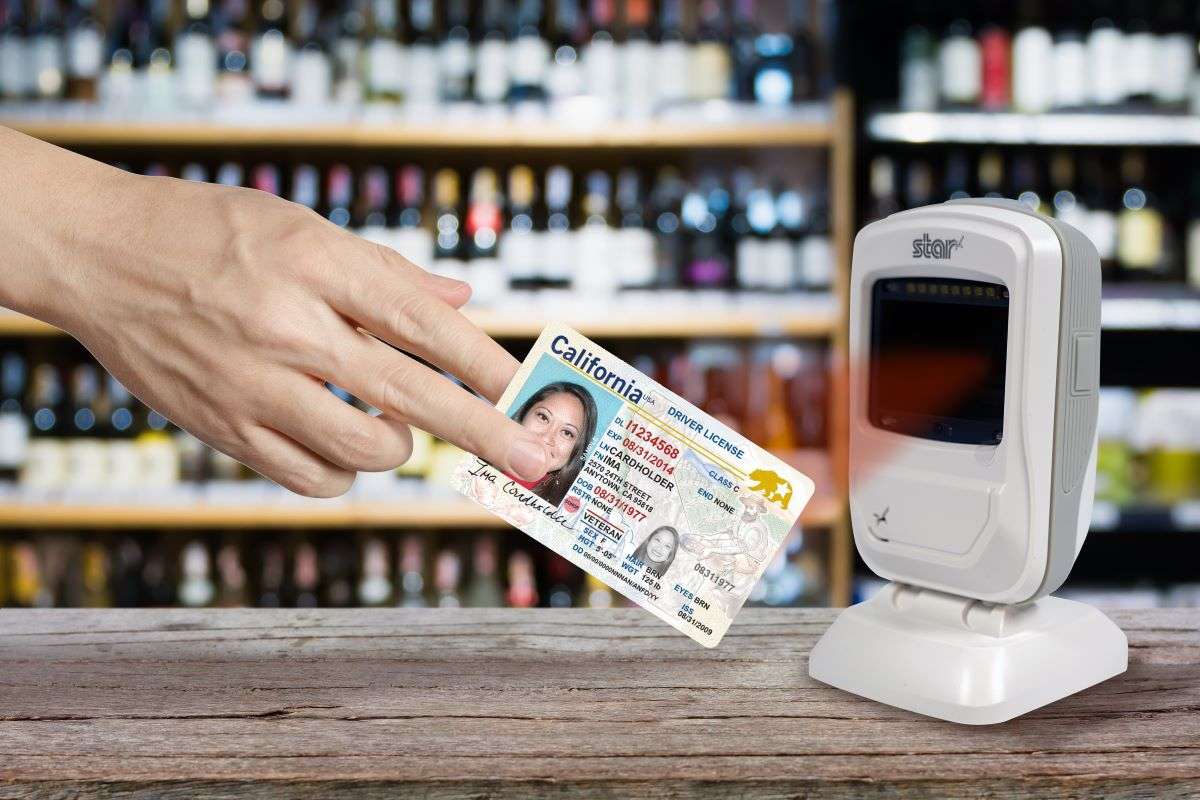
    Kate Orara: Welcome to another episode of the Rising Stars podcast, another little solo episode with little old me, where we are going to explore the latest innovations transforming the tech landscape. So today, we’re diving into the world of driver’s license barcode parsing and its potential to elevate value at resellers’ offerings. This is inspired by a recent article from our show sponsor, Star. We’re going to explore how this technology can streamline operations and enhance customer experiences. Driver’s license barcode parsing is more than just a tool for scanning IDs; it’s a game-changer for many industries, from retail and hospitality to healthcare and financial services. But how exactly does it work, and what benefits can it bring to your business?

    Kate Orara: So first, let’s talk about the technology itself. Driver’s licenses come with barcodes that contain a wealth of information, including names, addresses, dates of birth, and more. Barcode parsing technology reads and extracts this data accurately and quickly, eliminating the need for manual data entry. This not only speeds up the processes but also reduces errors, ensuring that the data collected is both accurate and reliable.

    Kate Orara: Now, let’s dive into the benefits for resellers and what they can do to implement this. Implementing driver’s license barcode parsing can significantly improve customer service. For example, in retail, it speeds up the checkout process, creating a smoother and more pleasant experience for the customers. In hospitality, it can streamline check-in procedures, reducing wait times and enhancing guest satisfaction.

    Kate Orara: Compliance is another critical area where this technology shines. Many industries face stringent regulations regarding data collection and customer verification. Driver’s license barcode parsing ensures that businesses capture the necessary information accurately and consistently, helping them stay compliant with local and federal laws.

    Kate Orara: Security is also a major consideration. Robust barcode parsing solutions can help prevent fraud by verifying the authenticity of the IDs presented. So all you young’uns that might have fake IDs, beware. This adds an extra layer of protection for businesses, safeguarding them against potential security breaches and identity theft.

    Kate Orara: Integration is key, though. When choosing a barcode parsing solution, it is essential to consider how well it integrates with your existing systems. A good solution should be flexible and secure, capable of seamlessly fitting into your business operations without compromising data privacy.

    Kate Orara: So in summary, driver’s license barcode parsing is a powerful tool for resellers, offering benefits like enhanced efficiency, improved customer service, regulatory compliance, and heightened security. It’s an investment that can transform your offerings and set you apart from the competition.

    Kate Orara: That’s all for today’s episode of the Rising Stars podcast. For more information on how driver’s license barcode parsing can benefit your business, check out the full article on the Star Micronics blog. Be sure to also subscribe to the podcast on YouTube, Apple Podcasts, Spotify, or whatever your podcast poison is. Leave us a five-star review – five stars – and let us know what you want to hear. So until next time, stay tech-savvy, and we’ll see you at the next one.

    Kate Orara: And that’s a wrap for this episode of the Rising Stars podcast. A huge thanks to our incredible listeners for tuning in and to our phenomenal guests for sharing your insights. Don’t forget to subscribe, rate, leave us a review, and let us know what you want to hear more about. Give us your feedback because it fuels our journey to bring you the best in retail technology. Stay connected with us on social media for updates and behind-the-scenes content. As we sign off, remember, the future of retail technology is in our hands, and together we’re shaping it. Keep innovating, rising, and until next time, this is Kate Orara signing off. Together we rise. [Music]
  • Making the Right Investment: Wired vs. Wireless Barcode Scanners

    Making the Right Investment: Wired vs. Wireless Barcode Scanners

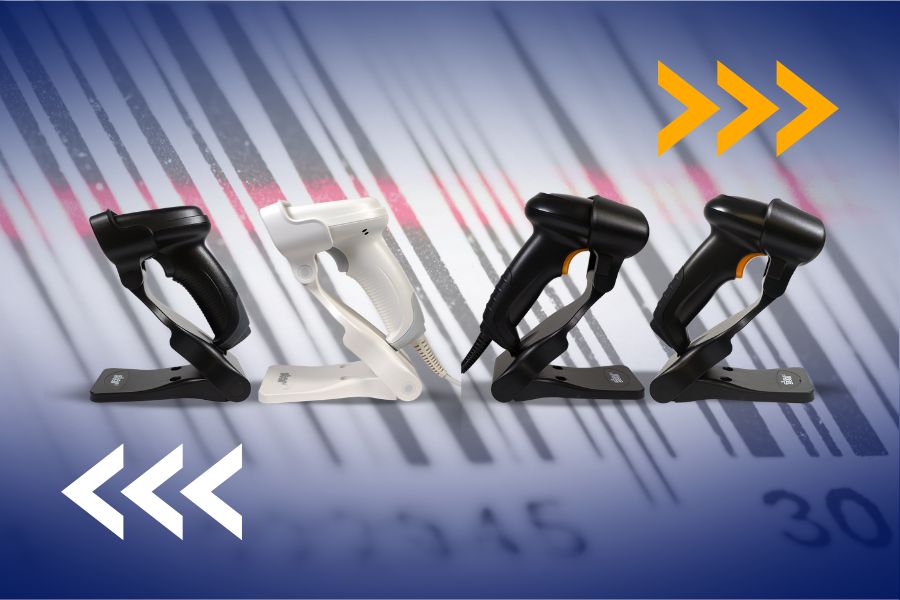
    Barcode technology offers many benefits to retail, manufacturing, healthcare, and other industries. For example, they enable more accurate inventory management, real-time visibility into products and stock, and more efficient checkout processes. However, businesses need the proper hardware, including a choice between a wired or wireless barcode scanner, to get the most value from their barcode solutions. 

    What Wired and Wireless Barcode Scanners Have in Common

    Both wired and wireless barcode scanners share several hardware features. For instance, you can find both types in laser scanners or imagers designed for reading 1D barcodes (like UPC codes) and 2D scanners capable of reading both 1D and QR codes.

    Additionally, both wired and wireless scanners are available with various ingress protection (IP) ratings. These ratings indicate the level of resistance to dust and liquid infiltration. For example, an IP rating of 42 means the device is protected from solid objects larger than 1 mm (indicated by the first number, “4”) and from water droplets (indicated by the second number, “2”).

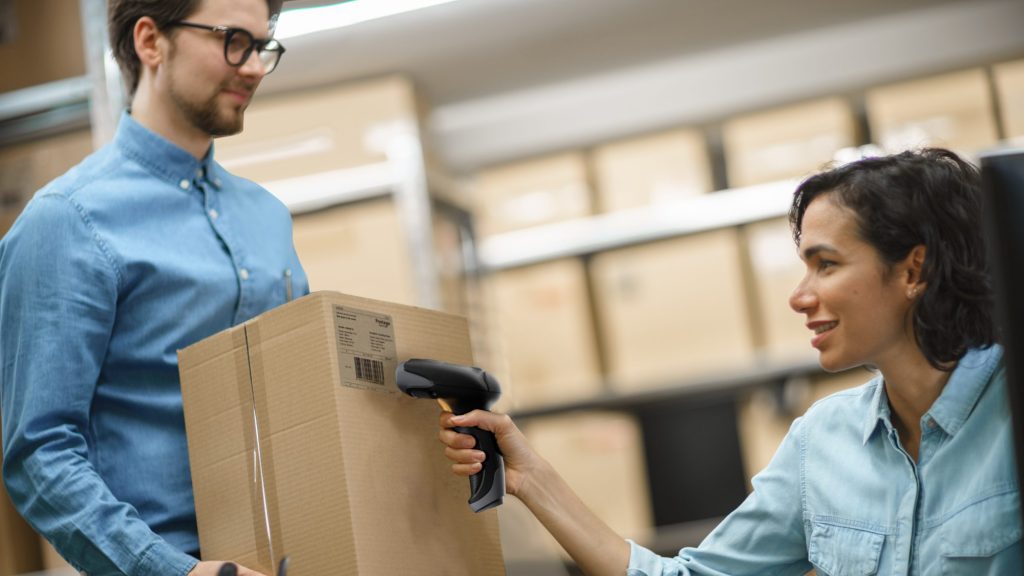
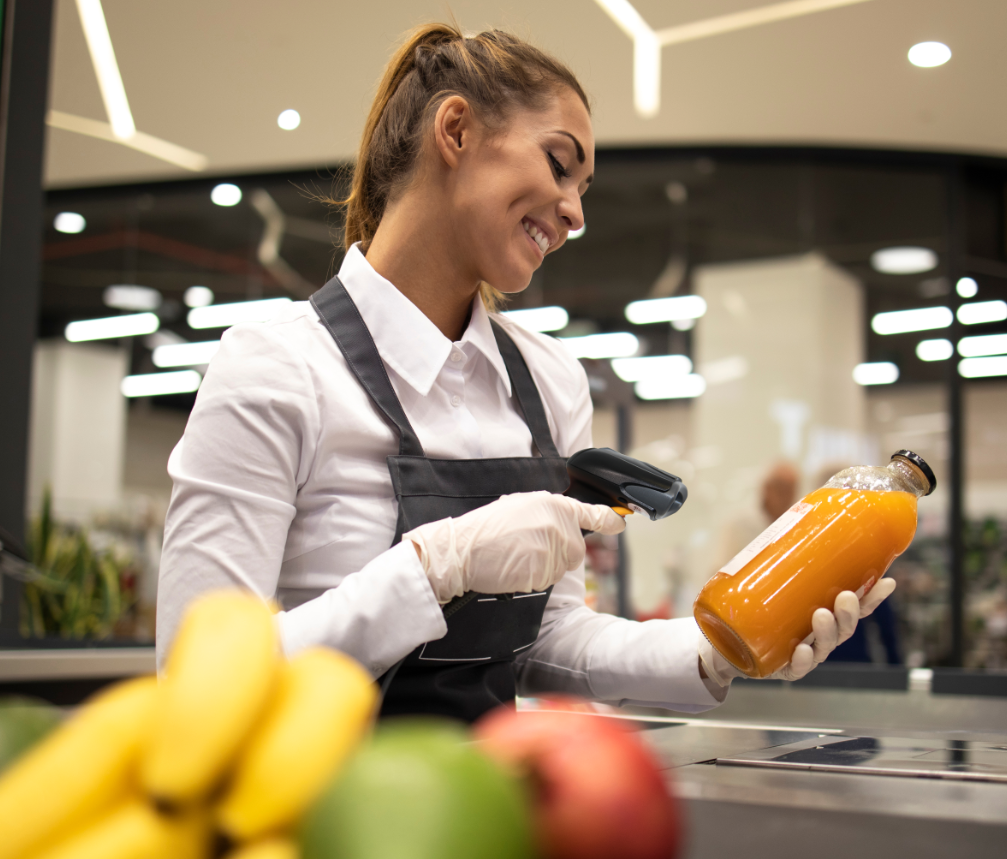
    Woman ringing up groceries with wireless barcode scanner by Star Micronics.

    There is also a range of scanner form factors, including handheld, presentation, fixed-mount, and in-counter models. The choice depends on your specific needs, such as scanning groceries at a checkout counter or shelf tags during inventory counts. It’s also essential to consider the environment in which you’ll use the scanner.

    The following comparison of wired and wireless barcode scanners will help you choose the best option based on your application needs and other crucial business factors.

    Advantages of Wired Barcode Scanners

    Wired barcode scanners are ideal for fixed locations like checkout counters or back-of-house workstations. They provide reliable, fast data transmission without the risk of interference from other devices. Wired scanners are typically plug-and-play, making them easy to set up and use quickly.

    These scanners are also generally more affordable than their wireless counterparts and don’t require battery replacements, reducing their total cost of ownership (TCO).

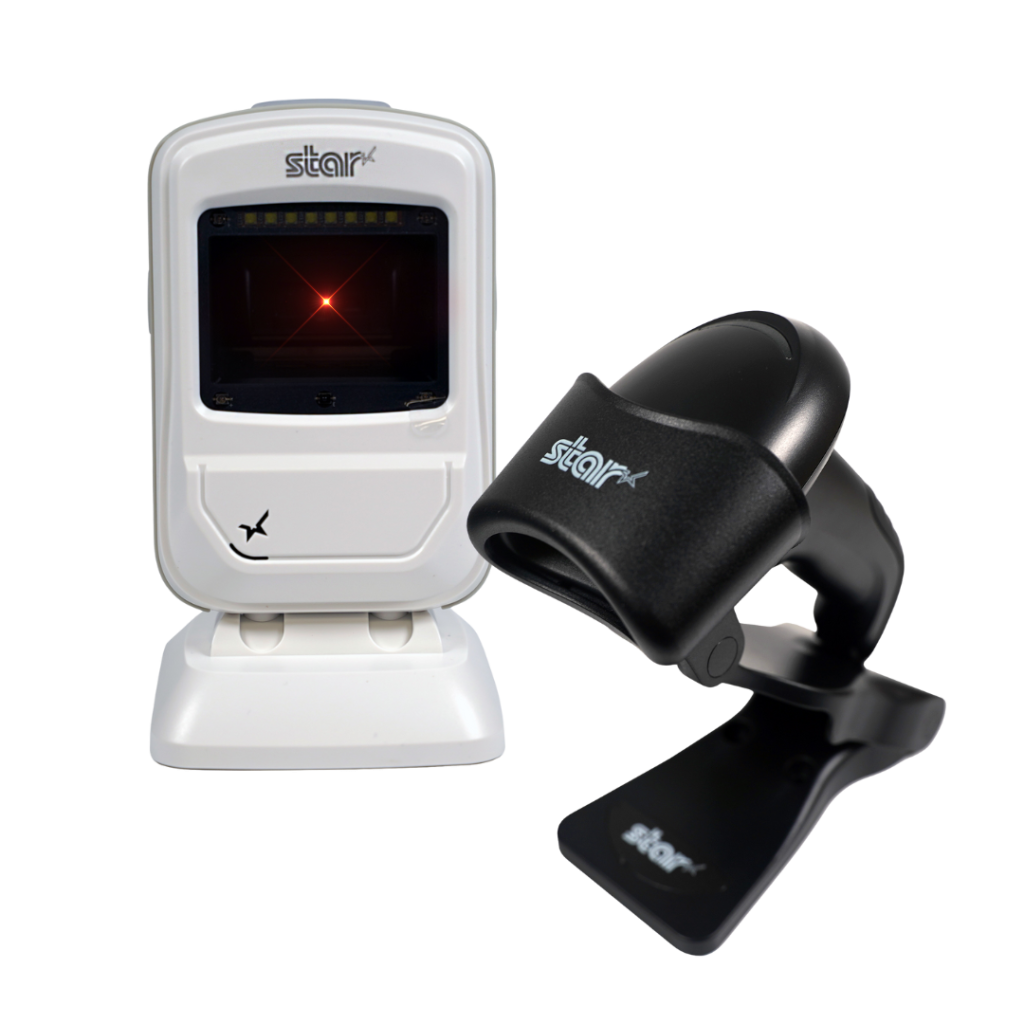
    Depending on the model, wired scanners can deliver fast, accurate scanning of 1D and 2D barcodes on various surfaces, including paper, uneven packaging, and screens with protective film. For example, Star’s BSH-20U and BSH-32U handheld barcode scanners can function as both a presentation scanner on a counter and a handheld device. This model offers a large field of view, onscreen barcode capture, and an infrared sensor for efficient scanning, even in low-light conditions.

    Advantages of Wireless Barcode Scanners

    Barcode scanning typically requires you to take the product to the scanner, not the other way around. Wireless barcode scanners free you from cords and cables that limit movement and allow you to use presentation or fixed-mount scanning when wired connectivity isn’t available. 

    Leading wireless barcode scanners have a long battery life with up to 12 hours of continuous use and offer reliable wireless data transmission. Star’s wireless barcode scanners, such as the BSH-32B and BSH-HR2081BT, are also easy to move between locations and have plug-and-play setup with any point-of-sale (POS) software.

    Woman scans inventory with wireless barcode scanner by Star Micronics.

    Simply connect via Bluetooth or the included USB dongle (USB dongle is imbedded in the charging cradle for the BSH-32B), and the scanner immediately works – no need to download any additional drivers. Star’s wireless scanners also have six scanning modes for convenience and capture images on paper, uneven media, and onscreen.

    Wireless scanners add flexibility to operations, allowing you to quickly accommodate changes in workflow, like when consumer behaviors shift to curbside pickup. They’re ideal for inventory management, stock takes, and cycle counts, enabling employees to capture data instantly and accurately.

    Wireless barcode scanners are also easily scalable. If you need to equip extra employees, you can add more scanners without altering your business infrastructure. 

    3 Factors to Consider When Choosing Between Wired and Wireless Barcode Scanners

    Overall, your choice between wired and wireless barcode scanners comes down to the following:

    1. Workflow Requirements

    Consider whether employees work at a checkout counter, stationary workstation, or need mobility. Also, don’t forget to take ergonomics into account. Repeatedly using a handheld might lead to fatigue and injury, whereas a wired fixed-mount scanner could prevent those issues. 

    Additionally, ensure the model has the power to provide the speed necessary to keep up with the scanning volume employees need to do their jobs efficiently.

    2. Budget

    Consider both upfront costs and TCO, including batteries for wireless scanners and ongoing maintenance costs. Remember to review the warranty to ensure you get the most out of your investment

    3. Environmental Considerations

    Determine where employees will use the scanner. A wireless barcode scanner may be the only choice if a wired connection isn’t possible. If a wired connection is possible, you may want to consider whether interference from other devices could diminish a wireless scanner’s performance. In that case, go with a wired barcode scanner.

    The Ultimate Guide to Barcode Scanner Types and Applications

    Navigate the world of barcodes with clarity and confidence, ensuring the right fit for your business needs.

    Make an Informed Choice

    Both wired and wireless barcode scanners have pros and cons, but when you consider workflow requirements, budget, and environmental factors, you’ll make the optimal choice for your application. 

    You can also contact your barcode technology solution provider to find the best scanner for your business. For example, antimicrobial scanners are available for companies in the healthcare industry, while rugged scanners are for more industrial or outdoor settings.

    Find the right wired or wireless barcode scanner for your application:

  • Navigating Change in Retail Technology with Blake Gillum

    Navigating Change in Retail Technology with Blake Gillum

    In the latest episode of the Rising Stars Podcast, “Navigating Change in Retail Technology with Blake Gillum,” host Kate Orara gets into the challenges of the retail technology industry and how to take them on as a business owner. Blake Gillum, President of Data Enterprises, Inc. and on the RSPA Board, joins the conversation to share his insights and strategies for thriving amidst major changes.

    With over 14 years of experience in retail and hospitality solutions, Blake provides a unique perspective on how businesses can stay relevant and competitive.

    The episode explores various topics, including the challenges and opportunities presented by generational shifts, the impact of remote work on the industry, and the importance of staying ahead of technological advancements. Blake discusses how DCR POS, a company with a rich history since 1961, continues to uphold its founder’s vision of exceptional customer service while adapting to modern demands.

    Embracing Change in Retail Technology

    Blake emphasizes the significance of embracing new technologies and evolving business practices to meet the changing needs of customers. He shares valuable advice on navigating the complexities of the retail technology landscape and highlights the key actions leaders should take to ensure their companies remain relevant and successful.

    For VARs, ISVs, and entrepreneurs in the retail technology space, this episode offers practical insights and inspiration. Discover how to leverage innovative solutions and leadership strategies to drive growth and success in your business.

    Discover cutting-edge retail technology from Star Micronics >

    Loving the podcast? Subscribe now, and let us know what you think by leaving a review!

    Stay up-to-date on all things Star, don’t forget to follow us on X, LinkedIn, Facebook, Instagram, and YouTube.

    The Rising Stars Podcast

    Immerse yourself in the world of point-of-sale (POS) with the Rising Stars Podcast by Star Micronics, hosted by industry pro, Kate Orara. Twice a month, we explore the fascinating journeys of innovators and businesses navigating the challenges of POS technology’s rapid pace.

    In every episode, Kate Orara, Star Micronics’ Partner Development Manager, discusses emerging retail technology trends and strategies with global industry giants. She’s spent her entire career meeting all the right people, and now listeners everywhere can benefit from this vast network of channel gurus.

    Always leading and always innovating, Star Micronics, a pioneer in POS and customer experience technology for over 60 years, welcomes you to join us in shaping a brighter future in the retail, hospitality, and cannabis industries.

    Want more industry news?

    Episode Transcript

    Kate Orara: [Music] Hey there retail tech enthusiasts, welcome to the Rising Stars podcast, your go-to source for all things retail technology and the ever-evolving world of point of sale. I’m your host, Kate Orara, Partner Development Manager at Star Micronics, and I am thrilled to be your guide on this exciting journey. Here at Rising Stars, we’re not just keeping up with the trends, we’re setting them. We dive deep into the tech landscape with global industry leaders, unpacking strategies and discussing the latest innovations that shape the future of retail. Whether you’re a tech aficionado, business owner, or just curious about the dynamic world of retail, this podcast is your backstage pass to insider knowledge. And hey, it’s not just about the tech, it’s about the community. Join me and the Star Micronics team as we lead and innovate, shaping a brighter future for the retail, hospitality, and cannabis industries, as well as beyond. Together, we rise. So hit that subscribe button, stay in the loop, and let’s make waves in the retail tech space. This is the Rising Stars podcast, where innovation meets inspiration. Let’s rise together.

    Kate Orara: Well, welcome back everybody to another episode of the Rising Stars podcast. I am really excited to be joined today with Blake Gillum, who is the president of DCR POS. How are you doing today, Blake?

    Blake Gillum: Hey, I’m doing great, Kate. Appreciate you having me on the podcast.

    Kate Orara: Well, I’m glad that you’re here and I’m so excited that you’re able to do this. I know with all the craziness of summer and vacations – you went to Disney, probably in the heat, with your family not too long ago – and of course I’ve had some vacation, so we’ve had a couple of jugglings to get this organized. I’m glad we’re able to finally get it settled and this recording going.

    Blake Gillum: Well, we’re glad to appreciate you bearing with me. Yeah, Disney – we are that weird bunch who, for some reason, love that place. You know, we love the Epcot Death March, we love walking around, and then giving the mouse all our money.

    Kate Orara: Well, we’ll have to chat a little bit later. One of these days I want to get back to Disney. I haven’t been to Disney in a few years. It’s probably been a hot minute, so I’ll have to kind of pick your brain a little bit. It’s different going with teenagers, and that would be what my kids are, but I don’t think you’re ever too old for Disney.

    Blake Gillum: Never too old, never too old.

    Kate Orara: Well, I would love it if you could tell our audience a little bit about DCR, your role, and just overall your experience in the retail IT channel industry.

    Blake Gillum: Of course. So as you said, I’m the president of DCR, and we are an ISV VAR hybrid who’s been serving the grocery, retail, restaurant, and fuel industries since 1961 – so a little over 63 years. My role here at DCR is, you know, I’m really responsible for implementing and developing our company strategy and pretty much ensuring the company’s long-term success. I’ve got about 15 years in the retail and hospitality solution provider space myself, unlike the company who’s been around obviously much more. But you know, I’m really passionate about delivering those first-class customer experiences, right? And that’s kind of what’s kept us so successful. You pair that with tailored solutions to fit our customers’ needs and people-oriented leadership, and I’m on board.

    Kate Orara: Awesome. Well, I love that you’ve been in business for 15 years, but DCR has been around for 63 years. That is an amazing feat, especially considering the evolution of this industry, consolidations of businesses, and all the economic challenges that really have faced the US and world over. I mean, 63 years. So I don’t know if you can tell us, like, what’s DCR’s secret sauce, or how have they been able to weather those storms?

    Blake Gillum: So like you said, it has been a long time, there’s been a lot of change, and you know, also a lot of storms, right? But much like we came on here to talk today about navigating change and how you keep your business relevant amidst a lot of change, right? And we’ve seen it. So you know, we kind of have an idea of how we approach change – embrace it. Change is good, change is not something to be afraid of. If I can compare it to, like, a tomato on the vine, right? You got to be willing to pull it off and go do something else. If you leave it just sitting, staying the same way, it’s going to rot and fall off, right? So we really choose to look at the landscape, see what’s changing, and look for opportunities to adapt. I think the worst thing a company can do is try to fight it. Change is inevitable, it’s going to happen. Fighting it, you’re just going to get worn out and be less successful, right? So we really keep it simple. Our recipe for success is really just three simple ingredients, right? We want to build great relationships, we need great people, and we need to deliver great products. Great relationships is really the core component of our culture. It’s around everything we do, right? We want to build really good long-term relationships with not only our clients but our vendors and team members here. So everything we do, we look at, hey, does this help build that type of relationship? And if it’s yes, then we do it. Part of having those great relationships, though, is, like I said before, the second ingredient is great people. And we have been blessed over these 63 years to have just, I mean, hands down, I’ve got to say, we have one of the most amazing teams I’ve ever seen anywhere. I mean, we have folks who have been on board still working today who’ve been with us for over 45 years, and I think that’s a testament to us doing something right. When we’re looking to build this amazing team, we really wanted to find the right people. I think that’s critical because to be successful, you got to have the right people that you can trust to move the needle forward. So when we look at what type of people we want to bring into the organization, we really look for three things. That’s someone who’s driven, they’re a team player, and they’ve got a good attitude, right? We need those three things. We can teach people how to sell point of sale, we can teach people how to program and configure systems, we can teach you the technical aspects of this, we can teach you how to repair printers, but I can’t teach you to have some drive. I can’t teach you to want to be a member of a team, and I can’t teach you to have a good attitude. So we really look for that, and we try to put people in leadership who kind of embrace that coaching and mentoring type of philosophy that kind of goes back to that people-oriented leadership that I’m a real big fan of. You should be there helping to grow your team. If you find yourself micromanaging and disciplining, one of two things has happened: you’ve either built the wrong team, or you’re not the right person to lead it. And that’s kind of how we’ve approached that here. Then, I guess, the third ingredient, of course, is great products, right? We try to pair, you know, we’re real big in providing first-class solutions and support to our customers. And to do that, we’ve got to get the best-in-class partners for us to pair with. So we search all over. We attend industry events, be it the Retail Now with the RSPA, we go to NGA, NRF, all looking for what’s new, what partners can we pair with to provide these great products to our customers. We also have an in-house development department where we develop our own components to build just that custom solution for each one of our clients that lets them compete and meet the market needs.

    Kate Orara: That’s awesome. I think people underestimate, or managers, when you’re hiring, I think they underestimate the importance of the type of people that you hire and the culture that you create. We talk about the relationships with the partners, but internally, if the house, that’s the foundation of the home or foundation of the building, right? And if that foundation is not sound, the building falls.

    Blake Gillum: You’re absolutely right. Absolutely right. I mean, that culture is so critical to moving the needle on your success of your company, right? We try to look at, I don’t know if you’ve ever seen or read the book by Jim Collins, “Turning the Flywheel,” but we look at the flywheel effect. What that is, you know, what are the key components that drive your business? One of those key components is our people and building the right team. Without that, again, you’re not going to be successful. In today’s job market, you’re competing with people who are doing crazy things to bring talent in. People are staying, you know, to find somebody for 40 years now is almost unheard of. Everybody’s worried, well, how do you keep them? How do you keep somebody for two years? Without that culture being strong, you’re not going to do it. You’re going to have a churn rate that’s going to be unsustainable.

    Kate Orara: This is a good segue into one of the next questions I have. You have been in business, you said, for 63 years. You have employees with a tenure of over 40 years, and then there’s yourself with 15 years. You probably have some newbies in there that are still trying to figure out what the heck DCR does. What are some of the generational challenges that you deal with, not only externally with customers but even internally in your company’s four walls?

    Blake Gillum: So, you know, I think the external generational challenges, and we can talk about that a little later, you know, there’s customer preferences are changing rapidly, and there’s several reasons for that. But with building the right culture and the right team in our four walls, I think this is really exciting times. For the first time to my knowledge, at least in DCR’s history, maybe the workplace as a whole, we actually have five generations in the workforce at one time. That’s incredible. You’ve got traditionalists, you’ve got the Baby Boomers, Gen X, Millennials, and Gen Z, all coming into the same place, trying to move in the same direction. Even here, we’ve got one of our team members who’s a traditionalist, 78 years old. I want to note they’re here because they want to continue to be here. They choose to continue coming in. You look at that, and you’re like, wow, how many different experiences and perspectives and ideas can you get out of a team like that, right? We don’t look at it as, you know, I hear a lot of people, “Oh, this generation does it this way, and they don’t care about this,” and “That generation is too rigid, and they believe in this old way.” We try not to fall into that trap because it’s really easy to do. Instead, we try to really embrace the uniqueness of each generation and their views. Say, okay, you all have very, there’s not a wrong way, right? Your views and perspective were shaped by the history you’ve had, and the future going forward is to make a whole new set of perspectives and ideas that none of us are ready for. What we try to do is have a culture where we really encourage everyone to share those ideas. We don’t want a bunch of yes-people who will just agree and then go off and complain to their co-workers that we didn’t do something this way or that. As long as those ideas are centered around what we try to do best, which is providing those first-class solutions and support to our customers, let them compete, then no idea is off the table. Throw it out there. We use that to hopefully motivate this very diverse workforce to not only participate and give the ideas but also stay. We’re big on listening. We’ll take the ideas. We’re okay with being wrong. We’ve done more things wrong than we’ve done right in 63 years. We want to listen, put these things into place, and review. If some things didn’t work out the way we wanted, that idea didn’t work, it bothered this group over here, then we listen, get the feedback, implement some changes, and do it again. We just keep going through that cycle. I think it has been fairly successful for us. It’s allowed us to have very diverse teams that seem to lean and learn on each other more than compete and try to one-up each other.

    Kate Orara: I think the comment you made there, we have five generations, this is the most diverse workforce it’s ever been. To be close-minded at all, whether you’re a traditionalist or Gen Z, to kind of poo-poo on somebody else’s, you know, “Well, you’re just old, you don’t ever change,” or “You’re just young, you’ve never had the experience,” being open-minded because everybody brings to the table a new perspective and a different idea. I think you mentioned it earlier, it’s being adaptable. The thing I hate hearing the most is, “Well, that’s how we’ve always done it.”

    Blake Gillum: Yes, it’s one of the worst things. I think you hear that from maybe older generations, but then the younger generations saying, “Well, they’re just too old, and they don’t even really want to understand the new technology.” It’s just like, no, it has nothing to do with that. A little bit more open-mindedness and collaboration can go a long way.

    Kate Orara: You’re 100% right. I feel like those words, “It’s how we’ve always done it,” are almost the nail in the coffin for many businesses. It’s easy to get in that rut. We’ve jostled ourselves out of that rut once or twice. I think, like you said, the thing is to be aware of it, don’t get trapped in it, and embrace what you’ve got. We’ve got a great team. Sometimes Gen Z are the easy targets now, but Alpha’s right behind them, and they’re going to feel the same way we’ve all felt. One day they’ll be running all of these companies and businesses.

    Kate Orara: I’m kind of curious. I don’t know what your policy is as far as working remote, but I know that’s been something that’s a challenge for a lot of employers these days. There are a lot of companies now that are almost 100% remote. Then there’s some that are really trying to push – I know we have an initiative that’s pushing employees to go back into the office, not every day, but at least like three days a week. I’m remote no matter what because I’m not based in New Jersey, and I’m not leaving South Carolina. I love it here. How has remote working affected your business and maybe even your customers?

    Blake Gillum: I’ve got a little story here. We were, I guess, lucky or unlucky enough, depending on how you want to look at it, to be thrust into this remote workplace before everyone else because of a tornado. I don’t know if you remember a few years ago in 2020, tornadoes came through Nashville. We are headquartered here in Nashville. Both of our buildings were directly in the path of these tornadoes. I get a call at 12:30 in the morning that an alarm is going off because all of our door sensors have got the pressure swelling those things out. Long story short, we have this tornado hit, and we’ve got a server, I guess what would you call a bank of servers here where we run all our tools that we’ve built to remotely support our customers from the office. We had all 45 team members reporting into the office every single day. When we got here, all power was off. We have a backup generator, and one line, the little fiber optic line to our servers, was the only thing left coming from that pole over to our building. By 8:00 AM the next day, we have a plumber out who is going to turn the gas back on, fingers crossed that nothing is damaged in this gas line so our generator can crank up and we get some stuff going again. They get out here, we crank this thing up, and sure enough, that one little line, when we powered those servers back, got our internet back. This thing all the way back to where it goes was apparently the only thing left undamaged. So we sent everybody remote. We had a great team before this who, you know, we’ve had some catastrophic and critical response plans in place of how do we deal with the unknown. There were some tools that had already been vetted to allow us to go remote. So all of a sudden, literally from, I think it may have been a Tuesday to Wednesday, we’re 100% remote, and we had to figure out how to adapt to that while rebuilding the building. We get all that in place, and it wasn’t long after, we took a little break – it was a hectic time – went down and spent a little time with the family, a couple of days to unwind, and saw the news break about COVID. I remember calling my predecessor and saying, “Hey, this looks like it’s going to be a real problem, isn’t it? This is going to last a while.” He goes, “Yeah, that’s kind of the sense I’m getting.” We were able to go remote quicker than everybody else, so when COVID came, we just kind of, we were already doing it, so there wasn’t a whole lot of stress there. I’ll say, I don’t know about you, but you do work remotely, but I’m naturally wired to be in the office. I like to be around the people. I feel the energy. If I want to go talk to somebody, I want to just walk over there and go, “Let’s knock it out. Let’s have the conversation and go on.” I think it’s easier to build a strong culture with everyone in together.

    Kate Orara: Absolutely.

    Blake Gillum: I’d be lying if I wasn’t secretly hoping there was a way to bring everyone back to the office because I’m like, I know the bottom line’s going to suffer, the customers, we’re going to not respond the same in the same length of time, and there’s got to be a reason. We’re going to pull everyone back in, and I was astonished to learn that, no, our team really thrived remotely. There was no drop in the bottom line, but the customer experience was actually, if anything, better because now we took a whole group of our technical team, and they’re in their house, they’re feeling good, they’re enjoying themselves, they’re even happier when they’re talking to the customers. For us, it’s really been good. To this day, we’ve got all the offices rebuilt, but there’s maybe only our admin and our executive team. We like to keep them in the office here because for our field service and break-fix, they can’t work remote. As long as we have one person who can’t, we want to be in. It’s about getting the right tools and not letting it get out of control. If you put the right tools in place, we feel like remote work is completely possible.

    Kate Orara: I’ve always told people, like, I’ve been working remote since before it was cool, since 2015. I love being – whenever I do go to visit the office in Jersey or even in Miami, I love seeing everybody because I’m the same way, I’m very obviously a people person. But I also do like the flexibility of working remote, not having to deal with traffic in the morning. There’s definitely lots of perks there. But I will say there are times that I think it depends on the scenario. There are times that when you’re in the office, you can be more productive, but then there are times too when you’re more productive remote. Sometimes it’s the only way for you to be able to, like, if I really need to get something done, I’m more likely to sit down and focus if I’m at my remote office. Whereas if I’m at the office, people come up, Blake might be coming up to my desk saying, “Hey, how’s it going? What did you do this weekend?” Like, “Look, it’s good to see you, but I’ve really got to work.”

    Blake Gillum: Exactly. Yes, you’re right. We do kind of look at that, right? Once everything settled down, we gave people the option. We said, “Hey, if you prefer remote, you can continue to work that way. If you’re the type – there are some who, whether they admit it or not, do much better in the office – we said, “Hey, when we’re rebuilding, we’re going to give you an office space if that’s what you’d like.” Some people have that, other people don’t. I will say we kind of left a lot of how each one of our revenue centers and departments handled remote was really left up to the management of that department because they do have their own little subcultures. We have some that are very chat-based, and they meet when needed. On the flip side, we have one team, our grocery team, who set up where they are connected via video all day, almost like they were in the same room like they used to. It’s not because there’s – it doesn’t even matter if there’s a member of management in there – they just enjoy that. I can hear what someone offers, some opinions if I hear you on the phone talking about this, they work really well. I think as long as it’s presented in a way where it’s not invasive, a tool to monitor you, we know if you’re doing your job. It’s more of a tool to collaborate and keep that culture. It’s been pretty awesome to watch everyone handle this remoteness in their own way. As a company, it’s worked for us. As much as I was a naysayer…

    Kate Orara: You’re eating crow now.

    Blake Gillum: I am. I’ve had my fair share of crow at this point.

    Kate Orara: Well, I’m going to kind of go into a different question because I want to go back to the history of your company. I went onto your website and noticed that DCR puts a lot of emphasis on its founder, Charlie Blackwell, I believe, the vision of first-rate customer service and the foundation. Some of the things that you may have mentioned earlier and the evolution of your business, what has DCR done to stay ahead to fulfill the demands of its partners with all these changes?

    Blake Gillum: I think what we have to do is, first of all, figure out what you do really well, right? What we do well, what we consider we do well and focus on, is providing those first-class solutions and support that allow our customers to compete and win in their market. So, when we’re looking at, okay, so much has changed, what do we do to stay true to our core values? Those haven’t changed, which is the great relationships, people, and putting out great solutions. We’ve tried to create a system where the product is almost interchangeable. If you’ve got those relationships, if you have the right people, we can move products in and out. Yes, there’s a huge cost to bringing on new products or retiring a product, but if you can’t change the way you deliver solutions, whether that’s a different solution or whether that’s a subscription and recurring revenue is the model now, right? You don’t do upfront charges anymore. If you can’t change the way you do business on that level, I feel like you’re going to get stuck, and it’s going to be hard to evolve. What has made us very successful in this evolution and the change was sticking to the core thing of just being who we are, which is trying to build good relationships and take care of our team. The rest kind of takes care of itself. The golden rule hasn’t changed. Just treat people the way you want to be treated. We operate in the Southeast, and that’s done mighty fine for us.

    Kate Orara: You’ve been in the industry for 15 years or the channel for 15 years. What are some of the biggest changes that you have seen in retail technology?

    Blake Gillum: I will tell you what, it’s been the past five years. I think there’s been plenty of change over 15, but the last five, I think everyone could agree, has been changing more rapidly than I think we’ve ever seen before. If you look at, there’s consolidation in our industry like never before. There’s outside investors coming in and purchasing companies, and this never happened before. Whether it’s in the channel, whether in distribution and manufacturers, whether it’s even the clients that we serve, we’re watching regional chains being gobbled up by other regional chains or mom-and-pops selling their stores to some of these chain environments. There’s a huge consolidation that’s happening right now, and we’re trying to figure out how best to navigate that. There’s huge market disruption happening out there from all these outside forces. I hate to bring up the pandemic because everybody’s so sick of talking about it, but I feel like we’re still seeing some of the things and the effects of that have put us in the position that we’re all in now. Some of the labor market and inflation is rampant. Some of the solutions we all put out during these times to help our clients solve some of their problems in the labor market and being able to still serve their customers in the way they want to be served has opened up new opportunity. We’ve seen this migration to the cloud. Changing from a CAPEX model selling product to now it’s all, are you getting it back via payments? Are you getting it back via a subscription? You’re lowering that upfront cost. All of that to be said is when you’re migrating all these things to the cloud, you’ve got all this new technology that’s being used to address not being able to hire people with self-service. You’re setting the stage for all this new tech to come in and address the new challenges that are coming, which really, I see AI coming. I think it’s something everybody should be paying attention to, and I don’t mean just traditional business logic that now we’ve rebranded to AI. I really think all this information going up into the cloud has really set the stage to do some amazing things from a technology standpoint when it comes to AI, machine vision, and machine learning. But also, if you’re looking at what’s the biggest change I think over the past five years too, it’s just the change of the customers that we serve. They’re major drivers in what solutions we bring to the table. A recent study by Progressive Grocer, I think they just came out maybe a month ago, said that 77% of customers in a grocery store now strongly agree that they’re open to trying new technology. 61% strongly agree that they consider themselves tech-savvy, and 54% agree that tech has made their shopping easier. That’s huge. When you have an end-user that wants to do more in their retail store than just go in and grab something off the shelf and go check out in a traditional lane or go into a restaurant and order food and they write it down, it’s really just amazing. The biggest changes that I’ve seen in the past five years are just the pace and all the opportunity that this brings if you’re willing to look at it.

    Kate Orara: What are some of the most unique and new technologies that you’ve seen in the most recent years, and where do you see it going? You talk about this past five years. How about the next five years? What do you envision?

    Blake Gillum: Where I see some of this going, I see a lot of AI, machine vision, and learning. The reason being is I think we’re going to have, there was a huge demand from the shopper that they wanted self-service options, they want better ways of checking out, right? They want a more frictionless experience, whether they’re in-store, whether they’re ordering from home, whether they’re in the restaurant, they don’t want to wait to pay their bill. They want to be able to take care of this when they want to. But they still want that traditional experience there as well. What I think we saw was people investing in these technologies, right? Investing in self-service, investing in all of these solutions to meet those needs. What happened was those created more opportunities because now all of a sudden, there may be some shrink opportunities that weren’t there before, there were some losses that weren’t there before. I think you see some stores and retailers are deciding, “Oh, well, we’ll just pull these systems out.” I don’t think that’s the right move because your shopper still demands that way of checking out. What I think is going to happen is we’re going to see people invest more heavily in how do I keep providing my customers the experience they want, the self-service they want, the loyalty they want, online shopping, electronic shelf labels, delivery, all of that. But how do I use AI and machine vision to help keep me profitable and do that as efficiently as possible? You’re going to have, let’s say, self-checkout, for example. It’s hard to find the perfect person to be that shopper attendant who’s going to really engage with those customers. You’ve got two types of losses there. One type is someone who came in with the intent to steal from you, and they will. They’re going to try to figure out the best way. You’ve got the other person who, you know, you’ve got these other losses that never intended to happen. They didn’t come in with the intention to steal. They rang up an item, it didn’t ring up correctly, and the shop attendant comes over. All they’ve been told is to get you through the line as soon as possible. They just clear the exception, the item goes into the bag, and it was never actually put on the receipt. I think what we’re going to see is a lot of loss prevention tools that utilize AI to help people combat that so they can continue to allow shoppers to shop the way they want to. It’ll extend through the store all the way to inventory management and shelf replenishment. I just think AI is here to stay. You better embrace it.

    Kate Orara: I was kind of hesitant about AI, but then especially like ChatGPT, once I started kind of getting into using it and getting more engaged with it and just understanding how I can use it as a tool, holy crap. It really does boost the productivity. I can get a lot more accomplished in a much shorter time frame. Especially if you hit writer’s block or something like that, it gets the ideas flowing. Do you use ChatGPT often, or how do you utilize it?

    Blake Gillum: I use it a lot, actually. It helps me with, again, if I’m hitting writer’s block, like if I’m trying to post something on LinkedIn or I am putting together a script, solo script for the Rising Stars podcast, I use it to kind of help me with formulating what the script is going to be. Obviously, I throw in my flair and stuff like that, but it just gives me a framework for it. Because otherwise, if I would do it from scratch – I’m not saying that’s not the right way to do it – it takes hours. It takes hours. I don’t have to do the research now. You do have to follow up, you have to check if it’s accurate, but overall, it gives you a good framework. I might do a little teaser for you all listeners, I’m probably going to do a little podcast of some other research that I read about things not to do on ChatGPT. Do not share proprietary company information, your social security number, or anything that you don’t want to be shared. Hackers are everywhere, and that is a whole new hacking system. You have phishing emails, you have all that stuff, and now unfortunately, that’s the downside. ChatGPT and AI have opened up the door for other avenues of hackers, so you have to be very careful.

    Blake Gillum: Absolutely. When you use ChatGPT, for someone like me who has not dabbled in that particular world of AI, how do you get started? I mean, where do you go? Do you just go to your IT team?

    Kate Orara: I would seriously talk to someone in IT. Our IT team, they’re like, “Hey, they gave us ChatGPT, they gave us a link.” I have it saved in my favorites, and I go there. It saves all my previous conversations, so I can go back and look at them. Again, you kind of have to understand that it’s a machine, it has no empathy, it gets clouded by some of the information it’s fed. You do have to check, if it gives a statistic, you might want to double-check that statistic because you’re going to look kind of silly when someone sends you a DM like, “That’s not right.” You have to make sure that you do the appropriate research. I would honestly, I’m telling you, your IT team is probably willing to geek out on you, and they will sing its praises. Like I said, I was very hesitant, but I think there was a joke, I got upset, something upset me, and I was talking with my co-workers. I put in ChatGPT, “Send an email to a customer in a professional way that basically tells them that they’re wrong.” I’m going to just make it PG right in here. It was so like, I fed it the information, and it came back with a response. You could say, “I want to tell a customer that he’s a butthead, but I can’t say he’s a butthead. How can I say it in a professional manner?” ChatGPT will tell you what to do. You can have some fun with it, for sure.

    Blake Gillum: That does sound like fun. Yes, I can think of a few cases right now that I could use that kind of guidance on.

    Kate Orara: You can do it for employees too. If you’re like, “Okay, Jane Doe is really not acting professional. How can I put this in a way that is HR-friendly?” You can do that kind of stuff. There are a lot of fun things. Again, you don’t want to send confidential information or anything like that, but you really can do just about anything. If you hit a writer’s block, like, “I don’t know how to type this email or how to introduce this new product or press release,” you can go to ChatGPT and say, “I have this new solution, and it does X, Y, and Z, and I need three sentences to just grab my audience for social media or whatever.” It’ll give it to you. You can look at it and say, “I don’t like this, but if I did this and this, I might like it.” You pack mail it, and then you’re like, “Oh, I love that.” It helps with creative juices. I don’t 100% rely on it, but I use it as a tool, for sure.

    Blake Gillum: That’s good to know. I’ll admit I’ve been a little hesitant to use it in my own personal writings, but like you said, it would be a great tool for efficiency. As long as, like you said, I like the point you made of making sure the human is still monitoring what the AI is putting out. Don’t just blindly trust that whatever this thing has decided. Like you said, the statistic it’s thrown out there is actually correct and not just something that it’s decided to come up with.

    Kate Orara: Yes, you can’t break it, so you might as well just give it a whirl. You can probably just Google ChatGPT, and it will give you a link. Just have fun with it. There’s nothing that you can break. You just have to be sensitive as far as what you put on there.

    Blake Gillum: I’ve heard too, because you said it learns everything that you said, does it write more like you as you interact with it more?

    Kate Orara: I have not dabbled down that path. A lot of times what I will do is say, “This is what I’m looking for, this is kind of the content that I’m trying to achieve.” Whatever it spits out, I look through it, read through it, and then I’ll put it in a Word document, like my script or whatever. Then I’ll just make my edits and put the Kate flair, if you will, to it. I’ll change things up, but I don’t have a conversation, conversation with it. It probably thinks I’m weird. “How do I tell a customer he’s a butthead without saying he’s a butthead?” I haven’t gone too back and forth with it, but who knows, maybe I will try to do that. It’s been very useful for me, for sure.

    Blake Gillum: Well, I’ll have to give it a try. I know many of our team members have used it, from not only a marketing but communication standpoint. I’ve been the holdout because I didn’t want to lose that personal touch, but it sounds like you can.

    Kate Orara: You can totally keep your personal touch. Talk to the people that have used it, they’ll tell you. Just play with it, you can’t break it. If anything, you’ll go down a rabbit hole for three hours, but it will be awesome.

    Blake Gillum: Y’all will know because everyone will start getting emails from me. They’ll be like, “Wow, Blake, you were really productive today. Look at that, 400 emails in one day.”

    Kate Orara: Well, I would love to hear maybe some recommendations because you’ve been around for so long and in leadership, especially as president. Maybe some key actions leaders of retail technology businesses should take to help them evolve with the times, not only to keep revenue strong but just grow as a business overall.

    Blake Gillum: One of the key things to growth is quick growth is easy, right? I think everyone’s looking for that long-term sustainable growth. I’m going to go back to talking about the flywheel effect and that book by Jim Collins. If everyone hasn’t gone through that exercise, I would highly encourage everyone to do it. Part of the way this came to be was on a project that Jim Collins was working on with the executive team over at Amazon. As simple as it is, there’s some proven results that everyone’s seen out of this. I think for long-term sustainable growth, you have to stay focused on what it is you do best, and you have to keep doing it over and over. That doesn’t mean you have to take a stick of dynamite and throw it in the way you do business every single time change comes. You have to be open to change and be able to adapt to it, but keep the core thing that makes your business unique and what you’re good at. If that’s building relationships, the right team, and picking out good products, then it doesn’t matter what change is coming down the pipe. You can adapt and shift your portfolio to be able to provide value regardless of what our clients or their clients are asking for. But if you don’t focus on what you do well and continue doing that over and over, you’re going to be so reactive to change that you’re going to find yourself trying to go in a thousand different directions. You could drift, it’s going to be very difficult. Exceptional companies don’t become that way because of one single action or one lucky break or innovation that sets them off. Windows was probably a good one. That was one innovation that probably made Bill a lot of money. But they typically become great by a series of small wins and many years of hard work. It’s many wins. Each time you perform those things that drive your business, the core pieces, think of it like a wheel. It gets easier each time you complete that circle. Each time, because you get a little better each time, you’re like, “Oh, I hired on this person, and I didn’t get the right result. I’m going to hire this way next time.” That part of the wheel gets a little easier. You’re like, “I brought this product on, and it didn’t quite do this, or I would have onboarded it this way.” You just keep improving each time, and eventually, that momentum builds up to such a sustained speed that you get periods of rapid growth that just are happening because you’ve now focused so laser-like on what you do well, and the rest kind of falls into place. My recommendation is that if you don’t already have these drivers, what drives your business and what ultimate purpose is that one thing you’re really good at, clearly defined and know what it is, then you should take the time to do it. I know it sounds silly because it’s, “Oh, we’re busy,” but I think it’s really worth it to help build the culture you want and really keep your business aligned in the direction it needs to for long-term sustained growth.

    Kate Orara: Absolutely. Well, I do appreciate your time today, Blake. I know you are, I want to make sure I plug this in as well. We’ve got Retail Now coming up, RSPA Retail Now at the end of this month. We’re recording on July 9th, and the show starts July 28th. I think the opening reception is on the 29th, and you will be there, right?

    Blake Gillum: I will be there.

    Kate Orara: And you’re on the current board of directors, correct, for RSPA?

    Blake Gillum: I am. I’ll be running for reelection this year. A little shameless plug if you’ll allow me.

    Kate Orara: Yes, and I want to make sure to put that on there. I was like, you’re running, so you’re trying to get your reelection.

    Blake Gillum: I’m running for my third time, so I’m hoping that third time’s the charm.

    Kate Orara: Absolutely. Well, I think you’d be a great addition to the board. I tell you, we look at the candidate list this year for who’s rerunning the board and who’s coming on to run. Personally, I feel like the RSPA is going to win regardless of who’s elected. It’s just amazing to see so many capable, talented people interested in joining the association. I think that’s just phenomenal. I’m really looking forward to this year’s Retail Now. I think the board is going to be extremely strong with the group of candidates we have running, of course, yourself included there. I encourage everybody, if you haven’t already signed up for Retail Now, please do so. I think it’s going to be a great experience. The education is top-notch, and the networking is like no other.

    Kate Orara: If you’re listening to this and you want to go to Retail Now or are interested in joining the RSPA, feel free to reach out to either myself or Blake. I will put your contact information, social profile, and everything from LinkedIn in the show notes of this podcast so people can go back and reach out to you if they have any questions, or they can reach out to me.

    Blake Gillum: Either one, yes.

    Kate Orara: Well, thank you so much for your time today, Blake. I think I learned a lot about how you guys are handling things. It sounds like you’re doing all the right things. 63 years to be in business at this time when there’s so much consolidation in the dealer market, that really goes to show about what you do as a company, as a culture, and really just keeping your employees. It’s all about the people. The technology is there, yes, but the people stay because they’re happy.

    Blake Gillum: That’s it. I sure appreciate you giving me the opportunity to join you on the podcast.

    Kate Orara: Thank you, of course. And that’s a wrap for this episode of the Rising Stars podcast. A huge thanks to our incredible listeners for tuning in and to our phenomenal guests for sharing their insights. Don’t forget to subscribe, rate, leave us a review, and let us know what you want to hear more about. Give us your feedback because it fuels our journey to bring you the best in retail technology. Stay connected with us on social media for updates and behind-the-scenes content. As we sign off, remember, the future of retail technology is in our hands, and together we’re shaping it. Keep innovating, rising, and until next time, this is Kate Orara signing off. Together we rise. [Music]
  • The Acclaimed mPOP® Hybrid mPOS Solution Now Includes Bluetooth Connectivity

    The Acclaimed mPOP® Hybrid mPOS Solution Now Includes Bluetooth Connectivity

    Enjoy flawless connectivity with the latest mPOP® model, the POP10CBi, featuring Bluetooth capability alongside USB-C.

    Somerset, NJ – July 17, 2024 – Star Micronics, a leading manufacturer of mobile, point-of-sale (POS), and customer engagement technologies, is proudly releasing their newest addition to the mCollection®, the mPOP model POP10CBi. Star’s mPOP (mobile point of purchase) remains the industry’s number one hybrid POS solution that combines a cash drawer and printer peripheral into one simplified and stylish system.

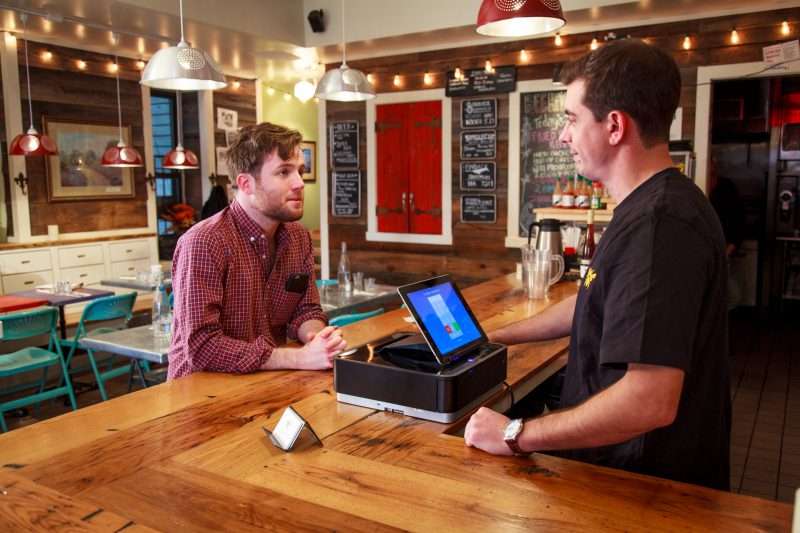
    With the POP10CBi, Star offers convenient Bluetooth connectivity, enhancing the flexibility of direct iOS connectivity while also supporting Windows and Android devices. This compact and fully integrated peripheral is ideal for tablet- and mobile device-based POS (mPOS) systems.

    Connect your preferred tablet or mobile device, and the POP10CBi transforms into a fully unified POS system. It’s compatible with all major operating systems (iOS, Android, Windows, macOS) and works with any supported POS or mPOS software, allowing retailers the freedom to use various platforms. With Apple MFi certification, the POP10CBi allows a direct USB-C connection with the iPad®, iPhone®, and iPod Touch®, enabling it to charge your iOS device while data is transferring. This convenient method uses the same charge cord included with the iOS device. Enhancing functionality, the POP10CBi has USB-A and USB-B ports for connecting external devices or peripherals, such as an optional 2D barcode scanner.

    The complete mPOP line combines a two-inch thermal receipt printer with “drop-in and print” paper loading and a unique, functional Flat Bill till. The till, featuring a 4-bill and 4- or 6-coin slot design, provides easy currency storage and management with the same small footprint. As an added option, Star Micronics also offers the mUnite EZPOS tablet display stand, fitting any mPOP® perfectly.

    The functions and connectivity of the mPOP make processing customer transactions smooth and hassle-free for small shops, cafes, florists, food trucks, and more. With multiple exit options for enhanced cable management, it complements any countertop or on-the-go area for a visually appealing POS system no matter where you do business. Aesthetically modern and elegant, the mPOP provides the ultimate POS solution for the new face of mPOS.

    Schedule private demos with Star representatives by contacting sales@starmicronics.com.

    Love Industry News? Explore our Podcast:

    Star Micronics logo, point-of-sale (POS) hardware and technology company.

    Star Micronics, a world leader in point-of-sale (POS), has designated a portfolio of printing, labeling, secure cash management, and customer engagement solutions for any retail or hospitality establishment. Embracing the mPOS wave, Star’s SDKs allow developers to utilize Star printers with Android™, iOS, iPad®, and iPhone® devices to generate receipts, labels, Chit, and tickets. Star Micronics is always leading and always innovating, creating cloud-based printing solutions, including CloudPRNT and Star Cloud Services, with AOA support and MFi connectivity. Star also has a wealth of peripherals, including 2D barcode scanners, scales, tablet display stands, and more. Visit starmicronics.com or follow us on Facebook, Instagram, X, YouTube, or LinkedIn to learn more.

    Media Contact:

    Christin Dorner
    Star Micronics America, Inc.
    cdorner@starmicronics.com
    848-216-3318

  • Star Micronics Unveils the SK5-31 Thermal Kiosk Printer

    Star Micronics Unveils the SK5-31 Thermal Kiosk Printer

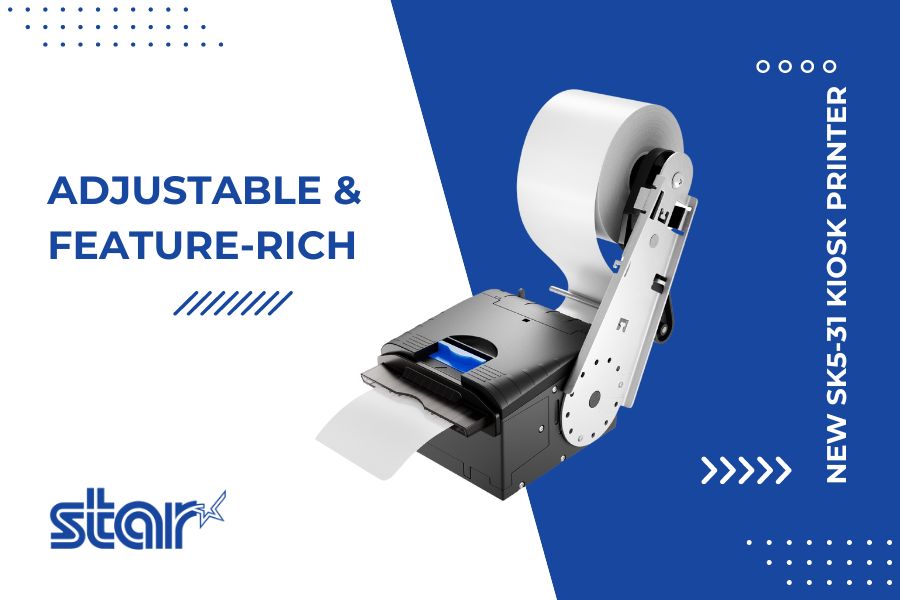
    The SK5-31 kiosk printer redefines speed and efficiency with a multitude of features found nowhere else in the industry.

    Somerset, NJ – July 10, 2024 – Star Micronics, a global industry leader in point-of-sale (POS) solutions, is proud to announce the launch of its highly anticipated SK5-31 Thermal Kiosk Printer. This new offering redefines the standard for kiosk printers, combining speed, flexibility, and convenience with innovative design features.

    The SK5-31 Thermal Kiosk Printer stands out with its easy-to-handle housing, free from the sharp edges typical of metal kiosk printers. It features a stylish design that rivals the aesthetics of desktop printers. This fully-housed, high-speed thermal printer offers unmatched performance and easy maintenance, setting a new standard in the industry.

    Key features of the SK5-31 include:

    • High-Speed Printing: With a maximum print speed of 250mm/s and 600mm/s paper ejection, the SK5-31 ensures fast, high-quality prints.
    • Anti-Paper Jam Function: The printer detects blockages and halts the printing process, resuming automatically once the obstruction is cleared.
    • Paper Eject Assistance: This function allows tickets to be printed in full before ejection, preventing premature paper removal.
    • Innovative Inner Looping Mechanism: Enhances seamless paper feed and supports anti-paper jam and paper eject assistance functions.
    • Extensive Flexibility: An adjustable paper guide and holder accommodate paper widths from 54mm to 82.5mm, with 12 total paper arm positions.
    • Versatile Connectivity: Featuring USB/LAN (Ethernet) or USB/Serial (RS-232) models for easy connection.
    • Extended Cutter Life: The SK5-31’s cutter life expectancy is double that of competitors, ensuring long-term reliability.

    In addition, the SK5-31 is equipped with StarPRNT and optional ESC/POS™ emulation for seamless integration into existing systems. It supports a wide range of media, including receipt printing, traditional black mark labels, and black mark tickets, making it ideal for various applications such as parking, self-payment, self-service, lottery, and gaming.

    With its launch, the SK5-31 Thermal Kiosk Printer solidifies Star Micronics’ position as an industry leader committed to technological advancement and user convenience.

    For more information about the SK5-31, please visit https://starmicronics.com.

    Love Industry News? Explore our Podcast:

    Star Micronics logo, point-of-sale (POS) hardware and technology company.

    Star Micronics, a world leader in point-of-sale (POS), has designated a portfolio of printing, labeling, secure cash management, and customer engagement solutions for any retail or hospitality establishment. Embracing the mPOS wave, Star’s SDKs allow developers to utilize Star printers with Android™, iOS, iPad®, and iPhone® devices to generate receipts, labels, Chit, and tickets. Star Micronics is always leading and always innovating, creating cloud-based printing solutions, including CloudPRNT and Star Cloud Services, with AOA support and MFi connectivity. Star also has a wealth of peripherals, including 2D barcode scanners, scales, tablet display stands, and more. Visit starmicronics.com or follow us on Facebook, Instagram, X, YouTube, or LinkedIn to learn more.

    Media Contact:

    Christin Dorner
    Star Micronics America, Inc.
    cdorner@starmicronics.com
    848-216-3318

  • Insights into the Retail IT Channel with Brett Bennett of POSitive Technology

    Insights into the Retail IT Channel with Brett Bennett of POSitive Technology

    In this episode of the Rising Stars Podcast, “Retail IT Channel Insights from Brett Bennett of POSitive Technology,” host Kate Orara speaks with Brett Bennett, the co-founder and President of POSitive Technology. The two really explore the evolving world of retail technology from the inside out, first looking at how OpSuite and OpSuitePOS are setting new standards in retail management and point-of-sale systems.

    The majority of the episode covers a range of topics, highlighting Brett’s extensive experience in the retail IT channel and his influential role as Board Chair of the Retail Solutions Providers Association (RSPA). Brett discusses the benefits of RSPA membership, his vision for the organization’s future, and the importance of engaging younger professionals in the channel.

    Transforming the Retail IT Channel

    In this episode, Brett shares his thoughts on demonstrating value to end-users and navigating the complex retail technology landscape. He also provides key tools and strategies for rising young professionals and future leaders in the retail IT channel.

    For VARs, ISVs, and entrepreneurs looking to stay ahead in the fast-paced retail landscape, this episode offers practical advice and showcases the innovative spirit crucial for success. Subscribe and listen now to discover how Brett Bennett’s experiences and strategies can inspire and inform your own business ventures.

    Discover cutting-edge retail technology from Star Micronics >

    Loving the podcast? Subscribe now, and let us know what you think by leaving a review!

    Stay up-to-date on all things Star, don’t forget to follow us on X, LinkedIn, Facebook, Instagram, and YouTube.

    The Rising Stars Podcast

    Immerse yourself in the world of point-of-sale (POS) with the Rising Stars Podcast by Star Micronics, hosted by industry pro, Kate Orara. Twice a month, we explore the fascinating journeys of innovators and businesses navigating the challenges of POS technology’s rapid pace.

    In every episode, Kate Orara, Star Micronics’ Partner Development Manager, discusses emerging retail technology trends and strategies with global industry giants. She’s spent her entire career meeting all the right people, and now listeners everywhere can benefit from this vast network of channel gurus.

    Always leading and always innovating, Star Micronics, a pioneer in POS and customer experience technology for over 60 years, welcomes you to join us in shaping a brighter future in the retail, hospitality, and cannabis industries.

    Want more industry news?

  • Establishing Your LinkedIn Professional Brand

    Establishing Your LinkedIn Professional Brand

    In this episode of the Rising Stars Podcast, “Building Your Personal Professional Brand on LinkedIn,” host Kate Orara delves into the essentials of crafting a compelling professional presence on LinkedIn. As Partner Development Manager at Star Micronics, Kate brings her expertise and passion for personal branding in the retail technology channel industry to provide actionable insights for professionals at all levels.

    This quick take episode focuses on three key strategies for leveraging LinkedIn to its fullest potential. Kate shares her top tips for optimizing your LinkedIn profile, curating engaging content, and networking strategically to build and maintain a robust professional brand.

    Enhance Your Professional Presence with Practical Tips

    Listeners will learn how to make a solid first impression with a well-crafted LinkedIn profile, including the importance of a professional photo, a compelling headline, and a captivating summary. Kate emphasizes the significance of sharing valuable industry content and engaging with your network to demonstrate expertise and build credibility.

    Whether you’re looking to attract potential employers, clients, or collaborators, this episode offers the tools you need to stand out on LinkedIn. Kate’s expert advice is tailored for both novice and experienced LinkedIn users, making it easy to implement these strategies today.

    Subscribe and listen now to gain the knowledge you need to elevate your LinkedIn game!

    Loving the podcast? Subscribe now, and let us know what you think by leaving a review!

    Stay up-to-date on all things Star, don’t forget to follow us on X, LinkedIn, Facebook, Instagram, and YouTube.

    The Rising Stars Podcast

    Immerse yourself in the world of point-of-sale (POS) with the Rising Stars Podcast by Star Micronics, hosted by industry pro, Kate Orara. Twice a month, we explore the fascinating journeys of innovators and businesses navigating the challenges of POS technology’s rapid pace.

    In every episode, Kate Orara, Star Micronics’ Partner Development Manager, discusses emerging retail technology trends and strategies with global industry giants. She’s spent her entire career meeting all the right people, and now listeners everywhere can benefit from this vast network of channel gurus.

    Always leading and always innovating, Star Micronics, a pioneer in POS and customer experience technology for over 60 years, welcomes you to join us in shaping a brighter future in the retail, hospitality, and cannabis industries.

    Want more industry news?

  • The Aptimyz Approach to Retail Technology Solutions

    The Aptimyz Approach to Retail Technology Solutions

    In this episode of the Rising Stars Podcast, “Retail Technology Solutions: The Aptimyz Approach,” host Kate Orara speaks with David Soden, the CEO at Aptimyz, an award-winning SaaS provider. Their conversation explores the intricate world of retail technology, focusing on Aptimyz’s journey and its innovative solutions that are redirecting retail management.

    The episode traverses a range of topics, underscoring what makes Aptimyz distinct within the retail technology sector and detailing the company’s evolution and expansion across international markets. David outlines the specific challenges that the groundbreaking iPad solution from Aptimyz addresses, enhancing the retail experience for both customers and staff.

    Empowering Innovation in Retail Technology

    Listeners will gain firsthand insights into how Aptimyz’s retail technology solutions cater to evolving market needs and how their flexible systems can be adapted across various retail formats. The discussion dives into strategic methods for navigating industry challenges, spotlighting how Aptimyz leverages emerging trends to stay ahead.

    Don’t miss out on understanding how advancements in retail technology can drive business growth and enhance operational efficiency. For VARs, ISVs, and entrepreneurs eager to harness the latest in retail tech, this episode offers practical advice and showcases the innovative spirit crucial for success in a tech-driven marketplace.

    Subscribe and listen now to discover how the experiences and strategies of Aptimyz can inspire and inform your own business ventures.

    Discover cutting-edge retail technology solutions from Star Micronics >

    Loving the podcast? Subscribe now, and let us know what you think by leaving a review!

    Stay up-to-date on all things Star, don’t forget to follow us on X, LinkedIn, Facebook, Instagram, and YouTube.

    The Rising Stars Podcast

    Immerse yourself in the world of point-of-sale (POS) with the Rising Stars Podcast by Star Micronics, hosted by industry pro, Kate Orara. Twice a month, we explore the fascinating journeys of innovators and businesses navigating the challenges of POS technology’s rapid pace.

    In every episode, Kate Orara, Star Micronics’ Partner Development Manager, discusses emerging retail technology trends and strategies with global industry giants. She’s spent her entire career meeting all the right people, and now listeners everywhere can benefit from this vast network of channel gurus.

    Always leading and always innovating, Star Micronics, a pioneer in POS and customer experience technology for over 60 years, welcomes you to join us in shaping a brighter future in the retail, hospitality, and cannabis industries.

    Want more industry news?

  • The Ultimate Buyer’s Guide to Choosing the Right POS Scale for Your Business

    The Ultimate Buyer’s Guide to Choosing the Right POS Scale for Your Business

    Selecting the perfect point-of-sale (POS) scale for your business is a crucial decision that can significantly impact your efficiency and customer satisfaction. With countless options available, finding the right one can be overwhelming. This comprehensive buyer’s guide aims to simplify the process by outlining the key factors to consider when choosing a POS scale for your business.

    Table of Contents

    Factors to Consider When Choosing a POS Scale

    Selecting the appropriate POS scale involves various crucial factors that can significantly influence your business operations and customer interactions.

    1. Business Type and Application

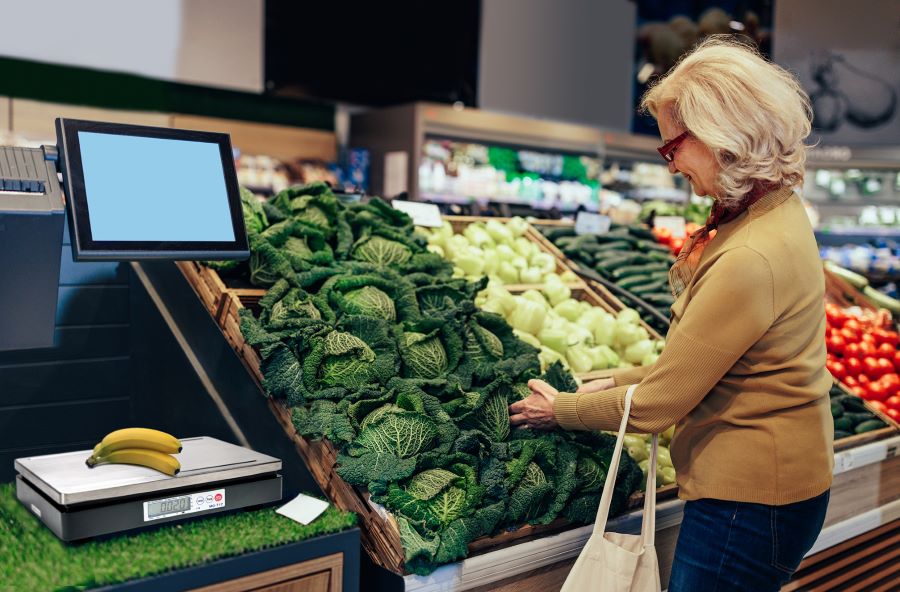
    Your business type and the specific applications for which you’ll use the scale play a significant role in determining the ideal POS scale. Different industries require unique features and capabilities. For instance, a grocery store might need a scale that can handle large volumes of produce, while a jewelry store requires a scale with high precision for small items.

    2. Weighing Capacity

    Consider the scale’s maximum weight capacity, ensuring it meets your specific business requirements. For instance, a grocery store selling bulk items might need a scale with a higher capacity, while a coffee shop measuring beans may require a lower capacity.

    3. Accuracy

    Accuracy is critical when it comes to POS scales, as precise weight measurements ensure fair pricing and minimize the potential for customer disputes. Look for a scale that offers the accuracy your business needs, whether high precision for small items or more general measurements for larger products.

    4. Size and Design

    The available space in your retail environment will influence your choice of POS scale. If your store has limited space, opt for a compact, space-saving design, while larger businesses might have more flexibility regarding scale size.

    5. Ease of Use

    A user-friendly scale with an intuitive interface and easy-to-read display is essential for streamlining the checkout process and minimizing errors. Look for a scale that simplifies the weighing process, ensuring employees can quickly and accurately measure items.

    6. Connectivity

    First, ensure your POS scale is compatible with your existing POS system, including the software you want to use. Seamless connectivity is critical for maintaining efficiency and minimizing disruptions to your business operations. Modern POS scales offer a variety of connectivity options to suit diverse technological environments.

    USB-C is popular for its fast data transfer and power supply capabilities, making it ideal for newer systems. Bluetooth connectivity allows for wireless communication with a range of devices, including tablets and smartphones, supporting both iOS and Android platforms. Additionally, traditional Serial interfaces are available for systems requiring a robust wired connection.

    Ultimately, choosing a POS scale with flexible connectivity options that include many choices ensures it can connect to your current and future POS setups, enhancing your business’s overall system adaptability and user experience.

    Ensuring Compliance with Trade Legal Scales

    A key consideration when selecting a POS scale for your business is ensuring it is trade-legal and certified by reputable standards such as the National Type Evaluation Program (NTEP) and Measurement Canada. NTEP certification ensures that a scale meets the stringent standards for accuracy and reliability set by the National Conference on Weights and Measures (NCWM). Scales with NTEP certification have undergone rigorous testing and evaluation to ensure precision, making them legally approved for commercial transactions.

    Similarly, Measurement Canada certification is crucial for businesses operating in Canada, as it assures compliance with the Canadian standards for measuring devices. This certification indicates the scale has passed accuracy and performance tests under specific conditions, adhering to the Measurement Canada guidelines.

    By choosing a trade-legal scale with both NTEP and Measurement Canada certifications, you demonstrate your commitment to fair and accurate pricing and ensure compliance with industry regulations in both the United States and Canada, protecting your business from potential fines and penalties. This dual certification can be especially important for companies that operate or plan to expand across North American markets, providing a level of reliability and trust in the measurements provided by their POS systems.

    Benefits of Investing in a High-Quality POS Scale

    Investing in a high-quality POS scale offers numerous advantages for your business, including:

    • Improved Efficiency: A reliable, accurate scale streamlines the checkout process, reducing wait times and enhancing the customer experience.
    • Better Inventory Management: Accurate weight measurements allow for more precise inventory control, helping you optimize stock levels and reduce waste.
    • Increased Customer Satisfaction: Fair, accurate pricing builds trust with your customers, leading to increased loyalty and repeat business.

    Star Micronics POS Scale Options: An Overview

    Star Micronics proudly offers a variety of POS precision scales that are NTEP and Measurement Canada certified with modern connectivity options, ideal for use in groceries, cannabis dispensaries, jewelry stores, pawn shops, and more.


    Star Micronics offers mG-T and mG-S series of POS scales.
    Star’s mG-T series on the top left & mG-S series POS scales on the bottom right.

    mG-T Series POS Scales

    The Star Micronics mG-T Series POS scales are designed for a wide range of retail applications, such as grocery produce, deli products, salad bars, and bulk items. Key features include:

    • High-precision measurement, accurate down to 0.01g
    • Compact, space-saving design
    • Bluetooth, serial & USB-C connectivity (mG-TUDB models only)
    • Easy integration with various POS systems
    • Suitable for retail, hospitality, grocery, and more
    • Durable construction for long-lasting performance
    • NTEP & Measure Canada-certified
    • Optional pole display for added convenience (mG-TUDB models only)


    The mG-TUDB digital pole display for POS scales by Star Micronics.
    The mG-TUDB model POS scale with optional pole display.

    mG-S1501 POS Scale

    Ideal for coffee shops, candy stores, and delis, the mG-S1501 POS scale offers precise weight measurements and NTEP certification. Its features include:

    • Capacity: 0 – 300g x 0.1g; 300 – 1500g x 0.5g
    • RS-232C and USB interfaces for easy integration
    • Internal rechargeable battery for portability
    • Stainless steel weighing pan for durability
    • NTEP certified

    mG-S322 POS Scale

    The mG-S322 POS scale is perfect for pharmacies, dispensaries, and jewelry stores, providing highly accurate weight measurements for small items. Key features include:

    • Capacity: 0 – 100g x 0.01g; 100 – 320g x 0.1g
    • NTEP certified, ensuring accuracy and compliance
    • RS-232C and USB interfaces for easy integration
    • Stainless steel weighing pan for durability
    • NTEP certified

    mG-S8200 POS Scale

    For businesses such as warehouses, shipping centers, grocery stores, and cannabis retailers, the mG-S8200 POS scale is an ideal choice. Its features include:

    • Capacity: 0 – 500g x 0.01g; 500 – 8200g x 0.1g
    • NTEP certified, ensuring accuracy and compliance
    • RS-232C and USB interfaces for easy integration
    • Stainless steel weighing pan for durability
    • NTEP certified

    Applications for Star Micronics POS Scales

    Star Micronics POS scales cater to various business types and applications, such as:

    • Grocery Produce: Accurately weigh fruits and vegetables for precise pricing.
    • Deli Products: Efficiently measure and price meats, cheeses, and other deli items.
    • Butcher Shops: Ensure correct weight and pricing for various cuts of meat.
    • Salad Bars: Easily measure and charge customers for their customized salads.
    • Bulk Items: For grains, nuts, dried fruit, candy, coffee, tea, and more.
    • Ice Cream & Frozen Yogurt Shops: Weigh and price frozen treats for a seamless customer experience.
    • Wash-and-Fold Laundry Services: Accurately charge customers based on the weight of their laundry.
    • Farmer’s Markets: For fresh produce, meats, and other locally-sourced bulk products.

    By understanding your business’s specific needs and selecting the appropriate Star Micronics POS scale, you can enhance the efficiency and accuracy of your transactions, leading to improved user and customer satisfaction.

    3 Ways POS Technology and Hardware Can Improve Your Deli Business

    Get the latest point-of-sale (POS) technology and hardware to streamline deli, butcher shop, or fish market operations.

    Love industry news? Get into our podcast:

    Original article written by the author and published on March 15, 2023.

  • How Driver’s License Barcode Parsing Can Transform Your VAR Offerings

    How Driver’s License Barcode Parsing Can Transform Your VAR Offerings

    Technological innovation is a key driver of business success. To stay ahead, value-added resellers (VARs) need to continually seek advanced solutions to enrich their product portfolios. One such solution, driver’s license barcode parsing, is gaining traction for its unique benefits. This technology, with its unmatched accuracy and efficiency, simplifies data entry across various sectors.

    By adding parsing capabilities to their offerings, VARs can gain a competitive edge in today’s dynamic business environment.

    What is Driver’s License Barcode Parsing?

    Driver’s license barcode parsing is a user-friendly technology that reads and extracts data from the barcode on a driver’s license using specialized scanners. This rapid data deciphering captures critical details like the holder’s name, address, and date of birth within seconds. Essential for processes from fraud prevention to age verification, this technology enriches a VAR’s toolkit, providing clients with a powerful tool for quick and secure information processing.

    Expanding Client Capabilities with Driver’s License Barcode Parsing

    Driver’s license barcode parsing not only simplifies data entry but also transforms the way businesses interact with their clients across various industries. With this advanced technology, businesses can unlock numerous benefits that enhance customer service, increase operational reliability, and ensure compliance with regulatory standards.

    Woman ringing up groceries with wireless barcode scanner by Star Micronics.

    Below, we explore some of the key capabilities that driver’s license barcode parsing can bring to your clients:

    1. Enhanced Customer Service: Quick, accurate data capture from driver’s licenses reduces transaction times and wait periods, which is especially crucial in environments like retail and hospitality. Thus, it boosts customer satisfaction.

    2. Increased Data Reliability: By minimizing human error, barcode parsing ensures that businesses operate with accurate and reliable information, critical for managing customer relationships and loyalty programs effectively.

    3. Boosted Operational Efficiency: This technology automates data capture in processes like customer onboarding and identity verification, allowing for the handling of more customers with greater accuracy, which enhances throughput and profitability.

    4. Strengthened Compliance and Security: Accurate data collection via barcode parsing aids compliance with strict legal standards, which is vital in regulated industries such as pharmaceuticals and alcohol sales.

    5. Automated Age Verification: This feature not only speeds up transactions but also eliminates calculation errors during age-sensitive sales, crucial for adherence to legal standards and preventing unauthorized sales.

    What is Barcode Technology, and How Does it Impact Retailers? >

    Diverse Applications of Driver’s License Barcode Parsing

    Driver’s license barcode parsing technology offers a wide range of applications across various sectors, significantly enhancing operational efficiencies and improving user experiences. Here’s how different industries can leverage this powerful tool to streamline processes and ensure compliance:

    Retail

    • Enhance the customer checkout experience with instant age verification and streamlined loyalty program sign-ups.
    • Simplify record-keeping for controlled substances, ensuring compliance and reducing administrative burdens.
    • Expedite the application process for store-branded credit and loyalty cards, attracting more sign-ups without additional wait times.

    Bars & Restaurants

    • Verify customer ages to comply with alcohol service regulations with a single scan.
    • Swiftly capture essential customer data from driver’s licenses for loyalty programs, accelerating the enrollment process and reducing paperwork.

    Hotels

    • Speed up guest check-ins by automatically populating registration forms, allowing guests to start their stay with minimal delay.
    • Increase security measures in services like valet parking by verifying driver identities quickly and accurately.

    Healthcare

    • Ensure patient safety with accurate identification and quick access to medical records, crucial for maintaining high standards of care and reducing the risk of medical errors.

    Driver's License Barcode Parsing Scanners by Star Micronics.

    Financial Services

    • Streamline account creation and identity verification processes, enhancing both customer experience and security in sensitive financial operations.

    Government

    • Facilitate faster access to citizen records and streamline payment processes, enhancing efficiency in government operations.

    Navigating Challenges and Considerations

    Adopting driver’s license barcode parsing technology is not devoid of challenges. Data privacy concerns and integration complexities are significant hurdles. Addressing these issues requires adherence to strict data protection laws and selecting robust, secure solutions that integrate seamlessly with existing systems.

    VARs should prioritize selecting barcode scanners that meet high security standards and effectively address data privacy concerns, ensuring their solutions comply with rigorous data protection laws.

    Selecting Optimal Barcode Parsing Solutions

    When choosing barcode parsing technologies, VARs should consider factors like flexibility, ease of integration, affordability, and the technology’s ability to handle diverse data types. Solutions should meet various industry standards, ensuring they are adaptable to different client needs and offer ease of use.

    Star Micronics 1D/2D Barcode Scanners

    Star offers a comprehensive range of IP-rated 1D/2D barcode scanners, ideal for diverse business needs. From retail to healthcare, our versatile scanners excel in parsing driver’s license and ID barcodes, ensuring swift and accurate data capture. Choose the perfect fit for your setup—desktop, handheld, or wireless Bluetooth options available.

    The Ultimate Guide to Barcode Scanner Types and Applications

    This guide has everything you need to know about barcode scanners in one place. Reviewing this will ensure you make informed decisions when deciding what barcode scanner to buy for your business’s success.

    Elevating Business Success with Driver’s License Barcode Parsing

    Driver’s license barcode parsing is a transformative solution for VARs aiming to elevate their service offerings and assist clients in achieving significant operational improvements. By incorporating such advanced scanning solutions into their portfolios, VARs can deliver enhanced value, improve client satisfaction, and tap into new revenue streams.

    Are you ready to revolutionize your service offerings with driver’s license barcode parsing technology? Contact us today to learn more about our innovative solutions and discover how they can benefit your business. Let us assist you in getting started with a tailored demo or consultation.