Tag: Restaurant & Hospitality

  • Star Micronics and OneTablet Help Restaurants Drive More Revenue from Delivery, Backed by Reliable Kitchen Printing

    Star Micronics and OneTablet Help Restaurants Drive More Revenue from Delivery, Backed by Reliable Kitchen Printing

    Star Micronics kitchen printing pairs with OneTablet’s delivery revenue platform to help restaurants increase order volume, improve menu conversion, and fulfill off-premise orders with greater accuracy.

    Somerset, NJ – May 1, 2026 – Star Micronics, a global provider of point-of-sale (POS) hardware, cloud printing, and labeling solutions, today announced its collaboration with OneTablet, a restaurant technology platform that helps independent restaurants and multi-location operators generate more revenue from third-party delivery. Together, the companies give restaurants the tools to improve menu visibility, conversion rates, and average order value across delivery platforms, while ensuring every order prints reliably at the right station.

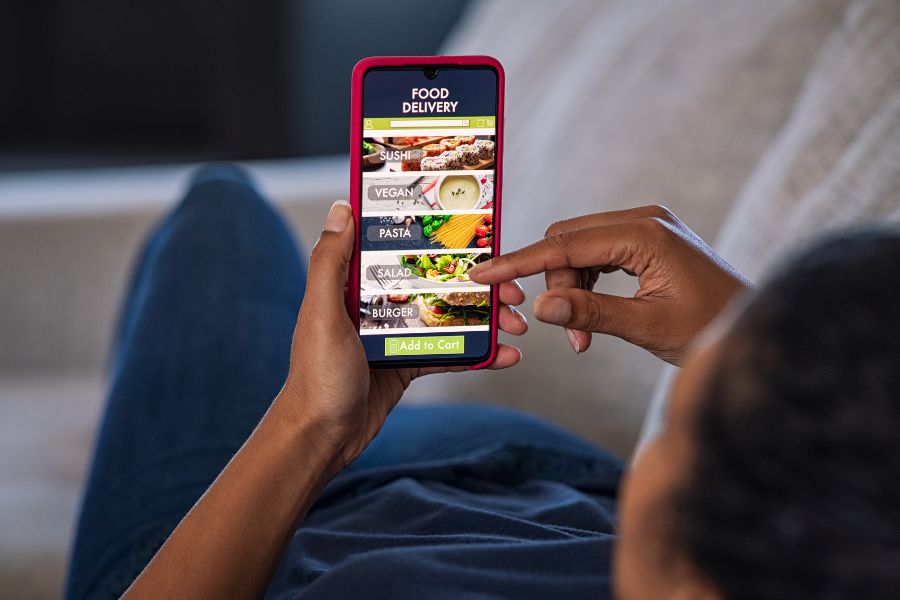
    Third-party delivery now accounts for 30% or more of a restaurant’s revenue, and that share continues to climb. Restaurants that aren’t actively optimizing their presence on DoorDash, Uber Eats, and Grubhub are leaving money on the table. OneTablet gives operators the tools to win on these platforms: better menu visibility, stronger conversion rates, higher average order values, and the performance data to know what’s working and what isn’t.

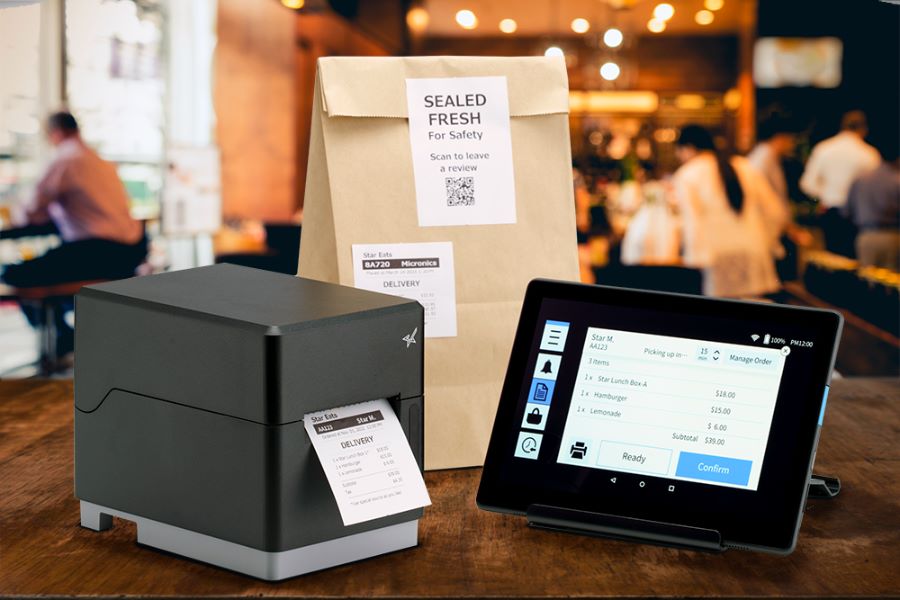
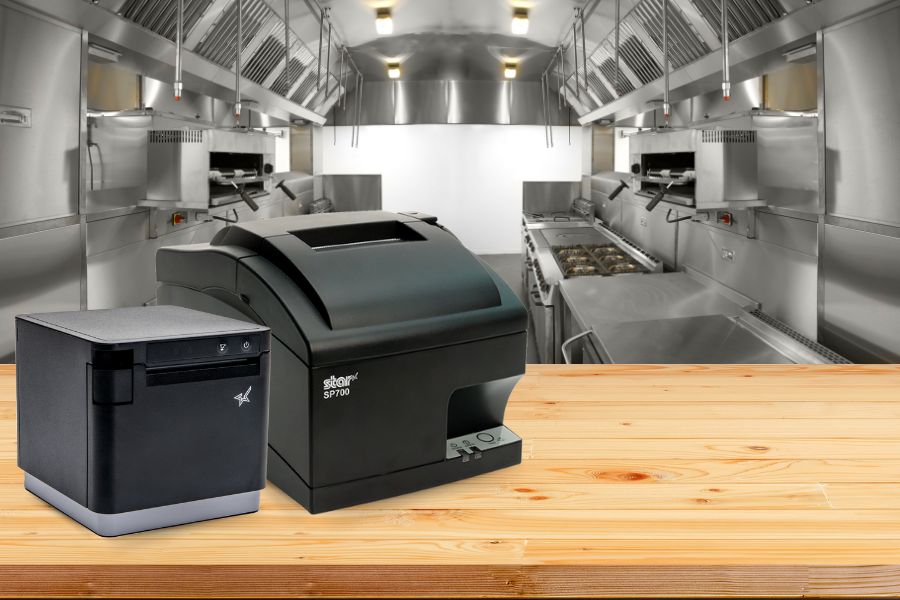
    As that order volume grows, kitchens need hardware that can keep up. Star’s TSP100 series delivers the print speed, reliability, and uptime that high-volume delivery operations demand, so every ticket reaches the right station, every time.

    From Delivery Platform to the Kitchen Line

    Aggregating orders is only part of the workflow. Restaurants also need to manage menus, monitor performance across delivery platforms, and maintain control over how orders are prepared and fulfilled.

    OneTablet is the operating system for off-premise restaurant operations, consolidating Uber Eats, DoorDash, and Grubhub into a single, unified platform. Beyond order aggregation, it gives operators centralized control over menus, pricing, and prep timing, while delivering real-time reporting across all channels.

    By surfacing performance data at the item, channel, and store level, OneTablet enables restaurants to continuously optimize their delivery business—adjusting menus, pricing, and availability to increase conversion, improve order volume, and maximize revenue. Through its integration with Star Micronics printers, OneTablet extends that control directly into the kitchen, ensuring orders are automatically routed, organized, and printed at the appropriate prep stations. This creates a seamless connection between digital optimization and in-store execution, reducing errors and improving throughput during peak service.

    Star’s TSP100 series thermal ticket printers, including the TSP143III (LAN, USB, and Bluetooth models), as well as the TSP143IV X4 and TSP143IV SK X4 sticky linerless label printers, were tested across OneTablet’s platform and performed reliably in each configuration. This allows restaurants to use the same trusted hardware for both standard ticket printing and sticky labeling workflows, depending on their kitchen setup.

    Supporting High-Volume Delivery Workflows

    Off-premise orders introduce significant pressure during peak hours, where missed tickets, unclear modifications, or delayed prints can quickly lead to errors and slowdowns.

    By combining OneTablet’s order aggregation with Star’s reliable printing, restaurants can:

    • route orders instantly to the correct prep station
    • maintain clear, readable tickets during peak volume
    • reduce missed or duplicated orders
    • kitchens moving at the pace of incoming delivery demand

    “Delivery isn’t linear. Orders hit in waves from multiple platforms at the same time. At OneTablet, we bring structure to that. We organize and route orders so kitchens can actually execute. If tickets are not clear and in the right place immediately, performance drops fast. Star gives us the consistency on the print layer to make sure that does not happen.”

    “As restaurants take in orders from multiple delivery channels, consistency at the kitchen level becomes critical. By working with OneTablet, we’re helping ensure those orders are reliably routed and printed at the right station, so staff can act on them immediately without confusion or delay.”

    Extending Workflows with Labeling

    In addition to ticket printing, labeling can be used to support order identification and quality control for off-premise orders. Applying labels to bags, containers, or drinks helps staff verify items before they leave the kitchen, reducing handoff errors during busy service periods.

    As delivery volume increases, combining order aggregation, printing, and labeling provides a more controlled workflow from order intake to fulfillment.

    For more information about Star Micronics solutions, visit starmicronics.com.

    To learn more about OneTablet, visit onetablet.com.

    Can’t get enough industry news?

    OneTablet Delivery Operations

    OneTablet is a restaurant technology platform designed to help independent restaurants and multi-location operators generate more revenue from third-party delivery. The platform consolidates DoorDash, Uber Eats, and Grubhub into a single dashboard, enabling operators to manage menus, improve visibility, increase conversion rates, and grow average order value across all channels.

    Unlike traditional POS-based integrations, OneTablet operates at the platform layer, giving restaurants direct control over menus, pricing, availability, and store operations within each marketplace. This allows operators to improve key performance drivers such as item availability, prep times, cancellations, and customer ratings—ultimately increasing order volume and revenue.

    Through advanced reporting and menu optimization tools, OneTablet surfaces actionable insights that help restaurants identify opportunities to improve performance, drive more orders, and capture incremental revenue.

    Originally founded as MealCo and relaunched as OneTablet in 2025, the company serves independent restaurants, enterprise brands, and digital-first operators across the United States.

    Star Micronics logo, point-of-sale (POS) hardware and technology company.

    Star Micronics is a global provider of point-of-sale (POS) hardware, cloud printing, and labeling solutions that help businesses connect digital workflows to real-world operations. Serving retail, hospitality, healthcare, and service industries, Star delivers printing, labeling, cash management, self-service, and cloud-based technologies designed to support scalable, connected, and automated environments. Star’s solutions support Android, iOS, Windows, and web-based platforms and extend into the cloud through services such as CloudPRNT Next and StarIO.Online, Star’s fully managed cloud printing service.

    Visit starmicronics.com or follow us on Facebook, X, YouTube, or LinkedIn to learn more.

    Media Contact:

    Christin Dorner
    Star Micronics America, Inc.
    cdorner@starmicronics.com
    848-216-3318

    Media Contact:

     
    Paula Moran
    OneTablet
    paula@onetablet.com

  • Cleaning Printers: How to Prevent Gummed-Up Printer Cutters

    Cleaning Printers: How to Prevent Gummed-Up Printer Cutters

    In a busy kitchen or retail environment, everything runs smoothly until it doesn’t. Orders are coming in, labels should be printing, and suddenly the printer slows down. Labels tear instead of separating cleanly. The cutter jams. Staff stop what they are doing to troubleshoot, and operations stall.

    This is a common issue with many label printers. Adhesive buildup from labels accumulates over time, especially in high-volume environments or when switching between media types. As residue collects on the printer cutter, it can cause jams, miscuts, and inconsistent label output. When maintenance is delayed, performance declines and downtime increases.

    Cleaning printers is a critical part of label printer maintenance for businesses that rely on accurate, consistent labeling. Multifunction printers handle linerless labels, die-cut labels, continuous media, and receipts, but they require regular cleaning to keep cutters operating properly. 

    This guide explains how to clean printer cutters, prevent adhesive buildup, and maintain reliable label printing in high-volume operations.

    Table of Contents

    What Is a Gummed-Up Printer Cutter?

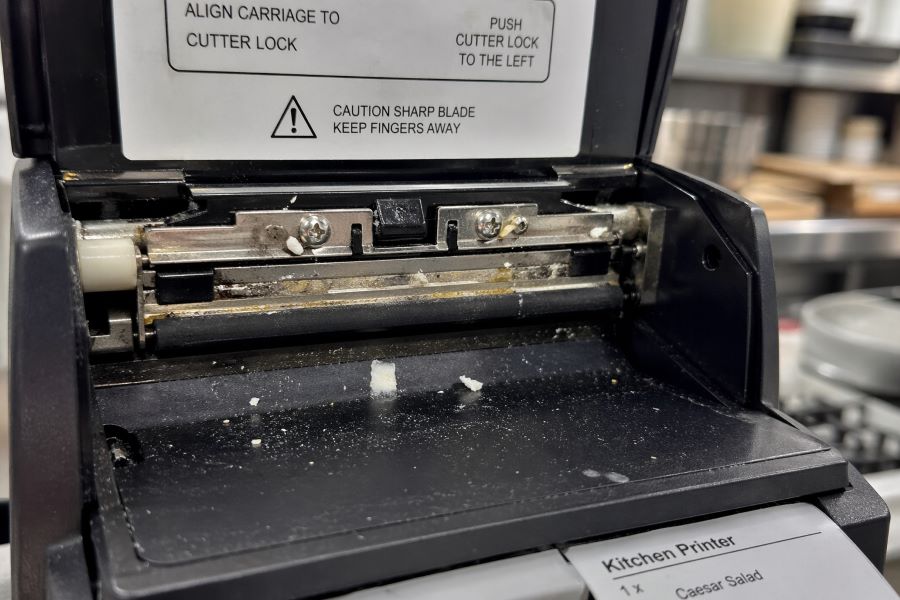
    A gummed-up printer cutter occurs when adhesive residue builds up on the cutter blade. Over time, this residue collects paper dust and label debris.

    As buildup increases, the cutter can become sticky, misaligned, or unable to cut cleanly. This leads to poor performance, inconsistent output, and eventual printer issues if left unaddressed.

    Gummed Up Printer Cutter
    A gummed-up printer cutter leads to poor performance and eventual printer issues if unaddressed.

    How Often Should You Clean a Label Printer Cutter?

    Cleaning frequency depends on print volume, media type, and overall label printer usage.

    High-volume environments and linerless label usage typically require more frequent cleaning due to increased adhesive exposure. Linerless labels, in particular, apply adhesive across the entire label surface, which makes buildup more likely.

    Rather than relying only on a fixed schedule, maintenance alerts are often a better approach. Alerts help ensure cleaning happens when it is actually needed, not too early and not too late.

    The Risks of Not Regularly Cleaning Printers

    Failing to clean printer cutters regularly can lead to a range of operational and mechanical issues:

    • Incomplete cuts, where labels tear instead of separating cleanly
    • Cutter jams that cause print queues to back up
    • Increased strain on the cutter motor, leading to long-term wear
    • Unexpected downtime that interrupts workflows and delays orders
    • Reactive maintenance that pulls staff away from their primary tasks
    • Workarounds that bypass labeling altogether, increasing the risk of errors, missing allergen information, or incorrect orders
    • Damage to brand perception when operations appear inconsistent or unreliable

    Over time, these issues compound. What starts as minor buildup can lead to more serious printer performance problems if not addressed early.

    How to Clean a Label Printer Cutter

    Keeping printer cutters clean is a simple process when done regularly. With the right approach, staff can remove adhesive buildup quickly and keep printers running without interruption.

    1. Power Off and Open the Printer

    • Turn off the printer before performing any maintenance.
    • Open the printer cover to access the cutter area.
    • Ensure the printer is stable and safe to handle before proceeding.

    2. Locate the Cutter Blade and Surrounding Area

    • Identify the cutter blade where labels or receipts are cut.
    • Check for visible adhesive buildup, dust, or debris.
    • Pay attention to edges where residue tends to collect.

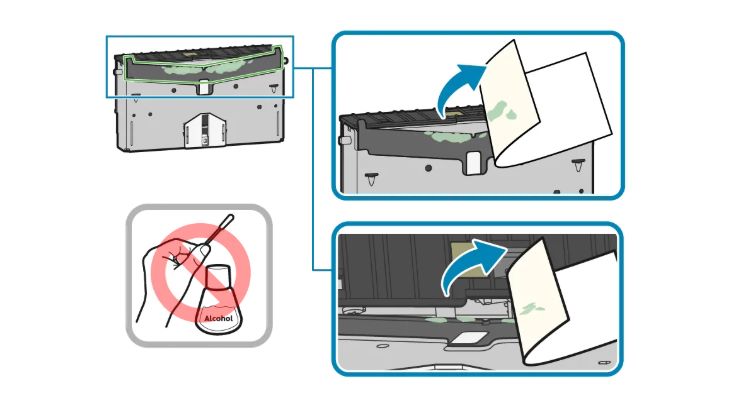
    3. Remove Adhesive Buildup

    • Use the adhesive side of an unused label to lift gum and residue.
    • Gently press and pull to remove buildup from the cutter surface.
    • Avoid using sharp objects or abrasive materials.

    Cleaning Printer Cutter Illustration

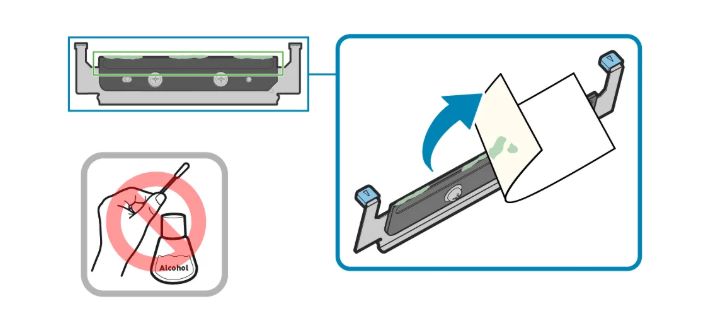
    4. Clear Loose Debris

    • Remove any remaining paper dust or label fragments.
    • Ensure the cutter area is free of obstructions.
    • Keep the cleaning process controlled and precise.

    Bottom Cutter Blade

    5. Close the Printer and Test

    • Close the printer securely after cleaning.
    • Power the printer back on.
    • Run a test print to confirm smooth, clean cuts.

    Printer Cleaning Do’s and Don’ts

    Do

    • Follow manufacturer guidelines for cleaning and maintenance
    • Clean printer cutters regularly, especially in high-volume or linerless environments
    • Use approved methods, such as the adhesive side of a label, to remove buildup
    • Perform cleaning in a controlled, well-lit area to ensure accuracy

    Don’t

    • Use sharp tools or abrasive materials that can damage the cutter
    • Apply harsh chemicals that may affect printer components
    • Attempt to clean the printer while it is powered on
    • Ignore early signs of buildup, such as uneven cuts or minor jams

    The mC-Label3 Multifunction Printer by Star Micronics great for delivery take out online ordering and QSRs.
    Keep your label printers working by following best practices for cleaning printer cutters.

    Best Practices for Cleaning Printer Cutters

    Keeping printer cutters clean comes down to a few practical maintenance habits.

    • Follow Maintenance Alerts, Not Just Schedules: Print volume can vary significantly. Built-in maintenance alerts help ensure cleaning happens at the right time, before performance issues begin.
    • Make Cleaning Instructions Easy to Access: When cleaning is required, staff need clear, immediate guidance. Printers that provide quick access to step-by-step instructions make maintenance easier and more consistent.
    • Simplify the Cleaning Process: If maintenance is complicated, it will be delayed. Tool-free access and clearly designed components allow staff to clean printers quickly without relying on IT support.
    • Replace Worn Parts Before They Fail: Even with regular cleaning, cutters and platens wear over time. Replacing these components proactively helps prevent jams and keeps printers performing reliably.

    Printer Cleaning and Maintenance Made Easy with Star Micronics

    Keeping label printers clean should not require specialized training or disrupt daily operations. In high-volume environments, printer cleaning and maintenance need to be simple, repeatable, and built into normal workflows. Star printers are designed so routine label printer maintenance can be performed by staff in minutes, without tools, service calls, or operational delays.

    The mC-Label2 and mC-Label3 multifunction label printers are built to support routine cleaning without technical expertise. Built-in maintenance alerts notify staff when attention is needed, helping prevent adhesive buildup before it impacts performance. When it’s time to clean, QR code-driven instructions provide immediate access to step-by-step guidance, so employees can act quickly and confidently.

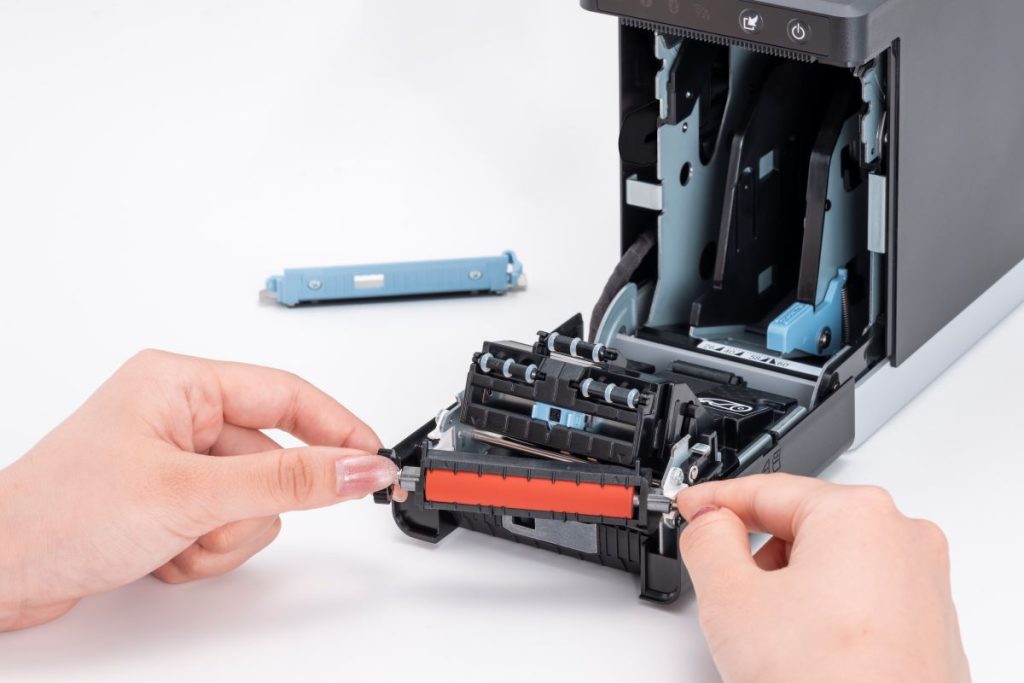
    Cleaning the printer cutter is straightforward. In many cases, staff can use the adhesive side of an unused label to remove gum and debris from the cutter. Tool-free, color-coded components make it easy to access, clean, and reassemble parts without delays or IT support.

    With the right maintenance approach and tools, cleaning label printers becomes a quick, routine task instead of a source of downtime.

    Want to learn more about how the mC-Label series helps reduce printer downtime? Read our blog, “Reduce Label Printer Downtime with Smarter Maintenance Tools.”

    The mC-Label2 multimedia printer by Star Micronics features user-friendly, tool-free maintenance.
    The mC-Label series uses tool-free, color-coded components for easy printer maintenance.

    Contact us for a demonstration to see how easy printer cleaning and maintenance can be.

    Frequently Asked Questions About Cleaning Printers

    How often should you clean a printer cutter?

    A printer cutter should be cleaned based on print volume and media type. High-volume environments and linerless label printing require more frequent cleaning due to adhesive buildup. Maintenance alerts help ensure cleaning happens at the right time.

    What causes a label printer cutter to become gummed up?

    A label printer cutter becomes gummed up when adhesive residue builds up on the cutter blade. This residue collects paper dust and debris, causing the cutter to become sticky, misaligned, or unable to cut cleanly.

    What happens if you do not clean a printer cutter?

    A dirty printer cutter causes incomplete cuts, label tearing, and frequent jams. Over time, this increases wear on the cutter mechanism and leads to downtime that disrupts labeling workflows.

    How do you clean a label printer cutter?

    To clean a label printer cutter, use the adhesive side of an unused label to remove buildup from the cutter blade. Always follow manufacturer instructions and ensure the printer is powered off before cleaning.

    Do linerless labels require more printer maintenance?

    Yes. Linerless labels apply adhesive across the entire label surface, increasing the likelihood of buildup on the printer cutter. More frequent printer cutter cleaning is required in these environments.

    Can employees clean printer cutters without technical training?

    Yes. Printers designed with tool-free access and guided instructions allow staff to perform printer cutter cleaning without technical training or IT support.

    When should you replace a printer cutter or platen?

    Replace a printer cutter or platen when cleaning no longer resolves cutting issues, or when consistent jams and uneven cuts occur.

    How can businesses reduce printer downtime caused by cutter issues?

    Businesses can reduce printer downtime by performing regular printer cutter cleaning, following maintenance alerts, and replacing worn parts proactively. Using printers designed for easy maintenance improves consistency and reliability.

  • Star Micronics Partners with Kitchen Technology, Innovations by ICC to Deliver Automated Food Safety Labeling with i.Print3™ and mC-Label2

    Star Micronics Partners with Kitchen Technology, Innovations by ICC to Deliver Automated Food Safety Labeling with i.Print3™ and mC-Label2

    The partnership combines automated labeling technology with compact, reliable printing to help foodservice operators improve traceability, compliance, and kitchen efficiency.

    Somerset, NJ – April 14, 2026 – Star Micronics, a global leader in POS hardware, labeling, and cloud printing technology, today announced a partnership with Kitchen Technology, Innovations by ICC (KTI/ICC) to integrate the i.Print3™ automated labeling solution with Star’s mC-Label2 multifunction label printer. The combined solution helps foodservice operators automate food preparation labeling, improve traceability, and support food safety compliance across modern kitchen environments.

    Foodservice operations often rely on handwritten labels or preprinted label sheets for food preparation and grab-and-go items. These manual processes can lead to inconsistent labeling, wasted materials, and increased labor. Integrating the i.Print3 device with Star’s mC-Label multifunction printer series, including the compact mC-Label2 and mC-Label3 printers, allows operators to generate clear, accurate labels at the point of food preparation, including preparation dates, expiration times, and other key food safety information.

    Automating Food Safety Labeling in the Kitchen

    The i.Print3 device is designed to automate kitchen labeling workflows in fast-paced foodservice environments. Instead of relying on multiple tools and fragmented workflows, the solution combines hardware, software, and cloud connectivity into a single integrated labeling platform.

    Cloud-based traceability allows operators to store labeling data and maintain records that support food safety oversight and operational visibility. This capability helps organizations track food preparation information, improve accountability, and support compliance with evolving regulatory and food safety requirements.

    “The i.Print3 was developed to simplify labeling and food safety processes for foodservice operators. Partnering with Star Micronics allows us to deliver a complete labeling solution that fits right into kitchen environments while supporting accurate, automated food safety labeling.”

    Compact Hardware Designed for Busy Kitchens

    Star’s mC-Label2 printer provides the compact footprint and operational flexibility required in space-constrained kitchen environments where countertop space is limited and efficiency is critical.

    The printer’s front-loading design allows labels to be reloaded without removing the device from the counter, making it easier to maintain during busy service periods. The integrated cutter supports die-cut labels and allows operators to use multiple label sizes, providing flexibility for different food preparation and labeling workflows.

    “The mC-Label2 was an ideal fit for this solution because of its compact design, reliability, and flexible media support. These features allow the labeling system as a whole to fit naturally into real kitchen workflows without adding complexity.”

    Supporting a Wide Range of Foodservice Environments

    The combined solution is designed for a variety of foodservice and retail food preparation environments, including quick-service restaurants (QSRs), convenience stores, grocery prepared food departments, and institutional kitchens such as hospitals and cafeterias.

    By printing labels directly at the prep station, the i.Print3 and mC-Label2 turn a traditionally manual task into a fast, automated process that improves food safety visibility and keeps kitchen teams moving without interruption.

    With more than four decades of experience developing technology solutions for the foodservice industry, KTI/ICC brings deep industry knowledge to the partnership. By combining KTI/ICC’s foodservice automation expertise with Star Micronics’ reliable printing hardware, the partnership delivers a modern solution for automated food preparation labeling.

    For more information about Star Micronics solutions, visit starmicronics.com.

    To learn more about Kitchen Technology, Innovations by ICC and the i.Print3™ solution, visit onkti.com.

    Can’t get enough industry news?

    Kitchen Technology Innovations by ICC logo

    Founded in 1987, Kitchen Technology, Innovations by ICC. (ICC) and its innovation division, Kitchen Technology Innovations (KTI), develop advanced, integrated technologies for the foodservice industry. Leveraging decades of expertise and a portfolio of patented solutions, KTI/ICC delivers intelligent systems that digitize food safety, automate product management, and provide real-time operational visibility across multi-unit environments. Designed for scalability and ease of use, KTI/ICC’s platform enables operators to reduce risk, improve consistency, and optimize performance. The family-founded company supports leading global brands, including EB Group, Paradies Lagardère, and Burger King.

    Star Micronics logo, point-of-sale (POS) hardware and technology company.

    Star Micronics is a global provider of point-of-sale (POS) hardware, cloud printing, and labeling solutions that help businesses connect digital workflows to real-world operations. Serving retail, hospitality, healthcare, and service industries, Star delivers printing, labeling, cash management, self-service, and cloud-based technologies designed to support scalable, connected, and automated environments. Star’s solutions support Android, iOS, Windows, and web-based platforms and extend into the cloud through services such as CloudPRNT Next and StarIO.Online, Star’s fully managed cloud printing service.

    Visit starmicronics.com or follow us on Facebook, X, YouTube, or LinkedIn to learn more.

    Media Contact:

    Christin Dorner
    Star Micronics America, Inc.
    cdorner@starmicronics.com
    848-216-3318

    Media Contact:

    Mark Salerno
    Kitchen Technology, Innovations by ICC
    marky@goicc.com
    631-673-5100

  • Star Micronics and ConnectedFresh Automate Food Safety and Traceability Workflows with Cloud-Connected Labeling

    Star Micronics and ConnectedFresh Automate Food Safety and Traceability Workflows with Cloud-Connected Labeling

    The integration combines ConnectedFresh’s IoT monitoring and food safety platform with Star’s cloud printing technology to automate mission-critical workflows, dramatically improving documentation and reducing food waste and risk for foodservice operations.

    Somerset, NJ – April 13, 2026 – Star Micronics, a global leader in POS hardware and cloud printing technology, today announced that ConnectedFresh has integrated Star’s mC-Label3 multifunction label printer and StarIO.Online fully managed cloud printing service into its digital food safety platform. The integration enables restaurants and foodservice operators to generate accurate, traceable food labels directly from the ConnectedFresh platform, helping improve compliance, increase food safety visibility, and reduce manual labeling tasks.

    Connecting Digital Food Safety Monitoring to Physical Labeling

    ConnectedFresh uses wireless IoT sensors to give restaurant and foodservice operators real-time visibility into temperature conditions, equipment performance, and food safety compliance across their locations. Through the integration with Star Micronics, that digital food safety data can now trigger on-demand label printing via StarIO.Online, connecting digital records to printed labels that document preparation details, product information, and traceability records. Because Star manages the cloud infrastructure, labels can be generated without local servers or complex on-site IT setup.

    Supporting FSMA Traceability and Recordkeeping

    With the FDA’s Food Safety Modernization Act (FSMA) Section 204 Food Traceability Rule requiring expanded recordkeeping for certain foods, foodservice operators are strengthening their traceability processes ahead of the rule’s enforcement date in July 2028. Many operators are moving away from manual logs and handwritten labels toward digital systems that can automatically document Critical Tracking Events and maintain accurate traceability records.

    By combining ConnectedFresh’s platform with Star’s labeling and cloud printing technology, operators can automatically generate labels documenting key food safety and traceability information, including preparation dates, product details, and cooling records. For time-sensitive compliance tasks like cool-down logging, ConnectedFresh sensors can monitor the entire process and automatically trigger a printed label documenting the result, helping improve documentation accuracy while reducing labor, food waste, and risk.

    On-Demand Labeling for Real Kitchen Workflows

    Star’s mC-Label3 multifunction printer supports a wide range of labeling applications in foodservice environments, including food preparation, grab-and-go packaging, and product identification, while supporting multiple media types such as linerless and die-cut labels. Star’s mG-T30 scale is also integrated with the platform, enabling weight-based labeling and verification as an additional capability for foodservice operations.

    “ConnectedFresh is built to help operators stay on top of food safety without adding more complexity to the kitchen. Working with Star lets us connect our platform directly to reliable labeling hardware so teams can print accurate, traceable labels at the exact moment food is prepared, cooled, or packaged.”

    “Food safety and traceability are becoming more data-driven, and operators need solutions that can scale across every location. By bringing together ConnectedFresh’s sensor-driven platform and Star’s labeling and cloud technologies, this partnership helps standardize how food safety information is captured and managed across distributed operations.”

    Cloud-Connected Printing for Multi-Location Foodservice

    StarIO.Online enables cloud applications to manage and control printers remotely, allowing businesses to deploy and monitor labeling across distributed locations without maintaining on-site infrastructure. This allows ConnectedFresh users to standardize and scale labeling workflows across multiple kitchens, restaurants, and food preparation facilities using a single, versatile device that supports food safety labeling, grab-and-go labeling, and order accuracy workflows.

    For example, when ConnectedFresh sensors confirm that a food item has completed its cool-down process within the required time and temperature range, the platform can automatically generate and print a label documenting the completion time and product details, ready to apply directly to the stored product without any manual logging.

    By combining ConnectedFresh’s digital food safety platform with Star’s labeling and cloud printing technologies, the integration helps operators bridge the gap between digital compliance systems and real-world kitchen operations.

    For more information about Star Micronics solutions, visit starmicronics.com.

    To learn more about ConnectedFresh, visit connectedfresh.com.

    Can’t get enough industry news?

    ConnectedFresh Logo

    ConnectedFresh is the most comprehensive sensor-driven intelligence platform built for foodservice, helping restaurants and food operators automate food safety processes, monitor facilities and equipment in real time, and manage risk and compliance across all locations. The platform is powered by wireless IoT sensor hardware, sourced and passed through to customers at cost, delivering real-time visibility from the kitchen floor to the back office. Through integrations with partners like Star Micronics, ConnectedFresh extends that intelligence to physical labeling, connecting digital food safety records with printed documentation for improved traceability.

    To learn more about ConnectedFresh’s 25+ turnkey solutions for foodservice, visit connectedfresh.com/solutions.

    Star Micronics logo, point-of-sale (POS) hardware and technology company.

    Star Micronics is a global provider of point-of-sale (POS) hardware, cloud printing, and labeling solutions that help businesses connect digital workflows to real-world operations. Serving retail, hospitality, healthcare, and service industries, Star delivers printing, labeling, cash management, self-service, and cloud-based technologies designed to support scalable, connected, and automated environments. Star’s solutions support Android, iOS, Windows, and web-based platforms and extend into the cloud through services such as CloudPRNT Next and StarIO.Online, Star’s fully managed cloud printing service.

    Visit starmicronics.com or follow us on Facebook, X, YouTube, or LinkedIn to learn more.

    Media Contact:

    Christin Dorner
    Star Micronics America, Inc.
    cdorner@starmicronics.com
    848-216-3318

    Media Contact:

    ConnectedFresh
    media@connectedfresh.com
    888-310-2019

  • Cash Drawer Security: Protecting Cash in a Digital Payments Era

    Cash Drawer Security: Protecting Cash in a Digital Payments Era

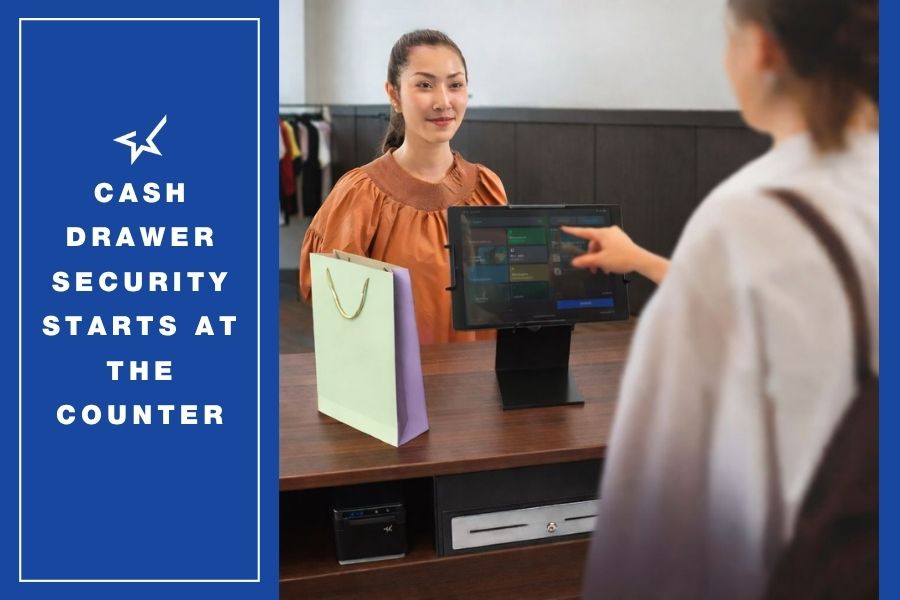
    Cash drawer security remains essential as consumers continue to use cash. Secure cash drawers feature robust access control and connectivity to the point-of-sale (POS) system, enabling greater oversight and employee accountability. Secure cash drawers also help to reduce human error and losses by keeping cash organized. Cash drawer construction also plays an important role in preventing jams and failures that lead to workarounds and put cash at risk. 

    Table of Contents

    Cash Is Still Common — and It Still Needs to Be Secured

    Although digital transactions account for an increasing share of payments, merchants still need to maintain focus on cash drawer security. Statistics from the Federal Reserve confirm that U.S. consumers use cash for about 14% of payments, and that rate has stayed steady for the past five years. Furthermore, the Fed reports that 90% of U.S. consumers intend to use cash to store value in the future. Older consumers are more likely to have cash in their wallets, but Empower reports that 24% of Gen Z carry cash daily. 

    The staying power of cash transactions can benefit merchants. With cash, merchants instantly have funds, and there are no processing fees or chargebacks when customers pay with cash. On the other hand, keeping cash secure and ensuring there aren’t any errors in till cash balances are long-term challenges.

    Pros of Accepting Cash Cons of Accepting Cash
    Immediate access to funds Risk of shrinkage
    No payment processing fees Manual counting and reconciliation required
    No chargebacks or payment disputes Risk of employee theft
    Works during internet or network outages Greater need for secure storage and procedures
    Accessible for all customers Human error when making change

    So, as long as consumers use cash, merchants need more than just a drawer for bills and change. They need a secure cash drawer designed for accountability and durability. 

    What is a Secure Cash Drawer?

    A secure cash drawer is a cash drawer that combines physical durability with controlled access through POS system integration. In most modern POS environments, the cash drawer opens only when triggered by the receipt printer or POS terminal, ensuring that every drawer open is tied to a transaction or authorized action. This creates a record of drawer activity and limits unauthorized access to cash.

    Secure cash drawers also include durable steel construction, secure bill clips, multiple till configurations, and lock mechanisms that prevent forced entry or accidental opening.

    How Cash Drawer Security Works

    Cash drawer security features help businesses control access to cash, reduce internal theft, prevent cash handling errors, and ensure the drawer can withstand high transaction volumes without failure.

    1. Cash Drawers Give Merchants Access Control

    The most important rule of cash handling is simple: when the drawer is not in use for a transaction, it should be locked. Secure cash drawers are typically connected to the POS terminal or receipt printer and open only when triggered by a transaction or authorized function. This ensures that employees must be logged into the system to access till cash and creates a record of each drawer open, improving accountability and reducing opportunities for unauthorized access.

    2. Insider Threat Mitigation with Cash Drawer Security

    Lax cash drawer security can tempt employees. A&M Consumer Retail Group reports that it’s a threat merchants must acknowledge, with over 50% of shrinkage coming from internal factors like employee theft. Cash drawers that interface with the POS system allow merchants to set policies for when the drawer can open and when manager authorization is required, for example, for voids, returns, or “no sales.” 

    Secure cash drawers help enforce cash handling policies. For example, the POS system can require manager authorization for voids, returns, or “no sale” drawer opens. Drawers that support multiple removable tills allow businesses to assign one till per cashier, making it clear who is responsible for the cash in that drawer during each shift and simplifying reconciliation.

    3. Reducing Human Error with Secure Cash Drawers

    The till design is also a factor in cash drawer security. Having the right number and size of compartments can help prevent cashiers from making mistakes, such as giving a $20 bill in change when $10 was due.

    Secure cash drawer design supports cash balancing best practices

    • Counting at the beginning of the shift
    • Depositing cash throughout the shift
    • Pulling the POS report at the end of the shift
    • Counting in a secure location 
    • Solve any discrepancies immediately

    An organized till reduces mistakes during transactions and makes end-of-shift reconciliation faster and more accurate. Proper till configuration is often an overlooked aspect of cash drawer security because disorganized drawers lead directly to cash-handling errors.

    4. Cash Drawers Need Strong Physical Security Features

    Cash drawers must be built to withstand daily use. In high-volume environments like grocery, cannabis, QSR, and large retail stores, drawers may open hundreds of times per day. All-steel construction, reinforced rails, metal bill clips, and dual-lock systems help prevent forced entry and reduce failures that can lead to security workarounds.

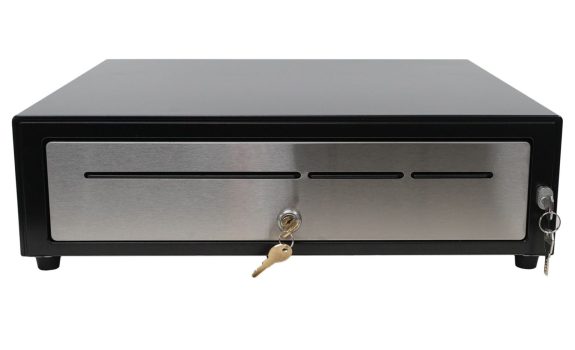
    The CD5-1918 cash drawer by Star Micronics sets the standard for high-cash volume, big-box, and enterprise-level cash management.
    The CD5-1918 Max Series Cash Drawer by Star Micronics

    Quick Cash Handling Security Checklist

    Businesses can improve cash drawer security by following these best practices:

    • Use POS-triggered drawers instead of manual key-only drawers
    • Assign one till per cashier
    • Require manager approval for no-sale drawer opens
    • Store large bills under the till
    • Perform till counts at the beginning and end of each shift
    • Reconcile cash in a secure back-office location
    • Use steel cash drawers in high-volume environments

    Additional Cash Drawer Security Accessories

    In addition to the cash drawer itself, several accessories can improve cash handling security and prevent unauthorized access.

    Locking Till Covers

    Locking till covers allow tills to be securely stored in a safe or back office during shift changes or when the drawer is not in use. This prevents loose cash from being transported in bags or left unsecured.

    Under-Counter Mounting Brackets

    Under-counter mounting brackets secure the cash drawer to the counter, preventing the drawer from being removed from the POS station. This is commonly used in retail and hospitality environments where the risk of theft is higher.

    Dual Drawer Secure Cable

    In dual drawer environments, traditional “Y” cables allow two drawers to connect to one printer, but they can create a security risk because drawers can be swapped at the printer. Secure dual drawer cables prevent drawer swapping by creating a fixed connection between the printer and both drawers, making it much more difficult for an employee to access a second drawer without authorization.

    These accessories are often used in high-volume retail, grocery, cannabis, and hospitality environments where multiple employees share POS stations and cash handling controls are especially important.

    How to Choose a Secure Cash Drawer

    Choosing a secure cash drawer is not just about size or price. The right drawer should match your transaction volume, integrate with your POS system, and support your cash handling procedures. In high-volume environments like retail, grocery, cannabis, and QSR, drawers must withstand constant use while maintaining controlled access to cash. In lower-volume environments, compact drawers with reliable POS integration and basic locking features may be sufficient.

    When evaluating cash drawer security, businesses should consider:

    • Steel construction and durability for high open/close environments
    • POS or receipt printer interface compatibility for controlled drawer opening
    • Till configuration and removable tills for shift-level accountability
    • Locking mechanisms and key options for controlled access
    • Mounting options such as under-counter brackets to prevent drawer removal
    • Support for dual drawer installations to prevent drawer swapping

    A secure cash drawer should support your cash handling procedures, not work against them. The goal is simple: limit access, create accountability, and make cash handling as controlled and traceable as possible.

    Cash Drawer Security by Industry

    Cash drawer security requirements vary by industry:

    • Retail: High transaction volume requires heavy-duty steel drawers and removable tills for multiple cashiers.
    • Grocery: Drawers open frequently and require reinforced rails and high-capacity tills.
    • Quick-Service Restaurants: Compact POS cash drawers are common, often connected to receipt printers.
    • Cannabis: Secure cash handling is critical due to cash-heavy operations and compliance requirements.
    • Hospitality: Bars and cafés often use compact drawers with under-counter mounting for security.

    Star Micronics Cash Drawer Security Solutions

    Star Micronics offers cash drawers and cash handling accessories designed for retail, grocery, hospitality, cannabis, and other environments where secure cash management is important.

    CD5 Max Series Cash Drawers: The CD5 Max Series is designed for cash-heavy environments where durability and cash handling control are critical. These heavy-duty steel cash drawers are commonly used in grocery stores, large retail, QSRs, and cannabis environments where drawers open frequently throughout the day.

    Key security features include:

    • Heavy-duty all-steel construction in every popular size
    • Dual interface (DK and USB) for POS or printer-driven operation
    • Reinforced drawer rails for high open/close cycles (millions of operations)
    • Dual or multiple media slot options for checks and large bills
    • Multiple till configurations to support different environments
    • Dual-locking mechanisms on select models

    These features help businesses maintain drawer reliability, control access to cash, and support consistent cash handling procedures in high-volume environments.

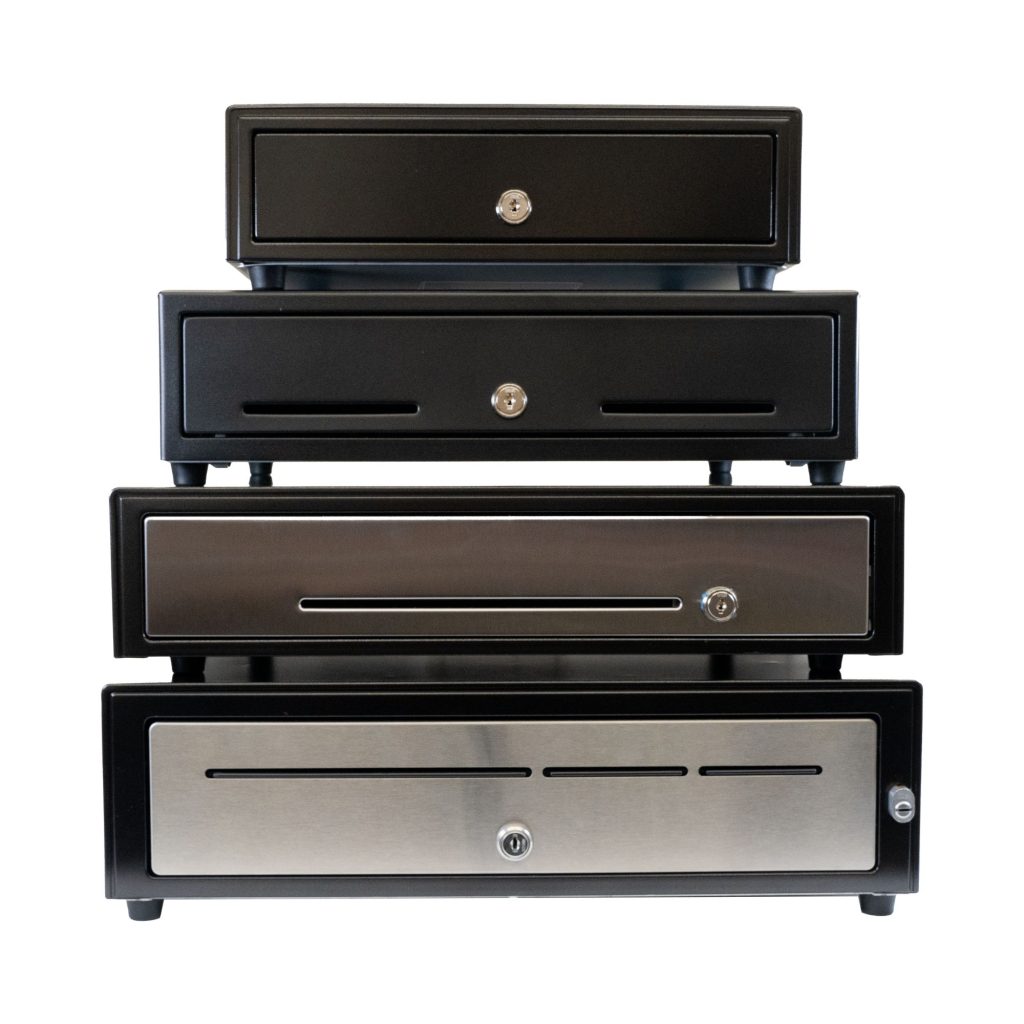
    CD5 Max Series Cash Drawers

    Designed for high-cash-volume environments, the CD5 Max Series features heavy-duty steel construction, dual lock options, and under-till storage for added organization. Multiple sizes and DK/USB interface options allow easy connectivity with virtually any POS system.

    Explore More >

    CD4 Choice Series Cash Drawers: The CD4 Choice Series is a standard-duty cash drawer designed for general retail, hospitality, and point-of-sale environments that need reliable cash handling with essential security features. These POS cash drawers are commonly used in retail stores, cafés, bars, and service counters where a compact drawer and dependable operation are required.

    Key security features include:

    • Durable steel construction with reinforced steel top
    • Multiple lockset options for key control and drawer access management
    • Dual media slots for storing checks or large bills without opening the drawer
    • Secure bill clips to keep cash organized and in place
    • Multiple till configurations to support different cash handling needs

    Standard-duty cash drawers like the CD4 are used in environments with moderate transaction volumes, but secure cash handling and POS-controlled drawer opening remain important.

    Star Cash Drawer Accessories and Tills

    In addition to cash drawers, Star offers cash handling accessories that help businesses improve security and cash control procedures:

    Using removable tills and locking till covers helps businesses assign responsibility for cash to individual cashiers and transport tills securely to the back office for reconciliation. Mounting brackets help prevent the drawer from being removed from the POS station, and secure dual drawer cables help prevent unauthorized access in dual-drawer POS setups.

    These accessories are commonly used in multi-employee environments where multiple cashiers share POS stations and cash control procedures are important for loss prevention and accurate reconciliation.

    Frequently Asked Questions About Cash Drawer Security

    What makes a cash drawer secure?

    A cash drawer is considered secure when it has durable steel construction, a reliable locking mechanism, and controlled opening through the POS system or receipt printer. Security also depends on proper till organization, removable tills to support cashier accountability, and consistent cash-handling procedures, such as shift counts and reconciliation.

    How do cash drawers prevent employee theft?

    Secure cash drawers give employees access to cash only when necessary and authorized, i.e., when accepting cash payments or making change. A secure cash drawer will also communicate with the POS system to track when an employee opens the drawer for any reason, and keep a record for reconciliation and accountability. 

    How does a cash drawer connect to a POS system?

    Most modern cash drawers connect to the POS system through the receipt printer or directly to the POS terminal. In many setups, the cash drawer is connected to the receipt printer using a drawer cable, and the printer sends a signal to open the drawer when a cash transaction is completed. This is often called a printer-driven cash drawer.

    This setup allows the POS system to control when the drawer opens and helps ensure that the drawer only opens for recorded transactions or authorized functions such as returns or no-sale opens with manager approval. Some basic cash drawers operate manually using only a key, but POS-controlled drawers provide much better security and accountability.

    Why is the removable till important for cash handling?

    One till per cashier has numerous benefits for secure cash handling. It enables secure transport of till cash when the cashier begins the shift and when carrying cash from the shift to the back office for reconciliation. Tills can be stored in a safe rather than in the drawer when not in use. Cash is never stored less securely, for example, in a bank bag or loose, and cashiers are each accountable for the cash in the tills they’re using.

    What is the most durable cash drawer for high-volume retail?

    The most durable cash drawers for high-volume environments are made of all-steel construction and are tested for durability and performance over millions of opens/closes. Star’s CD5 Max Series has all the features a high-volume retailer needs, including reinforced drawer rails and industry-leading lock strength. CD5 cash drawer models include several options, giving merchants the choice of the correct till configuration for the bills and change they accept. 

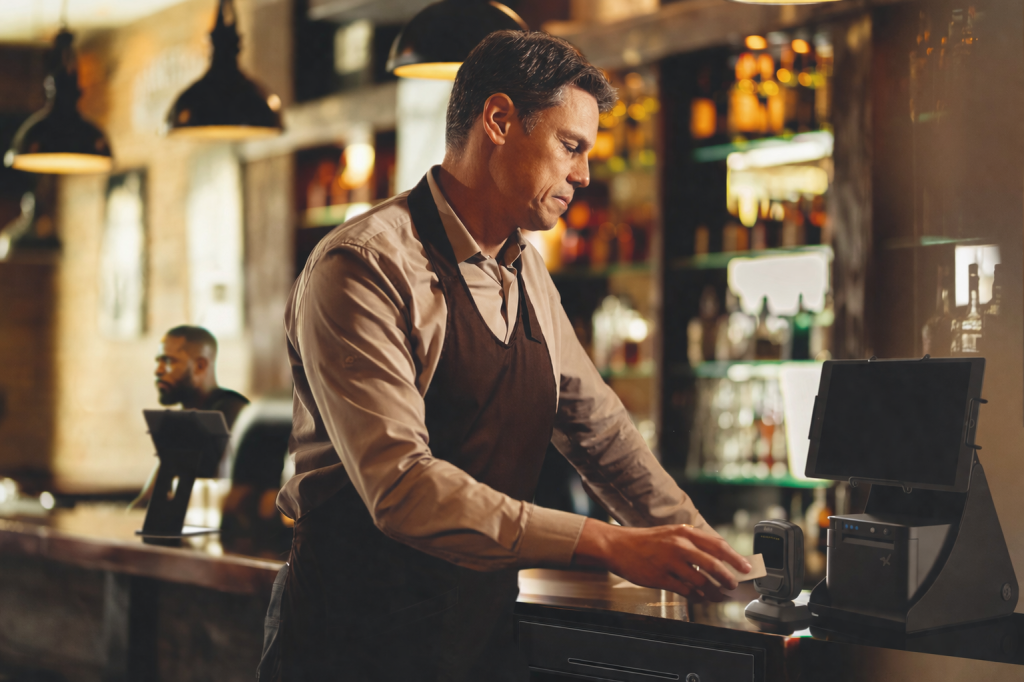
    Bartender Checking ID

    Where to Learn More About Cash Drawer Security

    Choosing the right cash drawer is an important part of cash handling and loss prevention. Star Micronics offers secure cash drawers designed for retail, grocery, hospitality, and cannabis environments, including heavy-duty and compact models with multiple till configurations and POS interface options.

    Contact us to learn more about Star Micronics CD5 and CD4 cash drawer solutions.

  • POS Printer Integration Shouldn’t Slow Down Your Platform. A New Case Study.

    POS Printer Integration Shouldn’t Slow Down Your Platform. A New Case Study.

    For many POS platforms, printing issues don’t show up during development. They show up during deployment. Different restaurant environments, network configurations, and connectivity challenges can quickly turn printing into one of the biggest sources of support calls.

    That’s exactly what Selflane experienced. Printing instability wasn’t just a minor inconvenience. It was pulling engineering and service teams into troubleshooting instead of product development and growth.

    By standardizing on the TSP143IV thermal receipt printer and moving to the StarXpand SDK, Selflane was able to modernize its POS printer integration, simplify installations, and reduce recurring support issues.

    We put together a short case study that walks through what changed and what other ISVs can learn from it.

    Download the Selflane case study to read the full story.

  • 4 Features to Look for in the Ultimate Restaurant Kitchen Printer

    4 Features to Look for in the Ultimate Restaurant Kitchen Printer

    A restaurant kitchen printer is one of the most important tools for maintaining order accuracy and speed in a busy kitchen environment. By printing clear, durable tickets instantly, kitchen staff can prepare orders efficiently and reduce costly mistakes.

    In modern restaurants—whether quick service, fast casual, or full service—kitchen printers connect the point-of-sale (POS) system directly to the back-of-house team. Instead of relying on handwritten tickets that can be misread or misplaced, orders are printed clearly and delivered immediately to the stations preparing them.

    Choosing the right printer matters. Commercial kitchens often expose equipment to heat, grease, steam, and constant activity, so not every printer is built to perform reliably under these conditions.

    Table of Contents

    What Is a Restaurant Kitchen Printer?

    A restaurant kitchen printer is a specialized printer used in commercial kitchens to print order tickets directly from a restaurant point-of-sale (POS) system. These printers ensure kitchen staff receive accurate order details immediately so food preparation can begin without delays or confusion.

    Unlike standard receipt printers used at checkout counters, kitchen printers are built to operate in demanding environments and are typically installed at prep stations, grill stations, expo lines, or beverage areas where orders are fulfilled.

    Restaurant kitchen printers generally use either impact printing for high-heat kitchen environments or thermal printing in modern, temperature-controlled kitchens. The best restaurant kitchen printer depends on the kitchen environment, order volume, and how the restaurant’s POS system sends orders to the back of house.

    If you’re evaluating a restaurant kitchen printer, here are four features that can make the biggest difference in kitchen performance and reliability:

    1. Durable Impact Printing for Harsh Kitchen Environments

    A restaurant kitchen printer must be built to withstand the realities of a commercial kitchen. Heat, grease, and airborne food particles can quickly damage equipment not designed for such environments.

    Impact printers, like the SP742 from Star, are widely used in restaurant kitchens because they are extremely durable and reliable. They work by striking an ink ribbon against impact paper, producing clear, legible tickets that remain readable even in high heat.

    Unlike thermal paper, which can darken when exposed to high temperatures, impact paper maintains readability in hot kitchen environments. This makes impact printing particularly useful near grills, fryers, and other high-heat stations.

    For these reasons, many restaurants rely on impact printers for high-heat kitchen environments.

    Impact vs. Thermal Kitchen Printers: Choosing the Right Technology

    While impact printers are widely used in traditional kitchen environments, some restaurants operate in modern, climate-controlled kitchens where thermal printing can also perform reliably.

    Thermal kitchen printers use heat to create images on specially coated paper, eliminating the need for ink ribbons and reducing maintenance. In controlled environments where excessive heat, grease, or steam are less of a concern, thermal printers can offer fast, quiet, and efficient ticket printing.

    For example, the Star mC‑Print3 thermal ticket printer is often used in modern restaurant kitchens, cafes, and quick-service environments where operators want the speed and simplicity of thermal printing.

    However, for kitchens exposed to high heat, oil, or heavy airborne particles, impact printers remain a dependable choice due to their rugged design and heat-resistant paper.

    Choosing between impact and thermal ultimately depends on the conditions of the kitchen and the restaurant’s operational needs.

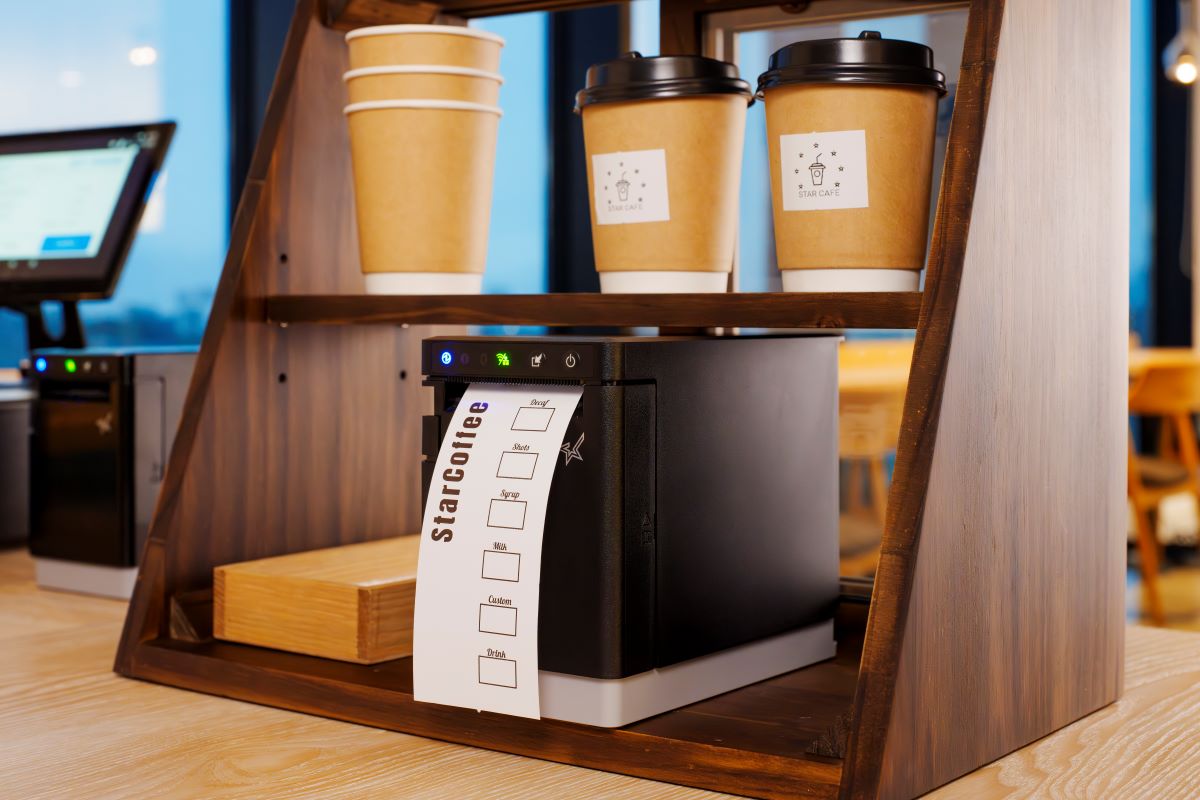
    The mC-Print3 thermal kitchen printer in a modern heat-controlled environment.

    2. Internal Power Supply for Flexible Kitchen Layouts

    Kitchen space is often limited, and equipment placement can directly affect workflow efficiency.

    A restaurant kitchen printer with an internal power supply simplifies installation and helps reduce cable clutter. Instead of managing bulky external power adapters, staff can install printers directly at prep stations, expo stations, or beverage areas.

    Benefits of internal power supplies include:

    • Cleaner workstation setups
    • Easier installation in tight spaces
    • Fewer exposed cables in high-traffic areas
    • More flexibility when arranging kitchen equipment

    In environments such as food trucks, kiosks, or compact restaurant kitchens, these small, space-saving features can make a significant difference.

    3. Fast Print Speed to Keep Kitchens Moving

    During peak service hours, kitchens operate at high speed. A restaurant kitchen printer must keep up with order volume without slowing down the workflow.

    High-speed printers can produce 13 or more receipts per minute, allowing orders to move quickly from the POS system to the kitchen staff.

    Fast printing provides several operational benefits:

    • Orders reach the kitchen instantly
    • Staff can begin preparation sooner
    • Order queues stay organized during busy periods
    • Restaurants can handle higher order volumes efficiently

    Fast, clearly printed tickets help kitchens maintain speed and accuracy even during the busiest service periods.

    4. Easy Paper Loading to Minimize Downtime

    Even the most reliable kitchen printer will eventually need a paper refill. When that moment comes during a busy shift, the process should be quick and simple.

    A restaurant kitchen printer with drop-in paper loading allows staff to replace paper rolls in seconds. This feature reduces downtime and helps kitchen operations continue smoothly during peak service periods.

    Look for printers designed with:

    • Drop-in paper loading
    • Jam-resistant mechanisms
    • Clear paper guides

    These design features allow kitchen staff to reload paper quickly and return their attention to preparing orders.

    Why Kitchen Printers Matter for Restaurant Operations

    A reliable restaurant kitchen printer helps restaurants maintain fast service and accurate order fulfillment. By delivering clear, durable tickets directly to kitchen stations, these printers reduce communication errors and improve overall workflow efficiency.

    Restaurants that invest in the right kitchen printing technology often see improvements in:

    • Order accuracy
    • Kitchen speed and efficiency
    • Staff productivity
    • Customer satisfaction

    In a fast-paced restaurant environment, even small improvements in communication and efficiency can lead to better service and stronger profitability.

    Choosing the Right Restaurant Kitchen Printer

    When selecting a restaurant kitchen printer, prioritize durability, speed, ease of use, and compatibility with your POS system.

    A well-designed printer helps kitchen staff stay organized, reduces order errors, and ensures food reaches customers quickly and correctly every time.

    The Smart QSR Delivery Playbook: Labeling, Accuracy & Efficiency Done Right

    This ebook explores how labeling, verification tools, and flexible POS technology can help restaurants manage QSR delivery workflows more effectively—from the kitchen to the handoff point.

    Kitchen Printer FAQs for Restaurants

    What is a restaurant kitchen printer?

    A restaurant kitchen printer is a specialized printer that prints order tickets directly from a point-of-sale (POS) system to kitchen stations. These printers ensure staff receive orders immediately so food can be prepared quickly and accurately.

    What printer do restaurants use in kitchens?

    Many restaurants use impact printers in kitchens because they are durable and can withstand heat, grease, and steam. In modern, temperature-controlled kitchens, thermal printers may also be used for their speed and low maintenance.

    When should you use an impact vs. a thermal kitchen printer?

    Impact printers are typically best for:

    • high-heat kitchens
    • heavy grease environments
    • grill or fryer stations

    Thermal printers are often used in:

    • temperature-controlled kitchens
    • cafes and quick-service restaurants
    • modern POS workflows

    Why do restaurants use kitchen printers instead of handwritten tickets?

    Kitchen printers improve order accuracy, speed, and communication between front-of-house staff and kitchen teams. Printed tickets are easier to read than handwritten orders and help reduce mistakes during busy service periods.

    Ready to learn more about how the ultimate restaurant kitchen printer can impact your business?

  • Star Micronics Powers Scalable Kitchen Workflows at MURTEC 2026

    Star Micronics Powers Scalable Kitchen Workflows at MURTEC 2026

    Visit Booth 112 to experience Star’s integrated labeling, KDS, and food safety solutions designed to improve consistency across multi-unit restaurant brands.

    Las Vegas, NV – March 9-11, 2026 – Star Micronics, a global leader in point-of-sale (POS), labeling, and cloud technology, is proud to announce its participation in MURTEC 2026, taking place March 9–11 at Caesars Palace in Las Vegas. Attendees are invited to visit Booth 112 to experience Star’s latest restaurant-ready hardware and connected kitchen solutions.

    At MURTEC 2026, Star Micronics will demonstrate how restaurant operators, enterprise brands, and technology providers can improve order accuracy, strengthen food safety compliance, and streamline kitchen workflows using integrated labeling and printing solutions built for modern foodservice environments.

    Attendees can explore live demonstrations at Booth 112, including:

    Food Safety Label Technology

    • KTI Food Safety Solution featuring i.Print3™: A live demonstration showing how Star’s mC-Label2 multifunction label printer, integrated with the i.Print3 automated prep labeling system, supports accurate date labeling, expiration tracking, and cloud-based traceability. Designed for high-volume kitchens, this workflow helps multi-unit operators strengthen food safety compliance and maintain consistent standards across locations.

    KDS Solutions

    • KitchenGO KDS Order Accuracy Demo with Logic Controls: A connected workflow demonstration showing how Logic Controls’ KitchenGO KDS and Star’s mC-Label3 multifunction printer work together to reduce missed modifiers, improve fulfillment timing, and increase order accuracy across dine-in, takeout, and off-premise channels.

    Online Ordering Cloud Printing Solutions

    • mC-Label Multifunction Cloud Printer Series (mC-Label2 and mC-Label3): Multifunction printers built for restaurant environments that support linerless labels, die-cut labels, and receipt media. Ideal for prep labeling, delivery workflows, and on-demand kitchen printing, the mC-Label series delivers flexibility and cloud-ready performance in a compact footprint.

    • TSP143IV SK X4 Linerless Label Printer: A compact 3″ linerless sticky label printer designed for high-volume foodservice environments. The X4 model delivers every modern connectivity option directly on its interface, including USB, LAN, Bluetooth, Wi-Fi, Android Open Accessory (AOA), and dual-band wireless, ensuring flexible deployment across tablet, mobile, and traditional POS systems. Supports repositionable linerless labels for cleaner operations and reduced waste.

    Star will also feature linerless labeling solutions powered by media partners Iconex and StickyPOS. These repositionable linerless labels eliminate backing liners to reduce waste while maintaining strong adhesion and print clarity for prep, delivery, and compliance labeling applications.

    “At MURTEC, we’re focused on helping restaurants solve real-world operational challenges inside the kitchen. Working alongside partners like Logic Controls and KTI, we’re demonstrating how connected KDS, labeling, and printing workflows improve order accuracy, strengthen food safety compliance, and support consistent execution across every ordering channel.”

    Restaurant operators, enterprise IT leaders, and technology providers are encouraged to visit Booth 112 to see live demonstrations and schedule one-on-one meetings with the Star team.

    To book a demo or for more information, contact sales@starmicronics.com.

    Can’t get enough industry news?

    Star Micronics logo, point-of-sale (POS) hardware and technology company.

    Star Micronics is a global leader in POS hardware and transaction technology, providing printers, secure cash management, and connected peripherals for retail and hospitality environments. Known for reliability and developer-friendly integration, Star solutions work seamlessly with Android™, iOS, Windows®, and web-based POS platforms to power receipt, label, ticket, and order printing across modern commerce environments.

    Star’s cloud technologies extend printing beyond the counter. CloudPRNT Next enables scalable direct cloud printing, while StarIO.Online is Star’s fully managed cloud printing service that removes the need for server infrastructure and simplifies remote printer management across distributed locations. Star also offers a broad portfolio of POS peripherals, including barcode scanners, scales, and tablet stands, designed to work together as a complete hardware solution.

    Learn more at starmicronics.com or follow Star on LinkedIn, YouTube, Facebook, Instagram, and X.

    Media Contact:

    Christin Dorner
    Star Micronics America, Inc.
    cdorner@starmicronics.com
    848-216-3318

  • Star Micronics Integrates Labeling and Printing Solutions with Crunchtime Kitchen to Improve Order Accuracy and Fulfillment

    Star Micronics Integrates Labeling and Printing Solutions with Crunchtime Kitchen to Improve Order Accuracy and Fulfillment

    The integration connects kitchen workflows with reliable labeling and printing to support faster, more accurate order fulfillment across modern restaurant environments.

    Somerset, NJ – February 23, 2026 – Star Micronics, a global leader in POS hardware, labeling, and cloud printing technology, today announced the integration of its printing and labeling solutions with Crunchtime Kitchen, an industry-leading kitchen display system (KDS) by Crunchtime. The integration extends digital kitchen workflows beyond the screen, helping restaurants improve order accuracy, accountability, and fulfillment across dine-in, takeout, and delivery channels, with particular impact for quick-service restaurants (QSRs), fast-casual brands, large casual-dining chains, and other hospitality venues.

    Kitchen display systems play a critical role in organizing and prioritizing orders, but accuracy challenges often arise once orders move from preparation to packaging and handoff. By integrating Star Micronics’ labeling and printing solutions with Crunchtime Kitchen, restaurants gain a reliable physical verification layer that supports accurate assembly, clear identification, and confident delivery of every order.

    Extending Order Accuracy Beyond the Screen

    Through the integration, orders displayed within Crunchtime Kitchen workflows trigger printed labels and receipts at key points in the kitchen process. Item-level and order-level labels help teams verify contents, eliminate missed items, and minimize confusion during packaging and pickup.

    Star’s mC-Label multifunction printer series supports a wide range of restaurant labeling needs, including item labels, bag seals, and order identification, using linerless, die-cut, or receipt media, all from a single model. Available in 2-inch and 3-inch options, the series also features user-friendly maintenance that reduces downtime and simplifies upkeep for kitchen teams.

    Star’s TSP143IV SK supports sticky linerless labels and receipt printing, giving restaurants flexible options for labeling and order verification. When paired with Crunchtime Kitchen, labeling helps ensure that digital orders are accurately reflected in the final order handed to the customer.

    Orchestrating Complex, Multi-Channel Kitchen Operations

    Crunchtime Kitchen is purpose-built to help restaurants manage complex, high-volume kitchen operations where speed, accuracy, and coordination are critical. Rather than simply displaying orders, the system orchestrates how orders move through the kitchen by pacing tickets, routing items to the right stations, and adjusting workflows based on real-time demand.

    “When kitchens are under pressure, teams need systems they can trust. Bringing Crunchtime Kitchen together with Star Micronics’ labeling and printing solutions gives restaurants greater confidence that orders are executed accurately for the guest.”

    Features such as delayed routing, customizable prep stations, and dynamic capacity management help balance workloads, reduce bottlenecks, and keep multi-item orders finishing together. This approach supports consistent execution across dine-in, takeout, and delivery channels, even during peak periods.

    Paired with Star Micronics’ labeling and printing solutions, these orchestrated workflows extend beyond the screen, giving kitchen teams a clear, physical way to verify, assemble, and fulfill orders accurately.

    Reliable Printing for Real-World Kitchen Execution

    The integration also supports Star’s mC-Print3 thermal receipt printer, delivering fast, dependable receipt and order printing in high-volume kitchen environments. Built for the demands of busy kitchens, the mC-Print3 provides consistent output at prep, expo, and fulfillment stations during peak service.

    Together, Star’s printing and labeling hardware provides restaurants with flexible options to support prep stations, expo lines, and fulfillment areas, while maintaining clarity and reliability across workflows.

    Supporting Modern Restaurant Operations

    As restaurants manage increasing order complexity driven by kiosks, online ordering, and third-party delivery, accuracy at handoff has become a critical factor in customer satisfaction and loyalty. Clear labeling and reliable printing help reduce costly remakes, refunds, and delivery issues, while improving the overall guest experience.

    The integration between Star Micronics and Crunchtime Kitchen enables restaurant operators to unify digital order management with consistent, real-world execution across every service channel. Designed for multi-channel, enterprise restaurant environments, Crunchtime Kitchen helps operators maintain service consistency and throughput by intelligently managing order flow across stations, channels, and peak demand periods.

    A Trusted Partner for KDS Labeling Solutions

    With decades of experience supporting restaurant technology ecosystems, Star Micronics continues to work closely with leading software providers to deliver dependable hardware solutions. The integration with Crunchtime Kitchen reinforces Star’s role as a go-to provider of labeling and printing technology for KDS environments.

    For more information about Star Micronics solutions, visit starmicronics.com.
    To learn more about Crunchtime Kitchen, visit crunchtime.com.

    About Star Micronics

    Star Micronics is a world leader in point-of-sale (POS) hardware, offering a portfolio of printing, secure cash management, self-service, and customer engagement solutions for retail and hospitality environments. Star’s technologies support Android, iOS, Windows, and web-based platforms, as well as cloud printing solutions such as CloudPRNT Next and StarIO.Online.

    About Crunchtime

    About Crunchtime: Crunchtime helps multi-unit restaurants operate every location like their best one. Trusted by 850+ brands across 150,000+ locations worldwide, Crunchtime connects the full operations management lifecycle across inventory management, labor and scheduling, kitchen management, and operations execution, in the industry’s only complete, AI-powered suite. Top operators, including Jersey Mike’s, Five Guys, Smoothie King, Wingstop, and Chili’s, rely on Crunchtime to achieve profitability and deliver great guest experiences every day in every store. To learn more, visit Crunchtime.com.

    Can’t get enough industry news?

    Star Micronics logo, point-of-sale (POS) hardware and technology company.

    Star Micronics is a global leader in POS hardware and transaction technology, providing printers, secure cash management, and connected peripherals for retail and hospitality environments. Known for reliability and developer-friendly integration, Star solutions work seamlessly with Android™, iOS, Windows®, and web-based POS platforms to power receipt, label, ticket, and order printing across modern commerce environments.

    Star’s cloud technologies extend printing beyond the counter. CloudPRNT Next enables scalable direct cloud printing, while StarIO.Online is Star’s fully managed cloud printing service that removes the need for server infrastructure and simplifies remote printer management across distributed locations. Star also offers a broad portfolio of POS peripherals, including barcode scanners, scales, and tablet stands, designed to work together as a complete hardware solution.

    Learn more at starmicronics.com or follow Star on LinkedIn, YouTube, Facebook, Instagram, and X.

    Media Contact:

    Christin Dorner
    Star Micronics America, Inc.
    cdorner@starmicronics.com
    848-216-3318

  • 3 Key Advantages of Online Food Ordering for Today’s Customers

    3 Key Advantages of Online Food Ordering for Today’s Customers

    Online food ordering has become a standard part of how customers interact with restaurants and QSR brands. What began as a convenience and accelerated during the COVID-19 pandemic has evolved into an essential way people discover menus, place orders, and enjoy meals on their own terms.

    Today, the advantages of online food ordering extend far beyond convenience. From faster ordering and improved accuracy to greater flexibility and control, digital ordering continues to redefine the customer dining experience. In this post, we explore the key benefits of online food ordering and why it remains a core part of the modern food service landscape.

    Table of Contents

    Key Advantages of Online Food Ordering for Customers

    The advantages of ordering food online for customers center on convenience, flexibility, and access to a wider range of dining options.

    1. A Convenient, Streamlined Experience

    The primary benefit of online food ordering is its unmatched convenience. Customers enjoy the flexibility of ordering from any location, eliminating the need to travel for meal collection. Features such as easy reordering, queue avoidance, and enhanced order accuracy significantly streamline the dining experience.

    These conveniences not only strengthen customer relationships but also encourage repeat ordering. Digital ordering platforms allow restaurants to meet customer expectations while supporting efficient, low-friction service.

    2. Catering to Evolving Dining Preferences

    Dining habits have continued to evolve as customers look for options that support both in-restaurant and at-home experiences. Online food ordering platforms help meet these expectations by offering flexible pickup, delivery, and ordering options that fit modern lifestyles.

    This shift reflects long-term changes in how people choose to dine, not just a short-term response to the pandemic.

    Explore Labeling Solutions for Online Ordering >

    3. Expanded Choices and Added Value

    Online food ordering gives customers access to a wider range of dining options and promotions. Digital platforms often feature exclusive deals, loyalty rewards, and seasonal offers that enhance value and encourage exploration.

    Virtual menus also make it easier for customers to discover new cuisines and customize their orders. High-quality images and clear descriptions create a more engaging and confident ordering experience.

    Meeting The Online Order Surge: How Hardware Impacts Efficiency

    To stay competitive as a business owner, you must be able to handle the surge in online orders, and one crucial aspect of this is re-evaluating your hardware systems.

    Online Orders with Star Micronics’ CloudPRNT Next Technology

    To fully support the advantages of online food ordering for both restaurants and customers, execution behind the scenes matters. Star Micronics developed CloudPRNT Next to ensure online orders move reliably from digital platforms to the kitchen without disruption.

    CloudPRNT Next simplifies how online ordering applications connect to restaurant printing workflows, helping orders from platforms like DoorDash and Uber Eats print accurately and consistently at the point of execution. It supports iOS, Android, Windows, and web-based environments, making it well-suited for modern POS and mobile ordering workflows.

    What is CloudPRNT Next?

    CloudPRNT Next is a cloud-based printing platform that enables direct communication between online ordering services and Star Micronics printers. Orders are securely transmitted through the cloud and printed automatically, without the need for additional hardware or complex network configurations.

    This streamlined approach makes it easier for restaurants to adopt and scale online food ordering while maintaining order accuracy and operational consistency.

    Key Features and Benefits of CloudPRNT Next:

    • Direct Cloud-to-Printer Communication
      Online food orders are sent directly from cloud-based ordering platforms to Star printers, reducing delays and eliminating unnecessary intermediary devices.

    • Improved Order Accuracy and Speed
      By automating how online orders reach the kitchen, CloudPRNT Next helps reduce manual steps, miscommunication, and missed items, improving the customer experience.

    • Scalable Support for Growing Restaurants
      CloudPRNT Next is designed to support multi-location restaurants and growing order volumes, making it easier to maintain consistent workflows as online demand increases.

    • Broad Device and Platform Compatibility
      The platform works across common operating systems and devices, giving restaurants flexibility as they adopt new POS systems or digital ordering tools.

    • Simplified Setup and Reduced IT Complexity
      CloudPRNT Next removes the need to manage IP addresses, local network configurations, or custom firewall rules, making installation and ongoing support easier for restaurant teams.

    Why This Matters for Online Food Ordering

    Reliable printing is a critical part of online food ordering. When digital orders are transmitted accurately and consistently to the kitchen, restaurants can fulfill orders faster, reduce errors, and deliver the convenience customers expect. CloudPRNT Next supports these outcomes by making printing a dependable part of the online ordering workflow rather than a point of failure.

    A Smarter Way to Support Online Food Ordering

    Online food ordering is no longer a temporary shift or a passing trend. It has become a standard part of how customers interact with restaurants. The advantages of online food ordering, from convenience and flexibility to improved accuracy and control, continue to shape customer expectations across the dining experience.

    Behind the scenes, reliable POS and printing technology plays a critical role in making online ordering work smoothly. When digital orders move accurately and consistently from the cloud to the kitchen, restaurants can fulfill orders faster, reduce errors, and deliver the experience customers expect.

    As online food ordering continues to evolve, restaurants that invest in dependable, scalable systems are better positioned to meet demand, maintain accuracy, and build long-term customer loyalty. The goal is not simply to offer online ordering, but to support it with the right technology so it works reliably every time.

    The Smart QSR Delivery Playbook: Labeling, Accuracy & Efficiency Done Right

    Learn how leading QSRs are using smart labeling and scalable POS technology to reduce errors, cut costs, and deliver a better guest experience.

    Frequently Asked Questions About Online Food Ordering

    What are the main advantages of online food ordering for customers?

    Online food ordering gives customers greater convenience, faster service, improved order accuracy, and access to digital menus, deals, and flexible payment options.

    Is online food ordering more accurate than ordering in person or by phone?

    Yes. Online food ordering reduces miscommunication by allowing customers to review their order before submission, resulting in fewer mistakes and higher satisfaction.

    Why do customers prefer online food ordering?

    Customers prefer online food ordering because it saves time, offers transparency, supports customization, and allows ordering anytime from mobile devices or computers.

    Does online food ordering improve the overall customer experience?

    Yes. Online food ordering improves the customer experience by making ordering faster, easier, and more reliable, especially for pickup and delivery.

    Which Star printer is right for your online ordering app?

    To browse all of our blog posts covering tips for small businesses, please visit our #StarForSmallBiz blog collection. Original article written by Heidi Orpilla and published June 18, 2020.