Tag: CloudPRNT

  • WebPRNT vs StarXpand SDK for Web: Choosing the Right Browser-Based Receipt Printing Solution

    WebPRNT vs StarXpand SDK for Web: Choosing the Right Browser-Based Receipt Printing Solution

    Browser-based receipt printing has become a core part of POS applications across retail, restaurants, kiosks, and self-service environments. As cloud POS platforms and online ordering systems continue to grow, software providers need reliable ways to trigger receipts, labels, and kitchen tickets directly from web applications.

    For years, Star Micronics’ WebPRNT has given developers a practical way to handle local USB printing directly from the browser, without requiring desktop software or additional middleware.

    Today, StarXpand SDK for Web builds on that same browser-to-device model with a more unified SDK for printing and peripheral control, while CloudPRNT supports LAN and cloud-managed printing across distributed environments.

    Understanding where each fits can help ISVs reduce integration complexity and choose the right architecture for long-term growth.

    Table of Contents

    How Browser-Based Receipt Printing Has Changed

    When browser-based POS systems became more common, one of the biggest technical challenges was local printer communication. A web application could manage transactions, but connecting directly to a receipt printer from a browser was often difficult without middleware, desktop applications, or custom local services.

    WebPRNT helped solve this by enabling direct browser-to-printer communication over USB. This made browser-based printing practical for:

    For many ISVs, this reduced deployment friction and simplified local printing workflows. But browser-based printing requirements have expanded.

    Today, many deployments include:

    • Multi-location stores
    • Cloud-managed ordering systems
    • Distributed kitchen printing
    • Shared hardware environments
    • Remote print routing

    That shift changes how printers need to communicate. Some environments still depend on local USB printing. Others now require printers to communicate over LAN or directly with cloud services.

    That distinction is what separates WebPRNT, StarXpand SDK for Web, and CloudPRNT.

    What Is WebPRNT?

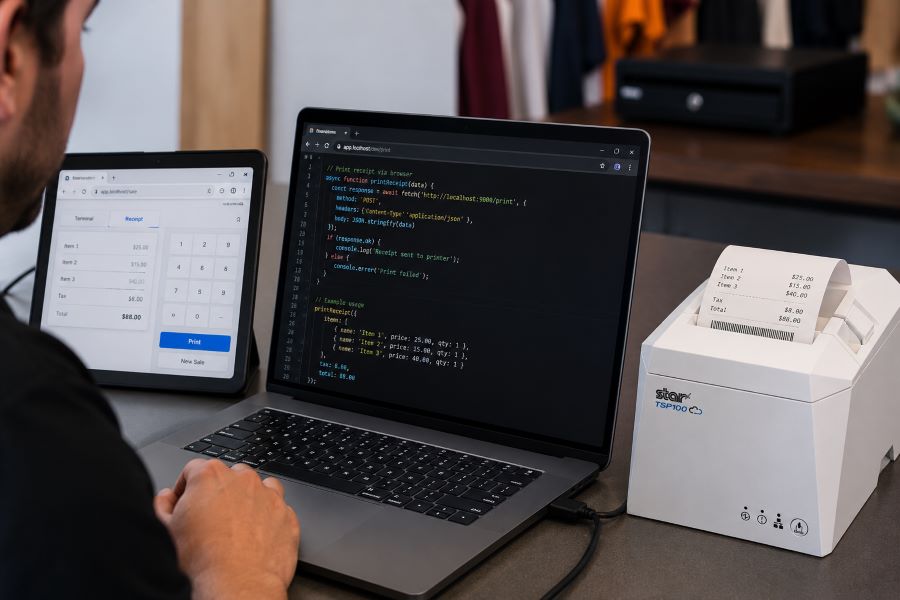
    WebPRNT is Star’s browser-based printing technology designed specifically for browser-based receipt printing over direct USB connections. It allows web applications to send print jobs directly to supported Star printers without requiring a native application layer.

    For developers, this makes WebPRNT useful when:

    • The browser runs locally at the print station
    • The printer is physically connected by USB
    • Printing requirements are focused only on output

    Many ISVs still use WebPRNT successfully in established deployments because it remains stable and predictable for local browser printing. For existing integrations that are already working, WebPRNT remains a practical option.
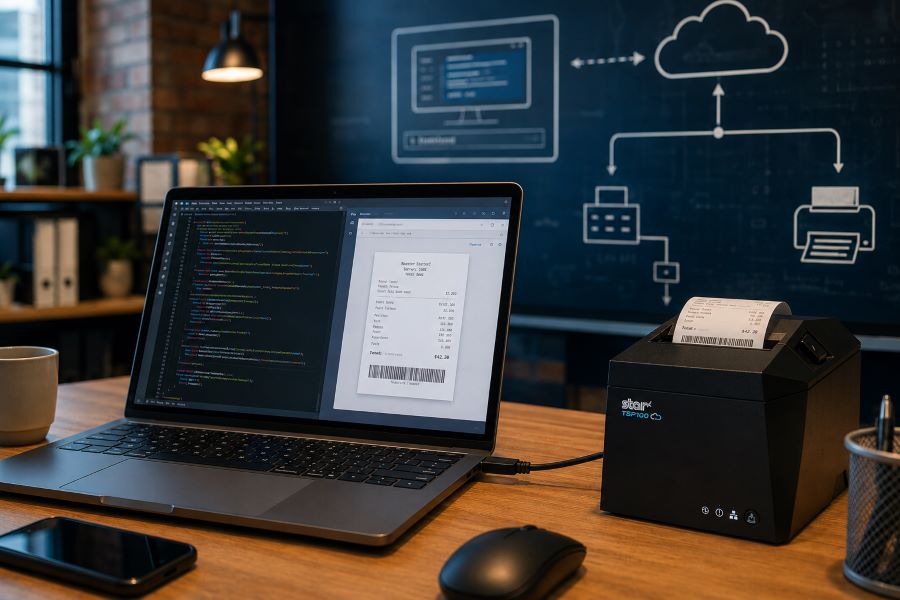
    TSP143IV USB Developer Test

    What Is StarXpand SDK for Web?

    StarXpand SDK for Web is Star’s browser-based SDK for USB-connected printers and supported peripherals. Like WebPRNT, it supports local browser-to-device communication over USB. The difference is in the SDK model.

    Instead of focusing only on print output, StarXpand SDK provides a broader API structure that aligns with Star’s SDK ecosystem across:

    For developers building new browser-based receipt printing workflows, StarXpand SDK for Web provides a broader SDK model that extends beyond print output. This can simplify development when browser applications need to interact with multiple hardware types, not just printers.

    StarXpand SDK for Web supports:

    • Receipt printing
    • Label printing
    • Cash drawer control
    • Barcode scanner integration
    • Peripheral status monitoring

    This makes it useful for browser-based POS environments where printing is only one part of the workflow.

    What Is CloudPRNT?

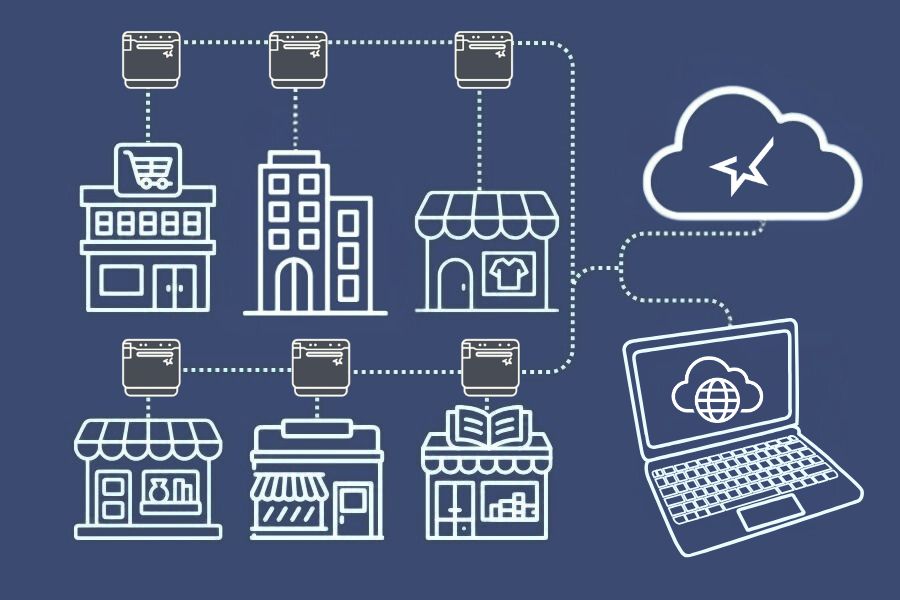
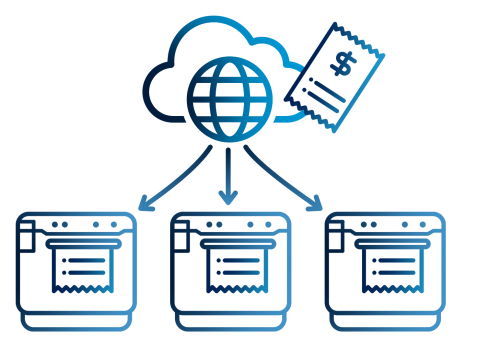
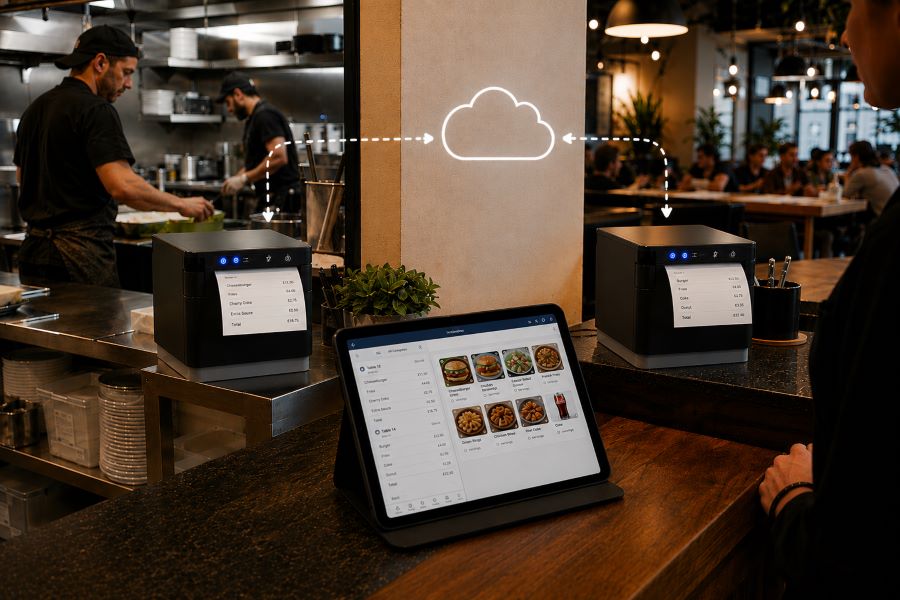
    CloudPRNT is Star’s cloud printing technology for LAN and Wi-Fi connected printers. Unlike WebPRNT and StarXpand SDK for Web, CloudPRNT does not depend on direct USB communication between the browser and printer. Instead, it allows printers to pull print jobs directly from cloud applications over a network.

    Star supports two CloudPRNT communication methods:

    • HTTP polling, where printers regularly check a cloud server for new print jobs
    • MQTT messaging through CloudPRNT Next, a publish-subscribe protocol that enables faster, more efficient real-time print delivery

    For developers, this provides more flexibility depending on the deployment.

    HTTP-based CloudPRNT remains effective for many existing cloud printing environments, while MQTT-based CloudPRNT Next can reduce latency and improve responsiveness for high-volume or multi-location deployments.

    This makes CloudPRNT useful when:

    • Print jobs originate remotely
    • Multiple locations need centralized print routing
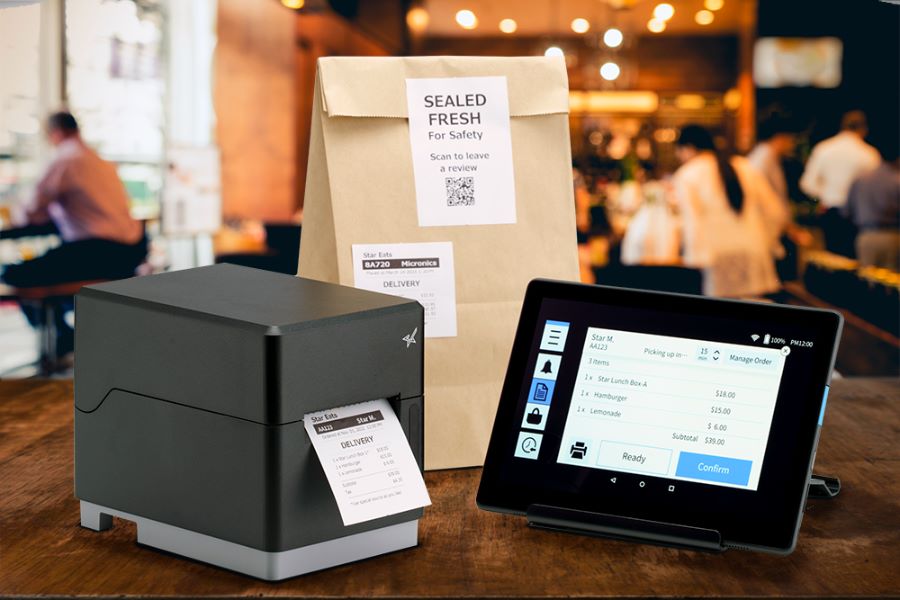
    • Online ordering systems send jobs directly to kitchen printers
    • Low-latency print delivery is important
    • Local devices should not manage printer connections

    For distributed environments, this can reduce local infrastructure requirements and simplify cloud-based receipt printing at scale.
    MC Print3 Cloud POS Restaurant

    Why StarXpand SDK for Web Matters for New Development

    For ISVs building new browser-based POS applications, StarXpand SDK for Web solves a different problem than WebPRNT. It is less about replacing WebPRNT and more about reducing fragmentation between SDKs.

    This matters when development teams need:

    Shared Logic Across Platforms

    If your software runs on browser, tablet, and mobile environments, StarXpand SDK creates more API consistency. This can reduce duplicated hardware logic across teams.

    More Than Print Output

    Many modern POS workflows include:

    • Drawer status checks
    • Scanner-triggered workflows
    • Labeling stations
    • Shared hardware access

    StarXpand SDK can support these through one SDK model.

    Easier Long-Term Maintenance

    Maintaining separate hardware integration layers across web and mobile can increase support costs over time. Using one SDK family can reduce that overhead.

    Migration Considerations for Existing WebPRNT Users

    If you already have a working WebPRNT deployment, there may be no immediate reason to change it.

    WebPRNT remains effective for:

    • Local USB receipt printing
    • Browser-based order ticket printing
    • Fixed workstation POS environments

    Migration becomes more relevant when:

    • Expanding into mobile apps
    • Adding peripheral hardware support
    • Standardizing SDKs across multiple platforms
    • Rebuilding core hardware logic

    For ISVs planning future product updates, this is often the point where StarXpand SDK becomes worth evaluating.

    Key Considerations Before Choosing a Browser Receipt Printing Solution

    Before choosing between WebPRNT, StarXpand SDK for Web, and CloudPRNT, start with the deployment model.

    Where does the print job originate?

    If the print job starts at the local browser and the printer is USB-connected, WebPRNT or StarXpand SDK for Web are often the right fit.

    If the print job originates in the cloud, CloudPRNT is often the better option.

    Is this an existing deployment or new development?

    For existing WebPRNT integrations, staying with the current architecture may be the simplest path.

    For new builds, the StarXpand SDK may offer greater long-term flexibility.

    Do you need to control more than printing?

    If the workflow includes drawers, scanners, or other Star peripherals, StarXpand SDK can simplify communication.

    If printing is the only requirement, WebPRNT may still be sufficient.

    Will this scale across locations?

    If the deployment spans multiple stores, remote kitchens, or distributed print stations, CloudPRNT often provides more flexibility than local USB connections.

    Choosing the right architecture early can reduce future integration changes and simplify deployment support.

    An Independent Software Vendor’s (ISV’s) Guide to Star Printer SDKs

    This guide breaks down Star Micronics’ printer SDKs, APIs, and integration tools to help ISVs choose the right solution for POS systems, cloud printing platforms, and custom software applications.

    Final Thoughts on Browser-Based POS Printing

    Browser-based receipt printing is no longer one-size-fits-all. Some POS environments still rely on direct USB connections at a local workstation. Others now depend on cloud-based routing across multiple locations. That’s why Star offers multiple browser and cloud printing technologies built for different deployment models.

    • WebPRNT remains a proven option for stable local USB printing.
    • StarXpand SDK for Web provides a stronger framework for new browser-based development that needs broader hardware communication.
    • And CloudPRNT remains the best fit for LAN-connected and cloud-managed printing environments.

    For ISVs and developers, the best choice depends less on features and more on architecture: where print jobs originate, how hardware is connected, and how the application will scale over time.

    Interested in browser-based receipt printing with Star?

    Frequently Asked Questions About Browser-Based Receipt Printing

    What is browser-based receipt printing?

    Browser-based receipt printing allows web applications to send print jobs directly to a receipt printer without requiring a traditional desktop application. Depending on the deployment, this can happen through local USB communication or cloud-based network printing.

    When should I use browser-based receipt printing instead of cloud printing?

    Browser-based receipt printing is best when a local device needs to send print jobs directly to a USB-connected printer. Cloud printing is often better for LAN-connected printers, remote print routing, or multi-location deployments.

    What is the difference between WebPRNT and StarXpand SDK for Web?

    WebPRNT focuses on browser-based USB printing. StarXpand SDK for Web also supports USB printing, but adds a broader API structure for printers and peripherals.

    Does StarXpand SDK for Web replace WebPRNT?

    Not directly. Existing WebPRNT integrations can continue to operate. StarXpand SDK for Web is better suited for new browser-based development.

    Can I still use WebPRNT for browser-based receipt printing?

    Yes. WebPRNT remains a supported and effective option for local USB browser printing.

    When should I use CloudPRNT instead of StarXpand SDK for Web?

    Use CloudPRNT when printers need to connect over LAN or Wi-Fi and receive print jobs directly from cloud applications.

    Is StarXpand SDK for Web only for USB printing?

    Yes. For browser deployments, StarXpand SDK for Web is designed for direct USB communication.

    Can StarXpand SDK for Web control devices besides printers?

    Yes. It supports compatible Star peripherals such as cash drawers, POS scales, and barcode scanners.

    What is the best receipt printing method for cloud POS systems?

    For cloud POS systems with remote or multi-location print routing, CloudPRNT is generally the best fit.

  • Build Your Product. Not Your Cloud Printing Infrastructure. A New Case Study by Star Micronics.

    Build Your Product. Not Your Cloud Printing Infrastructure. A New Case Study by Star Micronics.

    If you’re building a software platform that connects to the physical world, whether it’s for hospitality, retail, healthcare, or logistics, you eventually hit the same wall.

    Your app is triggering real-world actions. Orders are placed. Labels need to print. Receipts must be generated. Workflows move from screen to counter to customer.

    But how do those digital events reliably become real-world output without your engineering team building and maintaining the entire printing infrastructure layer?

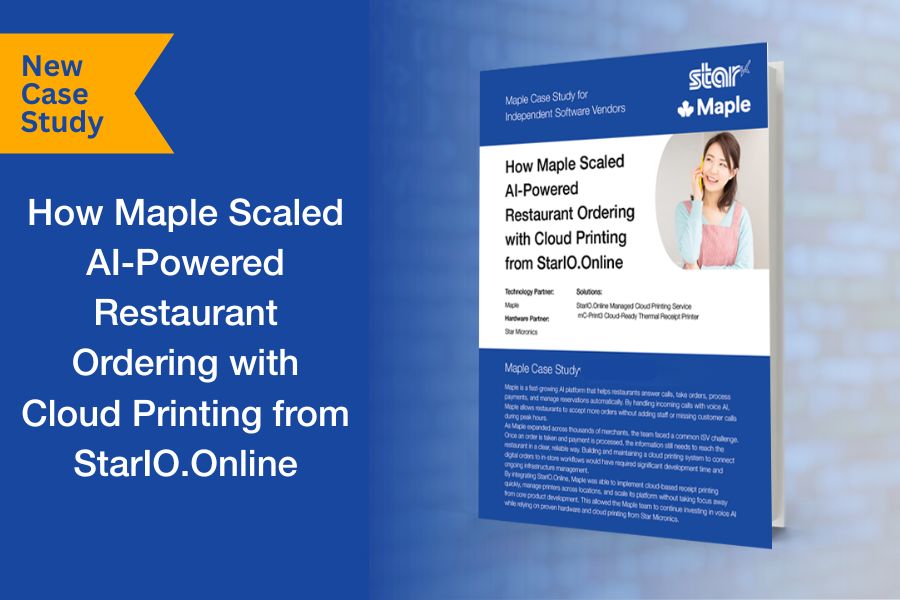
    That was the challenge facing Maple as it scaled across thousands of locations.

    A Critical Infrastructure Decision

    Do you build and maintain your own cloud printing layer?

    Or integrate and stay focused on your product?

    They chose focus.

    By leveraging Star’s managed cloud printing infrastructure, StarIO.Online, Maple was able to scale rapidly without turning printing into an engineering burden.

    For ISVs, the lesson is clear: printing may be essential, but it shouldn’t pull engineering time away from what makes your platform unique.

    Read the full case study to see how Maple implemented secure, scalable cloud printing without building it themselves:

  • Star Micronics Introduces Easy Deployment for Cloud Printing with StarIO.Online

    Star Micronics Introduces Easy Deployment for Cloud Printing with StarIO.Online

    New serial-based onboarding dramatically simplifies CloudPRNT printer setup for ISVs and merchants using the StarIO.Online service.

    Somerset, NJ – February 3, 2026 – Star Micronics, a global leader in point-of-sale (POS) hardware and cloud printing technology, today announced a new Easy Deployment method for cloud printing using StarIO.Online, its fully managed CloudPRNT service. This new deployment approach significantly reduces setup time and complexity by eliminating traditional server configuration and manual printer settings.

    With Easy Deployment, supported Star printers can now be connected to StarIO.Online using a streamlined, serial-number-based onboarding process. Once the printer is on the network, users simply enter the printer serial number into their application, perform a brief printer operation, and the device automatically connects to Star’s cloud infrastructure. A confirmation printout verifies successful enrollment.

    This marks a major improvement over traditional self-hosted CloudPRNT deployments, which typically require logging into a printer web interface or utility application, manually enabling CloudPRNT, entering server URLs, rebooting the device, and then completing application-side configuration.

    “Easy Deployment removes unnecessary friction from cloud printing. By shifting infrastructure management to Star and simplifying onboarding to just a few steps, ISVs can deploy faster, merchants can get up and running with minimal effort, and support teams can spend less time troubleshooting setup issues.”

    Key Benefits of Easy Deployment Include:

    • Dramatically reduced setup steps compared to traditional CloudPRNT deployments
    • No server hosting or URL configuration required
    • Faster, more consistent installations across multiple locations
    • Lower risk of setup errors and misconfiguration
    • Immediate confirmation of successful connection via printer output

    Easy Deployment is designed specifically for use with StarIO.Online, Star’s fully managed cloud printing service, which handles server infrastructure, device communication, and monitoring on behalf of the customer. This approach allows ISVs to focus on core application development while Star manages the complexities of cloud printing at scale. Star offers a 90-day free trial for StarIO.Online.

    The new deployment method further reinforces Star Micronics’ commitment to simplifying POS integration and delivering future-ready solutions for modern, cloud-based retail and hospitality environments.

    For more information about StarIO.Online and Easy Deployment, contact Star’s Integration Team at integrations@starmicronics.com.

    Can’t get enough industry news?

    Star Micronics logo, point-of-sale (POS) hardware and technology company.

    Star Micronics is a global leader in POS hardware and transaction technology, providing printers, secure cash management, and connected peripherals for retail and hospitality environments. Known for reliability and developer-friendly integration, Star solutions work seamlessly with Android™, iOS, Windows®, and web-based POS platforms to power receipt, label, ticket, and order printing across modern commerce environments.

    Star’s cloud technologies extend printing beyond the counter. CloudPRNT Next enables scalable direct cloud printing, while StarIO.Online is Star’s fully managed cloud printing service that removes the need for server infrastructure and simplifies remote printer management across distributed locations. Star also offers a broad portfolio of POS peripherals, including barcode scanners, scales, and tablet stands, designed to work together as a complete hardware solution.

    Learn more at starmicronics.com or follow Star on LinkedIn, YouTube, Facebook, Instagram, and X.

    Media Contact:

    Christin Dorner
    Star Micronics America, Inc.
    cdorner@starmicronics.com
    848-216-3318

  • How ISVs Can Deliver Cloud Printing with Less Risk and Faster Scale

    How ISVs Can Deliver Cloud Printing with Less Risk and Faster Scale

    Cloud printing has moved from a value-add feature to core infrastructure for modern software platforms. As ISVs support multi-location customers, omnichannel ordering, kiosks, and mobile workflows, printing must scale reliably, remain visible, and work consistently across environments.

    Hosted cloud printing shifts the responsibility for print infrastructure, monitoring, and ongoing maintenance from the software vendor to a dedicated provider. This model allows ISVs to deliver cloud-enabled printing without building or managing their own server environments. Developers can put all their focus into making the best product for their customers.

    In the past, offering cloud printing required ISVs to host print servers in-house, absorb infrastructure costs, and carry long-term operational risk. StarIO.Online, a fully managed cloud printing service from Star Micronics, removes that burden by handling hosting, monitoring, and connectivity at the infrastructure level. This allows ISVs to deliver enterprise-ready printing while staying focused on core product development.

    Table of Contents

    Who StarIO.Online Is Designed For

    StarIO.Online is designed for independent software vendors (ISVs) building cloud-based, web-based, or multi-location platforms that require reliable receipt and label printing. It is particularly well-suited for ISVs supporting enterprise retail, hospitality, quick-service restaurants, kiosks, and distributed operations where printing must function consistently across locations and devices.

    Developers Love Fully Managed Cloud Printing Services Like StarIO.Online

    What You’ll Learn in This Blog

    • Why cloud printing has become table stakes for competitive ISVs
    • How device visibility strengthens cloud printing reliability
    • What hosted cloud printing changes for ISVs and their customers
    • How cloud printing and device management together drive measurable ROI

    Why Cloud Printing Has Become Table Stakes for ISVs

    For years, ISVs have worked to meet customer demand for cloud-enabled printing. In 2026, that demand is no longer emerging. It is expected. As organizations adopt cloud POS platforms, mobile devices, self-service kiosks, and remote management models, printing must function seamlessly across locations, devices, and workflows.

    What has changed is the scope of that responsibility. Cloud printing now needs to support:

    • Multi-location and multi-device environments
    • High-volume, always-on workflows
    • Remote visibility and centralized control

    StarIO.Online is a fully managed cloud printing service by Star Micronics.

    Historically, bringing cloud printing to market required ISVs to host and maintain their own managed print services. That meant investing in servers, security, uptime monitoring, and ongoing maintenance. Over time, those responsibilities pulled resources away from core product development and introduced risk as customer footprints expanded.

    Market adoption makes this challenge impossible to ignore. Quocirca research found that 69% of organizations used some form of cloud-based printing in 2024, up from 55% in 2023. According to Grand View Research, the cloud printing market is projected to exceed $3.1 billion by 2030. ISVs that cannot scale cloud printing efficiently risk falling behind competitors who can.

    Partnering with a hosted cloud printing provider offers a practical path forward. It allows ISVs to meet growing demand for cloud-enabled printing while avoiding the infrastructure burden and long-term complexity of legacy approaches.

    The Benefits of Cloud Print Solutions for ISVs and their Users

    Cloud printing enables ISVs to extend the value of their platforms by centralizing how organizations manage and standardize printing. Templates for receipts, labels, and documents can be created once and shared across locations, ensuring brand consistency and operational alignment.

    From an administrative standpoint, cloud printing provides greater control over user permissions, job routing and queuing, policy enforcement, and audit and compliance reporting.

    For end users, cloud printing introduces flexibility. Employees can print from tablets, mobile devices, kiosks, and countertop terminals without being tethered to a specific workstation. New locations or devices can be added quickly, connecting to existing printers via the cloud without complex configuration. The result is improved productivity, faster rollouts, and more resilient operations.

    Why Device Visibility Is the Missing Piece in Cloud Printing

    While cloud printing solves distribution and accessibility, device visibility solves reliability. Without insight into printer status, even cloud-connected environments remain vulnerable to downtime, missed jobs, and service interruptions.

    By pairing cloud printing with device management, ISVs can give customers the ability to monitor printer health and connectivity remotely, identify issues before they cause downtime, and resolve certain problems without dispatching on-site support.

    Proactive monitoring improves uptime, protects service-level agreements, and reduces support costs. For ISVs, it also minimizes reactive troubleshooting that pulls engineering resources away from product innovation. For customers, it means more consistent performance and higher satisfaction across locations.

    Software Developers Use StarIO.Online Cloud Printing Service By Star Micronics

    What Hosted Cloud Printing Really Changes for ISVs

    Unlike self-hosted cloud printing, hosted cloud printing removes the need for ISVs to manage servers, security updates, and uptime monitoring internally. Infrastructure responsibilities shift to a dedicated provider, reducing operational risk and long-term maintenance costs.

    Recognizing the growing complexity of cloud printing, Star Micronics developed StarIO.Online, a hosted cloud printing service designed specifically for ISVs building modern, scalable platforms.

    With StarIO.Online, ISVs no longer need to deploy or maintain their own print servers. Star manages the infrastructure layer so software teams can stay focused on product innovation rather than printing back ends.

    StarIO.Online helps ISVs:

    • Eliminate the need to host and maintain print servers
    • Reduce infrastructure, security, and uptime management overhead
    • Support CloudPRNT-compatible printers across distributed environments
    • Scale printing reliably as customer footprints grow

    Integration is streamlined through REST APIs, allowing developers to send print jobs and receive printer status updates with minimal code. Webhooks enable real-time printer event notifications, supporting automated workflows and faster issue resolution.

    In addition, StarIO.Online provides:

    • A unified dashboard to manage, monitor, and configure printers across all customer locations
    • Centralized visibility into printer status and connectivity
    • The ability to extend offerings using Star Micronics Cloud Services, such as Label Builder or PromoPRNT

    These capabilities allow ISVs to tailor managed services to specific markets and create bundled, recurring-revenue offerings without increasing operational complexity.

    Built on scalable architecture, StarIO.Online grows alongside ISVs and their customers, whether onboarding new clients or supporting expanding enterprise deployments.

    How Cloud Printing and Device Management Drive Measurable ROI

    When cloud-enabled printing and device visibility come together, the impact extends beyond operational efficiency. ISVs gain a scalable foundation that lowers the cost of delivering managed printing while improving margins and accelerating time to market.

    Customers benefit from reliable, consistent printing experiences across devices and locations. ISVs benefit from reduced infrastructure costs, fewer support escalations, and stronger platform stickiness. Over time, these advantages contribute to increased customer retention, higher lifetime value, and a clearer path to sustainable growth.

    POS Printing Technologies Built for Modern Software Platforms

    This brochure shows how Star helps ISVs extend their platforms with dependable printing and device control while minimizing integration effort and long-term maintenance.

    Frequently Asked Questions About Hosted Cloud Printing

    What is hosted cloud printing?

    Hosted cloud printing is a printing model where servers, infrastructure, monitoring, and maintenance are managed by a third-party provider, allowing software vendors to offer cloud-enabled printing without hosting their own print servers.

    How is hosted cloud printing different from self-hosted cloud printing?

    Self-hosted cloud printing requires ISVs to build, secure, and maintain their own server environments. Hosted cloud printing shifts those responsibilities to a dedicated provider, reducing operational risk and infrastructure overhead.

    Who benefits most from StarIO.Online?

    StarIO.Online is ideal for ISVs supporting multi-location retail, hospitality, quick-service restaurants, kiosks, and enterprise environments that require reliable, scalable printing across distributed operations.

    How does managed cloud printing support AI-driven restaurant operations?

    AI-driven ordering, forecasting, and labor tools rely on fast, consistent execution at the edge. Managed cloud printing ensures that receipts, labels, and order tickets print reliably as AI systems dynamically route orders, adjust prep timing, or optimize fulfillment across channels. By centralizing print logic in the cloud and pairing it with device visibility, operators can trust that automated decisions are carried out accurately at every location without adding operational risk.

    Is hosted cloud printing secure enough for enterprise and multi-location environments?

    Yes. Hosted cloud printing platforms are designed with enterprise security and scalability in mind. Print jobs are transmitted using secure protocols, and device access can be centrally controlled by role, location, or application. For ISVs and MSPs, this model reduces exposure by eliminating on-premise servers while still providing auditability, monitoring, and compliance support across distributed restaurant and retail environments.

    Learn More About StarIO.Online

    To learn how StarIO.Online can help you deliver reliable, scalable cloud printing without the infrastructure burden:

  • Which Are the Best Star Micronics Printers for Online Ordering Apps?

    Which Are the Best Star Micronics Printers for Online Ordering Apps?

    Online ordering has become a vital part of restaurant and retail operations, but every platform connects differently. Learn which Star Micronics printers work best for online ordering apps and how CloudPRNT Next, Bluetooth, and USB connectivity simplify integration for ISVs and developers.

    Table of Contents

    Online Ordering Is Here to Stay

    Online ordering has become essential for restaurants and retailers that want to meet customers where they are. From platforms like DoorDash and Uber Eats to custom-built ordering systems, businesses depend on reliable printers for online ordering apps to keep operations running smoothly.

    The question many developers and operators ask is simple: Which are the best Star Micronics printers for online ordering apps?

    The answer is that most Star Micronics printers are already compatible. Whether your app prints directly from the cloud or through a tablet on-site, Star offers flexible solutions for both workflows. With built-in support for CloudPRNT, CloudPRNT Next, Bluetooth, and USB, Star printers make online order printing fast, reliable, and easy to integrate into any environment.

    All Star Micronics Printers Can Handle Online Ordering

    Every Star printer supports online order printing. The difference lies in how each printer communicates with your online ordering app or POS platform.

    In today’s market, there are two main ways that orders are sent to a printer:

    1. Cloud-based printing, where the printer connects directly to a remote server.
    2. Local printing, where a tablet or POS terminal serves as the connection point.

    Star printers are built to handle both. This flexibility allows ISVs and software developers to create integrations that work seamlessly across multiple online ordering platforms without extra middleware, custom builds, or device-specific configurations.

    The mC-Label2 multifunction label printer by Star Micronics.
    The mC-Label2 multifunction printer can integrate with any online ordering app.

    How Online Ordering Apps Communicate with Printers

    Online ordering systems typically operate in one of two ways: web-based (cloud) or local (tablet or device-based). Both approaches are common across the industry, and Star Micronics supports them all.

    1. Cloud-Based Printing with CloudPRNT and CloudPRNT Next

    CloudPRNT is Star’s cloud printing technology that enables printers to communicate directly with a web server to retrieve and print orders.

    Instead of relying on a tablet or POS terminal, a CloudPRNT printer connects to the internet and automatically checks the server for new jobs. When an order is received, it prints automatically—no local drivers, middleware, or PCs required.

    How it works:

    • The printer connects to the internet through Ethernet or Wi-Fi.
    • Orders are sent from the online ordering platform’s cloud server to the printer.
    • The printer retrieves the job, formats it, and prints automatically.

    Why ISVs love it:

    • Straightforward integration: Use Star’s CloudPRNT API to connect web or cloud-based systems directly to the printer.
    • Cross-platform flexibility: Works independently of the operating system or device.
    • Reduced support overhead: No middleware or local drivers to manage, meaning fewer service calls.
    • Scalable architecture: Centralized monitoring and remote updates make multi-location deployment easier.

    CloudPRNT Next, Star’s latest enhancement, takes cloud-based printing even further. It uses MQTT-based communication for faster, more reliable performance and provides real-time message delivery, instant status updates, and improved uptime.

    For example, a restaurant brand with hundreds of locations might use CloudPRNT Next to ensure orders print the moment they’re placed online. Instead of each printer periodically checking the server for new jobs, CloudPRNT Next keeps a live connection open. When a new order comes in, the printer is instantly notified, prints immediately, and sends a confirmation back to the server. This live communication gives IT teams real-time visibility and ensures that no orders are delayed or missed.

    Printers that support CloudPRNT or CloudPRNT Next

    All models include Ethernet and Wi-Fi connectivity, allowing them to communicate directly with cloud-based ordering platforms or web servers.

    2. Local Tablet Printing via Bluetooth or USB

    Many third-party ordering platforms, including Uber Eats, DoorDash, and others, use a tablet-based printing workflow.

    In this setup, the tablet acts as a local bridge between the ordering platform’s cloud server and the printer. The app receives incoming orders from the cloud, then sends them directly to a connected printer using Bluetooth or USB.

    How it works:

    • Orders are placed through the online ordering platform.
    • The restaurant’s tablet (logged into the app) downloads each order.
    • The tablet sends print jobs to a paired Star printer over Bluetooth or USB.

    Why it works well:

    • Developer control: Ideal for apps that handle print formatting, order logic, and device management internally.
    • Resilient operation: Printing continues through the tablet even if network connectivity is interrupted.
    • Straightforward integration: Star’s StarXpand SDK and StarPRNT SDK provide clear APIs and sample code for Android, iOS, and Windows environments.
    • Flexible deployment: Compatible with many tablets and operating systems, making it easier to support multiple delivery and aggregator platforms with one integration.

    For ISVs, Star’s StarXpand SDK and StarPRNT SDK make integration simple across Android, iOS, and Windows environments. The same printer models that support cloud-based workflows can also print locally through Bluetooth or USB, giving developers universal compatibility with virtually any online ordering platform.

    Looking for a Fully Managed Cloud Printing Option?

    For ISVs who want the power of CloudPRNT without hosting or maintaining their own print servers, Star offers StarIO.Online, a fully managed cloud printing service.

    StarIO.Online runs on Star-hosted servers and enables developers to integrate printing into web or cloud-based applications through a simple REST-style API. It provides:

    • Zero infrastructure management: Star handles uptime, security, and maintenance.
    • Real-time visibility: Monitor printers, job status, and device health from a single dashboard.
    • Fast integration: Send print jobs to any CloudPRNT-compatible Star printer with minimal code.

    StarIO.Online makes it even easier for developers to build, deploy, and scale cloud printing without adding IT complexity and overhead.

    Printers That Support Every Online Ordering Connection

    For developers, one of the biggest challenges in online ordering integration is dealing with different connectivity requirements across platforms. Some apps depend on tablets and Bluetooth, while others print directly from the cloud through APIs. Managing multiple printer models for each connection type can create unnecessary complexity in development, testing, and long-term support.

    Star Micronics solves that problem.

    Star’s newest printer lineup is designed for modern connectivity, giving ISVs a single hardware family that supports all four connection types: Ethernet, Wi-Fi, USB-C, and Bluetooth. These hybrid models can handle both CloudPRNT-based and local (tablet) printing workflows, allowing developers to build one integration that works everywhere.

    Printer Model CloudPRNT / CloudPRNT Next Bluetooth / USB Label & Receipt Support Best For
    mC-Label3 All media Multi-station restaurant environments
    mC-Label2 All media Compact counter setups, barcodes
    TSP143IV X4 Receipts General POS & restaurant integration
    TSP143IV SK X4 Sticky linerless labels, receipts Takeout & delivery bag labeling

    These printers combine every major connectivity option in one compact device, giving ISVs maximum flexibility in integration and deployment. Whether the printer communicates directly with the cloud or connects locally through a tablet, the experience is seamless. Developers can support both workflows through Star’s unified SDKs and APIs—no additional middleware or platform-specific configurations required.

    Why Star Micronics Printers Are Ideal for Online Ordering Integration

    • Broad compatibility: Can work with nearly every online ordering app and POS system.
    • Comprehensive connectivity: Bluetooth, USB, Ethernet, and Wi-Fi in a single device.
    • Future-ready technology: CloudPRNT Next delivers faster, more reliable cloud communication.
    • Developer-first design: Unified SDKs, APIs, and detailed documentation streamline integration.
    • Proven reliability: Backed by over 60 years of innovation in POS and hospitality printing.

    How VARs and ISVs Can Maximize ROI with Advanced Kiosk Printing Technology

    This ebook reveals how ISVs and VARs can harness the transformative potential of kiosk printing technology to maximize ROI for both their clients and their own businesses.

    Build Once, Integrate Everywhere

    For ISVs, the key to scaling online ordering integrations is flexibility.

    Star Micronics printers allow developers to build a single integration that supports every type of connection, whether printing through a cloud API, a web dashboard, or a local tablet app.

    With one printer family, you can support CloudPRNT, CloudPRNT Next, Bluetooth, and USB workflows, all backed by Star’s SDKs, APIs, and developer resources.

    Learn more about Star printers for online ordering apps:

  • The Power of a Fully Managed Cloud Printing Service

    The Power of a Fully Managed Cloud Printing Service

    Modern software applications are increasingly expected to support printing, whether it’s order tickets for a restaurant, labels for a retailer, or receipts for a kiosk environment. Yet for developers, enabling reliable printing across multiple locations is rarely simple.

    Traditional systems rely on local servers, complex firewalls, and manual setup, creating delays for developers and friction for end users.

    A fully managed cloud printing service changes that. It provides a way for independent software vendors (ISVs) and developers to build printing directly into their applications without managing the infrastructure behind it.

    That’s exactly what StarIO.Online was built for.

    Table of Contents

    What Is a Cloud Printing Service?

    A cloud printing service allows applications to send print jobs securely to networked printers over the internet without relying on local servers or middleware.

    For software developers and ISVs, this means print functionality can be built directly into web or mobile applications through APIs rather than through local drivers or complex network configurations.

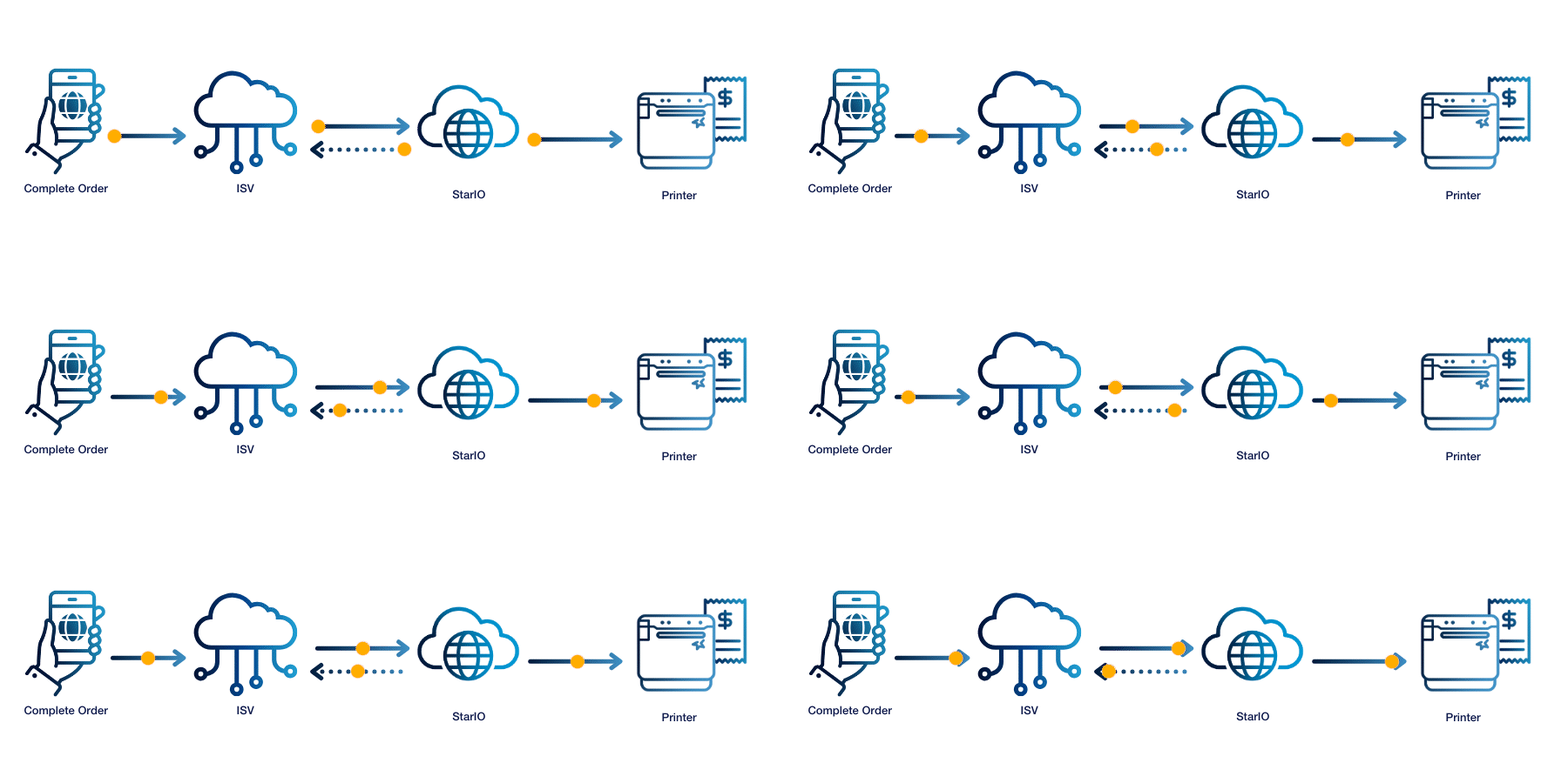
    In a typical cloud printing setup, the application communicates with a secure, centralized platform that manages print requests, job delivery, and device status across multiple locations. This architecture eliminates the need for local hosting, simplifies deployment, and enables global scalability while reducing the time and resources needed to manage print infrastructure.

    In short, cloud printing makes it easier for developers to integrate, monitor, and scale printing across distributed environments without worrying about on-site systems.

    Why “Fully Managed” Matters for Developers

    Not all cloud printing solutions are created equal. Many require developers to host their own infrastructure or manage external dependencies. A fully managed cloud printing service removes that responsibility entirely.

    In a managed model, the service provider handles the hosting, uptime, and security for the entire print environment. Developers can focus on building applications instead of maintaining servers, configuring networks, or handling firmware and API updates.

    This approach results in:

    • Simplified integration – Build faster with minimal backend setup.
    • Consistent reliability – Reduce downtime and failed print jobs.
    • Lower maintenance overhead – No need for server patches or manual monitoring.

    Meet StarIO.Online

    StarIO.Online is Star Micronics’ fully managed cloud printing service built specifically for ISVs and software developers. It gives developers a ready-to-use infrastructure to connect web and cloud-based applications to Star printers securely and reliably without the cost or complexity of maintaining print servers.

    With StarIO.Online, there are no servers, no firewalls, and no local installations. Developers can print to any CloudPRNT or CloudPRNT Next-compatible device through a simple REST-style API call. The platform handles job delivery, device status, and job queuing automatically, so print data is never lost, even if a printer is temporarily offline.

    Developers and IT teams can monitor every device through a centralized cloud dashboard that offers real-time visibility into printer health, job history, and error states. Webhook notifications make it easy to stay informed about device events and print results without custom polling or complex monitoring scripts.

    StarIO.Online takes the infrastructure burden off your team so you can focus on building features, not maintaining printers.

    The Benefits of Star’s Fully Managed Cloud Printing Service

    StarIO.Online was designed to simplify cloud printing for developers building connected platforms at scale.

    Key advantages include:

    • No server infrastructure – Star hosts and maintains the environment on secure cloud servers.
    • REST-style API integration – Developers can send print jobs or retrieve device data with minimal code.
    • Webhook notifications – Receive instant updates on print status, device events, and barcode scans.
    • Unified dashboard – Manage, monitor, and configure printers across all locations from one interface.
    • Scalable architecture – Deploy cloud printing for one store or thousands without changing your backend.
    • Secure communication – All print data is transmitted through Star-hosted, securely managed cloud servers.
    • Consistent performance – Reliable print delivery with automatic job retry and status confirmation.
    • No software installs – 100 % cloud-based operation, accessible anywhere.

    StarIO.Online is a fully managed cloud printing service by Star Micronics.

    When Developers Choose Cloud Printing

    A cloud printing service streamlines deployment and maintenance for any developer building connected applications:

    • Restaurant and QSR platforms – Send online orders directly to kitchen or counter printers through the cloud.
    • Retail and labeling software – Print receipts, tags, and labels remotely without local drivers.
    • Kiosk and ticketing solutions – Configure and monitor unattended devices from a central location.
    • Enterprise or multi-location platforms – Standardize printing workflows across hundreds or thousands of sites.

    For ISVs creating scalable ecosystems, cloud printing ensures dependable performance and reduces the time spent on network management, support calls, and manual configuration.

    StarIO.Online vs. Developer-Hosted Printing

    Feature Developer-Hosted Printing StarIO.Online
    Server Hosting Developer maintains servers Fully hosted by Star
    Integration Custom code and setup required REST-style API integration
    Monitoring Manual or limited Real-time dashboard and webhooks
    Maintenance Developer-managed Star-managed
    Scalability Tied to server capacity Enterprise-grade scalability
    Uptime and Support Varies by host Backed by Star Micronics

    StarIO.Online removes the complexity of maintaining custom print infrastructure, giving developers a faster, more reliable path from code to printed output.

    The Future of Cloud Printing for Developers

    As software continues to move to the cloud, developers need infrastructure that matches that flexibility. Printing should be just as simple, with no local servers, complex networks, or maintenance overhead.

    A fully managed cloud printing service offers a cleaner, more scalable way to add printing to any application. It lets developers focus on innovation while ensuring every print job, whether a receipt, ticket, or label, reaches its destination accurately and on time.

    With StarIO.Online, developers can integrate once, deploy anywhere, and rely on a print environment that grows with their software.

    Ready to find out more about Star’s fully managed cloud printing services?

  • Star Micronics Introduces StarIO.Online, a Fully Managed Cloud Printing Service for ISVs

    Star Micronics Introduces StarIO.Online, a Fully Managed Cloud Printing Service for ISVs

    ISVs can provide their users with cloud printing services without the need to host or maintain infrastructure.

    Somerset, NJ – October 8, 2025 – Star Micronics, a leading provider of point-of-sale (POS) and cloud technology solutions, today announced the release of StarIO.Online, a fully managed cloud printing service designed for independent software vendors (ISVs) and technology providers.

    StarIO.Online offers the same seamless integration process as CloudPRNT with minimal code and simple API calls, but eliminates the need for ISVs to host or manage their own printing server. Star oversees the servers, monitoring, and uptime, allowing ISVs to focus on application development and customer delivery.

    “StarIO.Online gives ISVs an easier path to added value. You can provide cloud printing services across 10 or 1,000+ customers with zero infrastructure burden. It’s your code and our cloud, together producing powerful results.”

    Key advantages of cloud printing with StarIO.Online include:

    • No hosting requirements. Star manages all infrastructure and uptime.
    • Rapid scaling. Support from single-site customers to large enterprise deployments.
    • Streamlined integration. One REST-style API call connects applications directly to Star’s managed cloud.
    • Broad compatibility. Works with any CloudPRNT and CloudPRNT Next compatible printer, including receipt, label, and kitchen models.

    “Many ISVs are seeking ways to reduce the time and resources devoted to server maintenance. StarIO.Online simplifies this process by offering a managed solution that helps software providers grow without adding IT overhead.”

    StarIO.Online is available immediately with a 90-day free trial, followed by subscription-based pricing. Developers can sign up at https://starmicronics.com/stario.

    For additional information, contact sales@starmicronics.com.

    Want more industry news?

    Star Micronics logo, point-of-sale (POS) hardware and technology company.

    Star Micronics, a world leader in point-of-sale (POS), has designated a portfolio of printing, secure cash management, self-service, and customer engagement solutions for any retail or hospitality establishment. Embracing the mPOS wave, Star’s SDKs allow developers to utilize Star printers in tandem with Android™, iOS, iPad®, and iPhone® devices to generate receipts, labels, Chit, and tickets. Star Micronics is always leading and always innovating, creating cloud printing solutions, including CloudPRNT Next and Star Cloud Services, with AOA support and MFi connectivity. Star also has a wealth of peripherals, including 2D barcode scanners, scales, tablet display stands, and more. Visit starmicronics.com or follow us on Facebook, X, YouTube, or LinkedIn to learn more.

    Media Contact:

    Christin Dorner
    Star Micronics America, Inc.
    cdorner@starmicronics.com
    848-216-3318

  • Jewelry Labeling: How to Print Quality, Small Barcode Labels

    Jewelry Labeling: How to Print Quality, Small Barcode Labels

    Jewelry labeling is no ordinary labeling task. In most retail environments, labels support inventory management, pricing, compliance, and brand presentation. But in a jewelry store, the stakes are higher, the space is smaller, and the details matter more than ever.

    Imagine fitting a scannable barcode, pricing, SKU, and brand logo onto a tag smaller than an inch, all while ensuring it stays securely attached to a diamond ring, gold chain, or luxury watch without damaging the item. Jewelry labeling has to communicate complex supply chain details, sync with inventory and e-commerce systems, and maintain absolute accuracy, even for one-of-a-kind pieces.

    Getting it right requires the perfect combination of high-resolution printing and premium media designed for the demands of fine jewelry retail.

    How to Print the Perfect Small Barcode Labels for Jewelry

    Jewelry labeling quality begins with the printer you choose. Your printer should be capable of printing small barcode labels as small as 25 mm, and work well in your operational environment. Features that will help you print quality micro-labels include:

    🔹High Resolution

    Look for a printer with at least 300 dpi resolution to ensure clear, scannable barcode output. This level of detail is essential for printing small, crisp text and preserving image clarity, especially if you want to include your logo or branded design elements on the label.

    Jewelry Labeling: How to Print Quality, Small Barcode Labels article by Star Micronics.

    🔹Practical Design

    Consider where your team will use the printer and choose a design that fits the space. A front-loading, front-exit layout works well for tight areas like under-shelf installations or jewelry prep counters. Flexible connectivity, like USB, LAN, WLAN, or MFi-certified Bluetooth, lets you label items on the spot, whether you’re in the stockroom or behind the display case.

    🔹Cloud Support

    A managed cloud service gives you centralized control over labeling across your locations. Your team can access approved, pre-designed templates (even offline) and print consistent, accurate jewelry labels that sync with your inventory and e-commerce systems.

    🔹Multimedia Printing

    Consider printers that support multiple types of media, such as small ID tags, barcode labels, die-cut labels, linerless labels, continuous labels, and even receipts. A single model that meets all your printing needs helps reduce costs and maintenance while improving flexibility.

    mC-Label2 Multifunction Printer

    The mC-Label2 packs powerful features into a compact, front-loading design, including 300 dpi resolution, support for linerless, die-cut, receipt, and continuous media, and connectivity options like USB-C, LAN, WLAN, Bluetooth, and Apple MFi-certified pairing (X4 models only).

    Explore the mC-Label2 >

    Select the Right Jewelry Labeling Media

    It’s not just the printer that matters—media quality is equally important. Choosing the right label material and adhesive ensures you produce reliable tags that stand up to the demands of jewelry retail. Your labeling media must be:

    1. Durable

    Labels should be tear- and smudge-resistant, even when sales associates repeatedly remove and reapply items from display cases or when customers try them on.

    2. Non-Marking

    Jewelry labels must stay in place without damaging delicate metals or finishes. After purchase, customers should be able to remove the label cleanly, with no adhesive residue left behind.

    3. High-Quality and Jewelry-Friendly

    When labeling intricate, high-value pieces, your media must print reliably, look professional, and perform consistently. Star Blue label rolls are engineered for smooth, jam-free performance, clear imaging, and reduced paper dust, which helps protect both your printer and your merchandise.

    Recognized by their distinctive blue core, Star Blue rolls are built for retail environments that demand precision and presentation.

    Overcome Jewelry Labeling Challenges for a More Efficient Operation

    In today’s competitive retail landscape, jewelry labeling is more than a necessity. Retailers who still rely on handwritten tags or manual inventory updates struggle to meet modern expectations for unified commerce, accurate pricing, and seamless cross-channel sales.

    By printing small barcode labels tailored for jewelry, you can capture and share essential product data, track inventory with precision, and present your merchandise with the level of professionalism customers expect from a luxury purchase.

    The right combination of a high-resolution printer and premium label media ensures your jewelry labels are clear, consistent, and worthy of the items they represent, whether they’re displayed in a case, sold online, or shipped across the globe.

    Beyond the Label: Elevating Brand Connection and Loyalty

    This free ebook offers insights into innovative labeling techniques that help retailers and restaurateurs captivate and connect with their audience more effectively.

    Additional Resources

    Star Micronics offers solutions that are ideal for jewelry labeling: 

    mC-Label2 Multifunction Printer >

    This compact, 2-inch multimedia printer prints at 300 dpi to produce sharp logos, small text, and high-resolution barcode labels. With a front-loading, front-exit design and flexible media support (linerless, die-cut, traditional labels, and receipts), the mC-Label2 is ideal for jewelry counters and compact workstations.

    Star Blue Label Rolls >

    Our premium Star Blue media is built for consistent cuts, reduced dust, and smooth performance—essential for printing small, professional-quality jewelry labels that reflect the value of your merchandise.

    Star CloudPRNT Next >

    Enable reliable remote cloud printing with MQTT technology. Perfect for multi-location jewelry retailers that need fast, secure communications between cloud systems and labeling hardware.

    StarIO.Online >

    A fully managed, cloud printing service and printer management platform that eliminates the need for local infrastructure. Print and manage labels from anywhere using web-based applications.

    Star Micronics Cloud Services >

    A portfolio of connected technologies designed for modern retailers, including Star Label Builder and PromoPRNT for custom messaging on receipts and labels.

    Ready to find out more about Star’s jewelry labeling solutions?

  • Star Micronics Introduces the mC-Label2: High-Res Printing in a Compact Format

    Star Micronics Introduces the mC-Label2: High-Res Printing in a Compact Format

    A space-saving, cloud-connected printer that supports linerless, die-cut, and receipt media, perfect for retail, cannabis, pharmacy, jewelers, and more.

    Somerset, NJ – July 23, 2025 – Star Micronics, a global leader in point-of-sale (POS) and labeling solutions, is pleased to announce the launch of the mC-Label2, a 2-inch multifunction printer built for sharp, small-format labeling in space-constrained environments. Designed for retailers, QSRs, dispensaries, and more, the mC-Label2 combines high-resolution 300 dpi printing, front-loading design, and multi-media compatibility into one sleek device.

    With a compact footprint and front-exit paper path, the mC-Label2 can be installed under shelves or flush against walls, making it ideal for locations where space is at a premium. Businesses can choose between two models: an all-media version that supports linerless, die-cut, continuous labels and receipts, or an LBL model dedicated to die-cut label and receipt printing.

    Key Features of the mC-Label2 include:

    • 300 dpi Resolution: Crisp, detailed text, barcodes, and logos, even on small labels.
    • Front-Loading, Front-Exit Design: Ideal for tight spaces, such as counters and shelves. Devices can even be mounted on top of the printer for added versatility.
    • Two Model Options:
      All Media Model – Supports linerless, die-cut, continuous labels, and receipts
      LBL Model – Optimized for die-cut labels and receipts only
    • Flexible Connectivity Options: The X4 models feature USB, LAN, WLAN, and MFi-certified Bluetooth for full wireless and wired connectivity, while the Ci models offer a streamlined, wired-only configuration with USB-C, LAN, and USB-A ports.
    • Cloud & App Support: Compatible with CloudPRNT Next, StarIO.Online, and Star’s Label Builder app for template-based label creation and One Touch Label printing.

    Like the mC-Label3, the mC-Label2 is part of Star’s growing lineup of multimedia printers designed to simplify operations across retail and hospitality. It’s built on the same developer-friendly platform, with native SDKs for iOS, macOS, Android, Linux, and Windows, and supports Star’s incredibly easy BLE-assisted wireless setup.

    “The mC-Label2 brings the power of our labeling technology into an even smaller footprint. With 300 dpi resolution, support for multiple media types, and all communication interfaces, this printer meets the super precision needs of our customers without taking up valuable counter space.”

    To learn more about the mC-Label2, visit https://starmicronics.com.

    Love industry news? Explore our podcast:

    Star Micronics logo, point-of-sale (POS) hardware and technology company.

    Star Micronics, a world leader in point-of-sale (POS), has designated a portfolio of printing, secure cash management, self-service, and customer engagement solutions for any retail or hospitality establishment. Embracing the mPOS wave, Star’s SDKs allow developers to utilize Star printers in tandem with Android™, iOS, iPad®, and iPhone® devices to generate receipts, labels, Chit, and tickets. Star Micronics is always leading and always innovating, creating cloud-based printing solutions, including CloudPRNT Next and Star Cloud Services, with AOA support and MFi connectivity. Star also has a wealth of peripherals, including 2D barcode scanners, scales, tablet display stands, and more. Visit starmicronics.com or follow us on Facebook, X, YouTube, or LinkedIn to learn more.

    Media Contact:

    Christin Dorner
    Star Micronics America, Inc.
    cdorner@starmicronics.com
    848-216-3318

  • Always Innovating: 5 Tech Trends Gaining Momentum in 2025

    Always Innovating: 5 Tech Trends Gaining Momentum in 2025

    One of Star Micronics’ most impactful objectives is to provide customers with products and services that meet their needs today and anticipate the tech trends of tomorrow. We listen to stakeholders, explore options, and develop with the overarching goal of making businesses more efficient. This is Star’s spirit of “always leading, always innovating.”

    Based on feedback from our customers and partners, and maintaining our position at the forefront of the industry, we’ve identified several tech trends gaining momentum as we head into the second half of 2025. I’m sharing this information to help our partners prepare to meet growing demand and to assist our customers in staying on track toward reaching their business goals.

    Take these five tech trends into account to finish 2025 strong and set the stage for a successful 2026:

    1. Migration to Cloud Printing in Retail & Hospitality Systems

    This year’s tech trends align with the rapid shift toward cloud-first, host device-agnostic ecosystems. Point of sale (POS) software and backend platforms are increasingly cloud-based, driving demand for cloud-managed printing and peripheral solutions.

    To support our customers, we are launching a new, fully managed cloud printing solution. StarIO.Online eliminates the need for local infrastructure. Businesses can host their print jobs on secure Star servers, monitor their devices remotely, and manage updates from a single dashboard. Managing printing in the cloud complements businesses’ increasingly cloud-based computing environments with streamlined workflows and increased efficiency.

    2. Rising Demand for Multi-Function Printers & Modular Hardware

    Tech trends reflect businesses’ desire to simplify device fleets and reduce complexity by upgrading to single devices that can support multiple use cases. Printers are now available that do it all, from printing receipts and chits to sticky and die-cut labels. A single device allows businesses to optimize space, control costs, and increase flexibility, which has particular benefits in QSR, fast casual, and retail environments. We’ve designed our mC-Label series printers to meet this demand and give businesses the flexibility to easily build multifunction printers into their workflows.

    In addition, today, even small printers come with all interfaces in one device. The printer can now be tethered to a USB or Ethernet connection, be connected wirelessly through Bluetooth or Wi-Fi, or be connected to a local or cloud based network, all with the same printer. What’s better than making the right choice? Not having to choose at all.

    3. Growing Focus on Sustainable Printing & Compliant Media

    Sustainability is no longer optional — customers expect it. There’s rising demand for linerless labeling to reduce waste and Prop 65-compliant paper in response to evolving state and regional regulations. Prop 65 in California mandates warnings if products contain harmful chemicals, such as BPA/BPS, which are found in traditional printer paper. Although it’s now the law in California, other legislatures are likely to follow suit. Along with transitioning to sustainable printing to help protect the environment, compliance is driving a shift in how businesses select print media,  partners, and hardware.

    4. Shift Toward Loyalty-Focused, Value-Added Channel Partnerships

    Solution providers want more than discounts. They want programs that support joint marketing, loyalty incentives, and true collaboration. The partner ecosystem is evolving beyond pure pricing to strategic partnerships that help both sides grow.

    To support our channel partners, Star is reimagining its Empower Program to accommodate the business models of our reseller and ISV partners. We’re introducing a loyalty program that rewards our partners with marketing funds to help them grow their businesses. Our updated program will support trade show attendance, help create customized campaigns, and deliver content that meets our partners’ go-to-market strategies.

    5. Transition to More Agile, Scalable Distribution

    While businesses plan to update printing technology to enhance operations, channel dynamics are more critical than ever. With last-minute deployments, multi-location rollouts, and complex integration timelines, distributors and vendors that can deliver speed, flexibility, and stock availability have a significant competitive edge. Star is uniquely positioned to offer our products through the largest, most innovative, and efficient distribution channel.

    Get the complete POS solutions from Star Micronics.

    Don’t Pass By This Opportunity

    For many business leaders, summer is the time for a break from the day-to-day. But it’s also a great time to take stock and course correct, if necessary, to keep your business moving in the right direction. Businesses have the opportunity to increase efficiency with cloud printing, operate more cost-effectively with multi-function printers, and operate more sustainably with eco-friendly paper and linerless labels. Star channel partners (and potential partners) can meet that demand by providing products from Star’s portfolio and collaborating more closely with us to market their businesses.

    Join us in always leading, always innovating in 2025 and beyond.

    Written by Christophe Naasz, Director of Business Development at Star Micronics America.

    Take the Next Step with Smarter POS Solutions