In the latest episode of the Rising Stars Podcast, titled “Kate’s Quick Take: The Power of Social Commerce,” host Kate Orara explores the growing world of social commerce. This solo episode highlights the pivotal role of social media platforms like Instagram and Facebook as emerging retail powerhouses.
Kate discusses how authenticity and user-generated content are reshaping how consumers interact with brands online. She underscores the importance of these elements in creating trust and enhancing brand loyalty.
Listeners will gain insight into leveraging social commerce platforms to boost sales and customer engagement. Businesses can harness these social media strategies to remain competitive and relevant in the digital age.
Tune in to discover strategic tips that could revolutionize your approach to e-commerce and help you tap into the lucrative world of social commerce.
Immerse yourself in the world of point-of-sale (POS) with the Rising Stars Podcast by Star Micronics, hosted by industry pro, Kate Orara. Twice a month, we explore the fascinating journeys of innovators and businesses navigating the challenges of POS technology’s rapid pace.
In every episode, Kate Orara, Star Micronics’ Partner Development Manager, discusses emerging retail technology trends and strategies with global industry giants. She’s spent her entire career meeting all the right people, and now listeners everywhere can benefit from this vast network of channel gurus.
Always leading and always innovating, Star Micronics, a pioneer in POS and customer experience technology for over 60 years, welcomes you to join us in shaping a brighter future in the retail, hospitality, and cannabis industries.
Consumers are sold on the convenience of food delivery. Statista reports that online food delivery orders worldwide are projected to reach $1.22 trillion in 2024 and will continue to grow at a 10.06% CAGR through 2028 to reach $1.79 trillion.
Both restaurant and grocery food delivery will see greater demand. Statista analysts estimate that 27.4% of the world’s population, about 2 billion people, takes advantage of meal delivery, and they expect the market to grow to 2.5 billion users by 2028. Analysts also expect the grocery delivery market, now about $257.5 billion, to grow to $422.9 billion by 2028.
Due to this growing demand, restaurants and grocery stores have had to adapt their processes. Restaurants must fulfill orders placed online through their websites or apps and third-party delivery services in addition to orders at the table, counter, drive-thru, or self-service kiosks. Grocers have repurposed space and reallocated labor to manage online orders. However, expanding operations has created challenges to efficiency and controlling waste and losses.
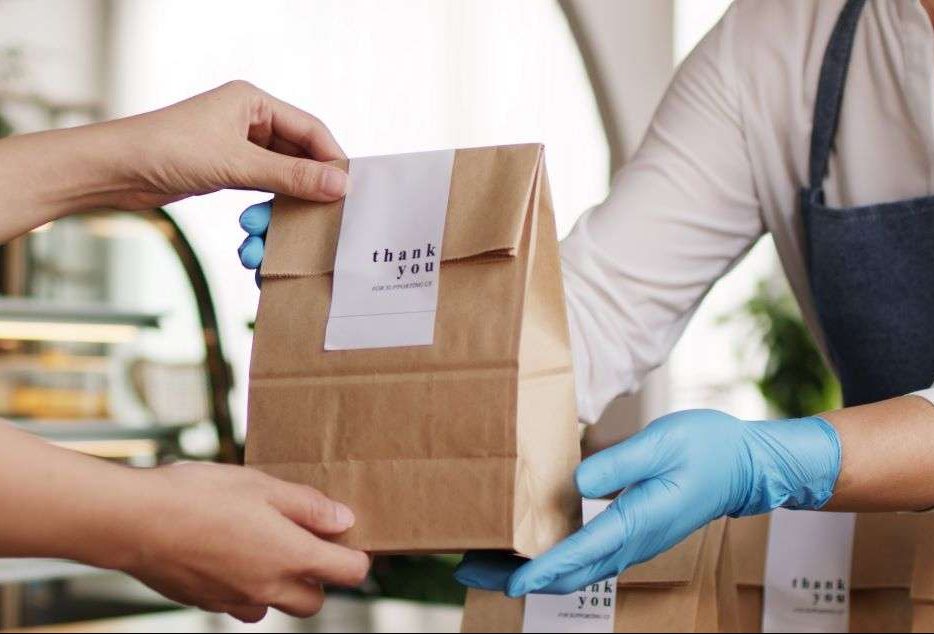
Labeling solutions have become essential to streamlined, accurate order fulfillment. Labels help teams organize food and order prep, and food packaging labels ensure customers receive the correct orders securely and on time.
Communication is crucial throughout fulfillment processes, and labels are the most efficient way to bring digital information from online ordering to employees tasked with food prep and packaging.
For example, follow an online order placed with a quick-service restaurant until it reaches the customer:
Repositionable linerless labels:
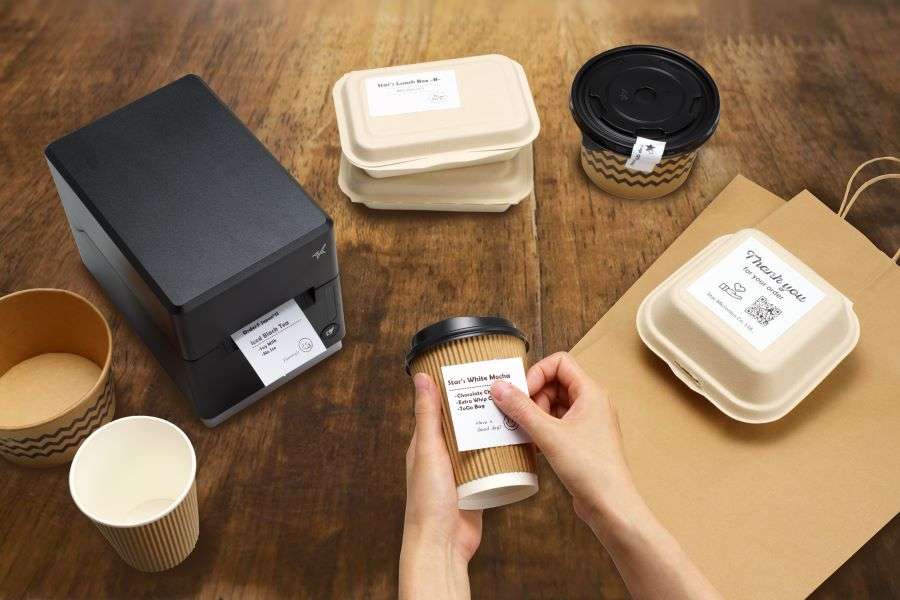
The online ordering platform communicates the order to the QSR’s point-of-sale (POS) system and generates repositionable labels. These labels, applied to trays in food prep areas, communicate the customers’ menu choices and modifiers to the kitchen staff. Employees can reapply the labels to packaging down the line to ensure precision, eliminate errors, and decrease waste.
Die-cut labels:
When the order is complete, the restaurant can print die-cut labels on demand, adding its brand logo or a thank you message. Labels, whether traditional liner-backed or linerless, can also include promotional messaging or QR codes that customers can scan to join the loyalty program, check their rewards balance, or save a coupon code for future orders. These food packaging labels can contribute to a positive customer experience.
Permanent linerless labels:
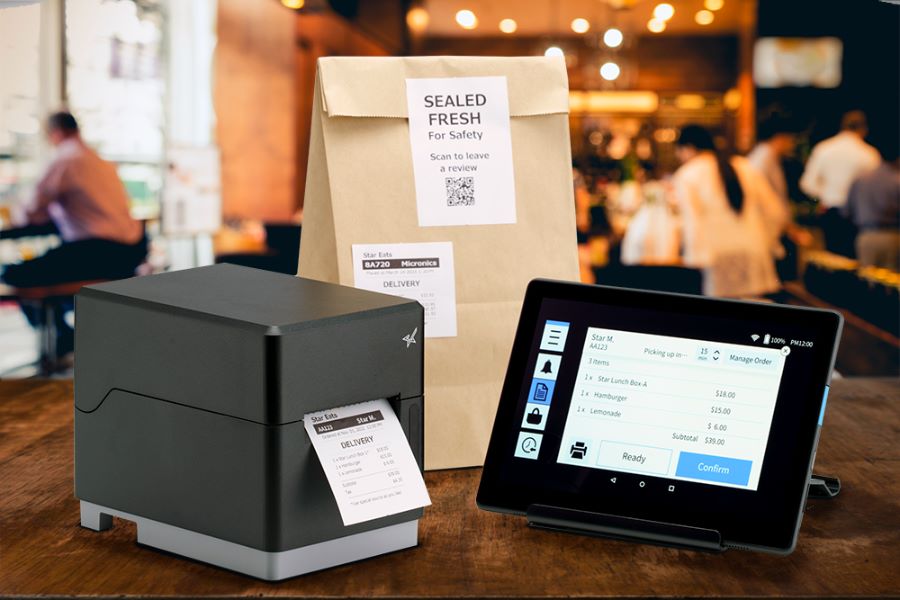
Permanent labels direct the order to curbside or in-store pickup, in-house delivery drivers, or third-party delivery. These labels ensure orders go to the proper place, enhancing operational efficiency. Food packaging labels with delivery information can also include barcodes that allow the restaurant to track the order and confirm the correct delivery.
Permanent labels that close containers or bags ensure the order is tamper-proof. If the label is intact, it signals to the customers that their orders are in the same condition when they receive them as when the restaurant packed them.
How Labeling Solutions Overcome Food Delivery Challenges
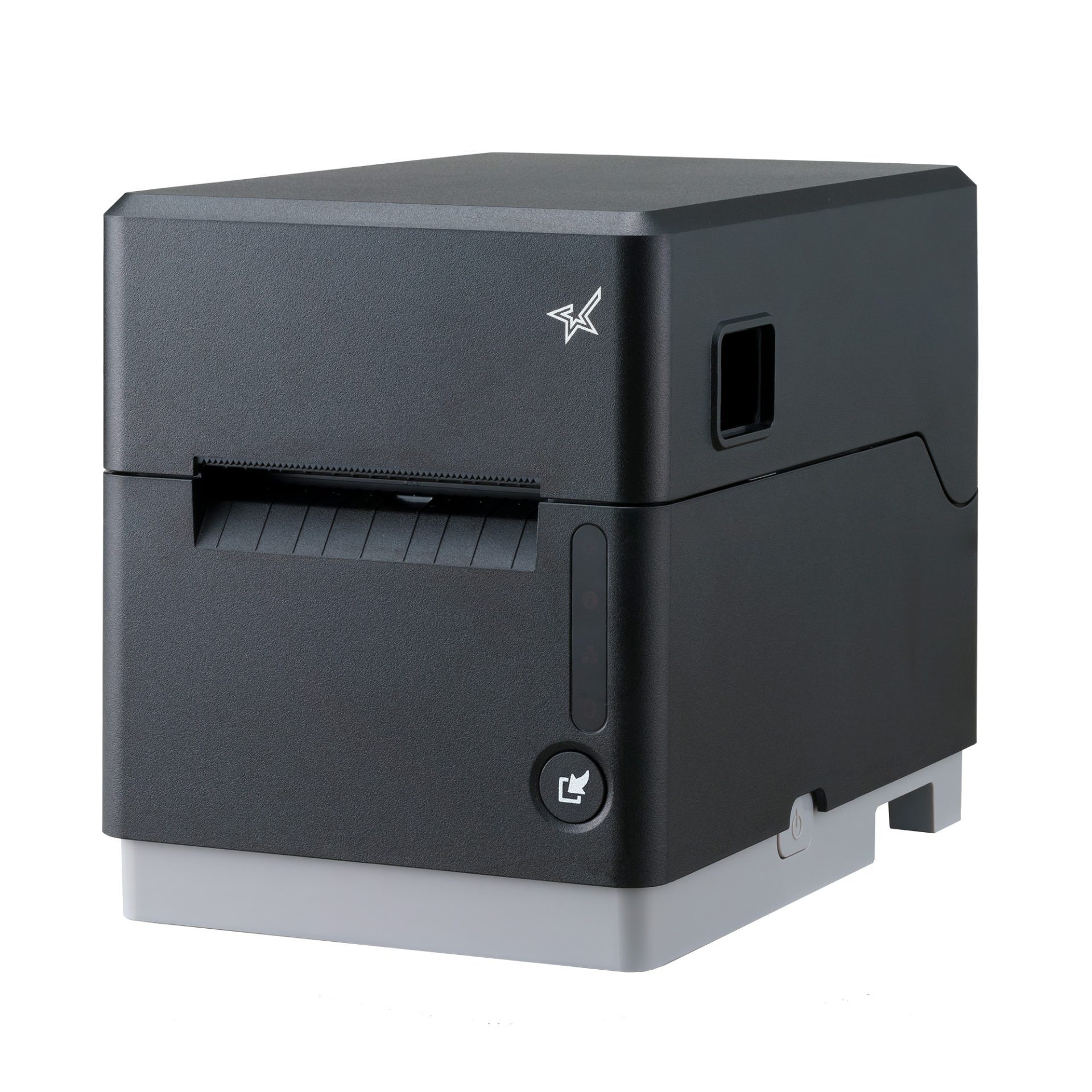
The mC-Label3 Multimedia Printer by Star Micronics is great for online ordering, takeout, and delivery.
Adding food prep and food packaging labels to online order fulfillment processes results in a range of benefits for restaurants and grocery stores, even beyond ensuring accurate delivery. The return on investment (ROI) of labeling solutions includes:
Cost control: Clearly labeled containers and bags allow the kitchen staff or grocery pickers to see exactly what to pack. Therefore, businesses generate less waste and expense from inaccurate orders.
Greater productivity: With labels communicating what each online order fulfillment team member must do, employees will have fewer questions that slow processes. Employees will work more quickly and can complete more orders per shift.
Increased customer satisfaction: Consumers expect accurate, on-time orders that are neatly and securely packaged. Labels help restaurants and grocery stores deliver what their customers want and help build loyalty.
Key Features of Food Delivery Labeling Solutions
To achieve greater accuracy, productivity, and customer satisfaction, restaurants and grocery stores need printers capable of producing the types of labels they need as they require. Star Micronics has developed printers with features that benefit online food order fulfillment, including the mC-Label3 Multifunction Printer and the TSP143IV SK Sticky Linerless Label Printer.
Both have CloudPRNT connectivity for cloud-based printing and are Cloud Ready for Star Cloud Services. They allow restaurant and grocery store managers to build labels on Star’s Label Builder. The mC-Label3 enables users to store up to three images on the printer so that employees can print them on demand with the One Touch button–no internet required.
Linerless labels are an increasingly popular choice among restaurants and grocery stores because they decrease paper waste, require fewer roll changes, and streamline workflows by allowing employees to print and apply labels with one hand.
The best printers for online order fulfillment and food packaging labels will also be easy for employees to use and maintain. Downtime isn’t an option when preparing orders accurately and on time. Both the mC-Label3 and TSP143IV SK are designed with user-friendly features. The mC-Label3 even sends maintenance alerts and QR codes with easy-to-follow instructions to keep it operating in top condition.
Exceed Expectations with Labeling
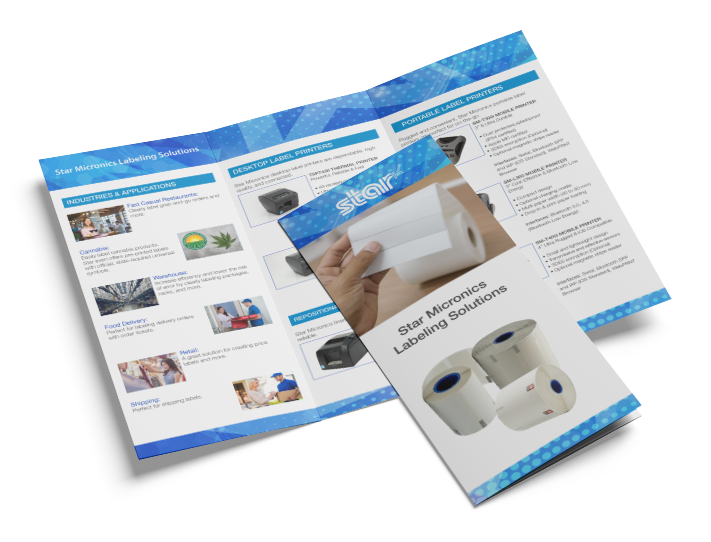
Star Micronics Labeling Solutions Brochure
Star’s advanced labeling solutions cater to a variety of unique needs and applications, ensuring seamless and efficient operations in any industry.
Online food ordering is a relatively new part of many consumers’ routines; however, when they engage with restaurants or grocery stores, they expect accuracy, fast fulfillment, and excellent service. Labeling enables online order fulfillment teams to meet those expectations while keeping operational costs low.
Furthermore, innovative restaurants and grocery stores can use labeling creatively to elevate their brand image, keep their businesses at the top of consumers’ minds, and increase customer loyalty.
A printing solution with features developed for online order fulfillment and food packaging labels makes it possible.
Explore the range of solutions offered by Star Micronics.
The grocery industry is undergoing rapid transformation, fueled by digital innovation and evolving consumer expectations. For grocery retailers and technology solutions providers, staying ahead in this dynamic landscape requires a deep understanding of the intersection between technology and customer service.
In the latest episode of the Rising Stars Podcast, “The Impact of Technology on Modern Grocery Stores,” host Kate Orara welcomes Kevin Spencer, President and CEO of Rod Plus Solutions and host of the podcast Retail Checks and Balances. Together, they explore Rod Plus’s pivotal role in reshaping the grocery sector through innovative technology solutions that cater to the digital retail landscape and changing consumer behaviors.
Kevin Spencer shares insights into Rod Plus’s contributions to the grocery technology sector, focusing on how the company’s solutions have revolutionized inventory management, e-commerce platforms, and customer engagement. This episode offers a unique glimpse into Rod Plus Solutions’ innovative strategies to help grocery retailers adapt to the digital era, enhancing both operational efficiency and customer satisfaction.
What Listeners Will Discover
By listening to this episode, audiences will discover:
The strategic innovations Rod Plus brings to the grocery industry.
How Rod Plus Solutions addresses common challenges in the sector.
The role of AI and IoT in advancing grocery services while maintaining a human touch.
Kevin Spencer’s perspectives on managing digital transformation in grocery retail.
A Must-Listen for Industry Stakeholders
“The Impact of Technology on Modern Grocery Stores” is essential listening for anyone involved in the grocery industry—from technology providers to retail managers and business leaders. As Kevin Spencer and Kate Orara explore Rod Plus Solutions’ approach to leveraging technology for grocery retail, they highlight the importance of balancing digital advancements with the intrinsic value of human connections in creating memorable customer experiences.
As Rod Plus Solutions and Star Micronics prepare for their appearance at the upcoming National Grocers Association (NGA) show, this episode is a timely resource for retailers looking to navigate the complexities of grocery technology and digital transformation.
Tune in to gain actionable insights into the future of grocery retail, driven by technology solutions that prioritize efficiency, customer engagement, and adaptability in a quickly changing market landscape.
Immerse yourself in the ever-evolving world of point-of-sale (POS) with the Rising Stars Podcast by Star Micronics, hosted by industry pro, Kate Orara. Twice a month, we dive into the fascinating journeys of innovators and businesses navigating the challenges of technology’s rapid pace.
In every episode, Kate Orara, Star Micronics’ Partner Development Manager, takes listeners on an exploration of emerging retail technology trends and strategies with global industry giants. She’s spent her entire career meeting all the right people, and now listeners everywhere can benefit from this vast network of channel gurus.
Always leading and always innovating, Star Micronics, a pioneer in POS and customer experience technology for over 60 years, welcomes you to join us in shaping a brighter future in the retail, hospitality, and cannabis industries.
The retail industry stands at a pivotal crossroads, with digital innovation and customer expectations evolving faster than ever before. For retailers aiming to excel in this dynamic environment, understanding and leveraging the latest trends and technologies is essential.
In this compelling episode of the Rising Stars Podcast titled “NRF 2024 Insights: Retail’s Digital Inflection Point,” host Kate Orara engages in a thought-provoking discussion with two of Star’s brightest: Jon Levin, Director of Product Management, and Christophe Naasz, Global Director of Business Development. Together, they explore insights gleaned from NRF 2024: Retail’s Big Show, offering a comprehensive look at what they learned about the future of retail in the digital age.
This episode holds a wealth of industry experience and expert analysis on how cutting-edge technologies like AI are used in retail strategies to meet and exceed market demands. Levin and Naasz share their unique perspectives on the importance of finding the right balance between innovative tech solutions and the genuine needs of the market, a balance crucial for the retail industry’s sustained growth and relevance.
Listeners are treated to an in-depth exploration of the rise of labeling in e-commerce and omnichannel retailing, underscoring the episode’s focus on practical, technology-driven solutions for enhancing operational efficiency and customer satisfaction.
What Listeners Will Discover
By tuning into this episode, listeners will gain invaluable insights into:
The ongoing adoption of AI and other emerging technologies in retail.
The critical role of labeling in e-commerce and omnichannel strategies.
Practical advice on aligning technological investments with real market needs.
The art of listening to customers to shape future-proof retail solutions.
Collaborative approaches to innovation that benefit all stakeholders in the retail ecosystem.
Essential Listening for Forward-Thinking Retail Professionals
“NRF 2024 Insights: Retail’s Digital Inflection Point” is a must-listen for anyone invested in the retail industry’s future, from business leaders and innovators to frontline managers and tech enthusiasts. Through engaging discussions and expert analysis, Orara, Levin, and Naasz offer a unique roadmap for navigating the complexities of digital transformation in retail, highlighting the opportunities that lie ahead for those ready to embrace change.
Don’t miss this opportunity to arm yourself with the knowledge and insights needed to be a leader in the industry. Subscribe and listen now!
Immerse yourself in the ever-evolving world of point-of-sale (POS) with the Rising Stars Podcast by Star Micronics, hosted by industry pro, Kate Orara. Twice a month, we dive into the fascinating journeys of innovators and businesses navigating the challenges of technology’s rapid pace.
In every episode, Kate Orara, Star Micronics’ Partner Development Manager, takes listeners on an exploration of emerging retail technology trends and strategies with global industry giants. She’s spent her entire career meeting all the right people, and now listeners everywhere can benefit from this vast network of channel gurus.
Always leading and always innovating, Star Micronics, a pioneer in POS and customer experience technology for over 60 years, welcomes you to join us in shaping a brighter future in the retail, hospitality, and cannabis industries.
Something I find particularly exciting about the start of each new year is getting to look through the growing retail and e-commerce trends, and 2024 did not disappoint. At a time when digital storefronts and spaces are just as crucial as physical ones, the retail landscape is undergoing yet another epic transformation.
Part of this shift is the emergence of social commerce, a trend that’s setting the stage for this next retail revolution. Combining mobile shopping and social media, two of the most popular contemporary pastimes, retailers are finding more creative ways to engage consumers, drive sales, and enhance the shopping experience. It’s never been easier to meet your customers where they already are.
This blog post explores the rise of social commerce and how retailers can leverage this trend to their advantage. I will also show how Star Micronics is leading innovation in mobile point-of-sale (mPOS) hardware for businesses entering and thriving in the online ordering space.
Social commerce, the process of selling products and services directly through social media platforms, is not just an extension of ecommerce; it’s a new frontier in retail, and still a relatively new one. Social commerce combines the interactive and social aspects of social media with the modern convenience of online shopping, creating a powerful tool for retailers.
The Convergence of Mobile Ecommerce and Social Media
The explosion of mobile ecommerce has been a critical driver for social commerce. Innovations in mobile technology have made smartphones the primary device for internet access, social interaction, and online shopping. Retailers leveraging mobile commerce hardware and technologies are uniquely positioned to capitalize on social commerce growth.
Platforms like Facebook, Instagram, Pinterest, and TikTok have native shopping features, allowing users to purchase without leaving the app. This harmony of social media and ecommerce is transforming how consumers discover and buy products.
Benefits of Social Commerce for Retailers
The advantages of social commerce extend beyond just increased sales. Here are a few benefits that highlight its importance for retailers:
Enhanced Customer Engagement: Social commerce turns shopping into a social experience, encouraging users to share, like, and comment on products. This engagement builds a community around a brand, fostering loyalty and repeat business.
Direct Sales Channel: By selling directly on social media, retailers can reduce the steps in the buying process, making it easier for consumers and the potential for higher conversion rates.
Rich Customer Insights: Social commerce platforms offer detailed analytics about customer preferences and behavior. Retailers can use this data to modify their marketing strategies, product offerings, and even product development.
Credibility via Social Proof: Social commerce boosts brand visibility and trust by leveraging user reviews and recommendations as powerful forms of social proof.
Cost-Effective Marketing: Marketing on social media platforms is extremely cost-effective for merchants, allowing small businesses the chance to be competitive in the market.
Implementing Social Commerce: Strategies for Retailers
A successful social commerce initiative requires more than just setting up a shop on a social platform. Here are effective strategies retailers should consider:
1. Cultivate a Robust Social Media Presence
The foundation of successful social commerce lies in maintaining an active, engaging presence on social media. Retailers should craft content that resonates with their audience, prompts engagement, and showcases their products attractively.
2. Create and Nurture Online Communities
Beyond posting content, use your social channels to foster vibrant online communities. Engage with your audience through interactive content, Q&A sessions, live footage, and community discussions to build a loyal customer base.
3. Embrace Influencer Partnerships
Influencers can significantly amplify your reach and credibility. But don’t pick just anyone! Work with influencers who align with your brand values and appeal to your target audience, leveraging their reach to introduce your products to real potential customers.
4. Maximize Platform Shopping Features
Leverage the built-in shopping functionalities of social platforms to facilitate easy purchases. Utilize features like Instagram’s Shopping tags and Facebook Marketplace to integrate seamless shopping experiences within your social profiles. Make sure your store is easily seen on your business profile.
Encourage purchases directly through social platforms by offering special discounts and promotions exclusive to your followers. This not only rewards engagement but boosts followers and incentivizes direct sales through these channels. This activity can signal to platform algorithms that your store deserves to be seen by more people.
6. Add User-Generated Content
Encourage and share user-generated content (UGC) to enhance credibility and trust among potential customers. UGC, such as customer reviews, unboxing videos, and product photos, serves as authentic social proof that can influence buying decisions.
7. Optimize for Mobile Shopping
With most social media browsing done on mobile devices, ensure your social commerce experience is optimized for mobile users. This includes easy navigation, quick loading times, and a streamlined checkout.
8. Implement Targeted Social Media Advertising
Utilize social media ads to get your message out to a broader audience with precision targeting. By running ads on platforms where your audience is most active, you can increase brand visibility, drive traffic to your social commerce channels, and boost conversions.
Preparing for the Surge
With social commerce set to continue its rapid growth, retailers must be prepared to adapt and refine. This means investing in mobile-friendly platforms, exploring new social media features, and finding creative ways to engage with your audience.
Building a solid social media presence takes time and consistency, so start as soon as you can and keep going. Retailers that can effectively leverage social commerce will find themselves well-positioned to capitalize on it and drive significant business growth.
Omnichannel Ordering with Social Commerce
As retailers strive to provide the easiest shopping experience across all platforms, incorporating social commerce into an omnichannel strategy becomes essential. Omnichannel retail solutions ensure that whether a customer shops online from a mobile device, a laptop, their television, or in a brick-and-mortar store, the experience is consistent and complementary.
For instance, a customer might see a product on a brand’s social media, purchase it through their mobile app, and choose to pick it up in-store. This streamlined process enhances customer satisfaction and loyalty, driving further growth in social commerce.
Conquering Omnichannel Order Management with Cloud-Based Technology Solutions
Consumers have spoken! The future of retail and hospitality is omnichannel, cloud-based, and connected. Is your business prepared?
While the benefits of social commerce are clear, retailers must also be prepared for its challenges. Privacy concerns, the complexity of managing different social media platforms, and the need to craft engaging content require thoughtful strategy and execution.
Consumer skepticism about data privacy on social platforms remains a barrier, especially for smaller businesses. Shoppers often show a preference for dealing with well-established retailers. Instances of counterfeit products and unsatisfactory delivery experiences reported by social commerce consumers could exacerbate this mistrust.
Retailers must ensure they can handle these challenges by investing in technology with robust security, training their teams, and staying informed about changes in social media platform policies and consumer behavior.
Equipping for Online Orders with Smart Hardware Solutions
As social commerce amplifies online order volumes, having the proper hardware becomes crucial for managing this influx. Printers equipped with innovative technologies like CloudPRNT from Star Micronics offer seamless integration with cloud-based and mobile ordering systems, ensuring orders are processed swiftly and accurately.
Strategic labeling, facilitated by advanced printers such as the mC-Label3 multimedia printer, becomes indispensable for sorting and fulfilling online orders, enhancing operational efficiency. Additionally, organizing workstations with versatile solutions like the Tri-Mount from Star, which can secure three tablets simultaneously, allows for streamlined handling of orders from multiple online platforms.
This suite of smart hardware solutions not only supports the rise in online orders but also helps maintain organized, efficient operations in the fast-paced world of social commerce.
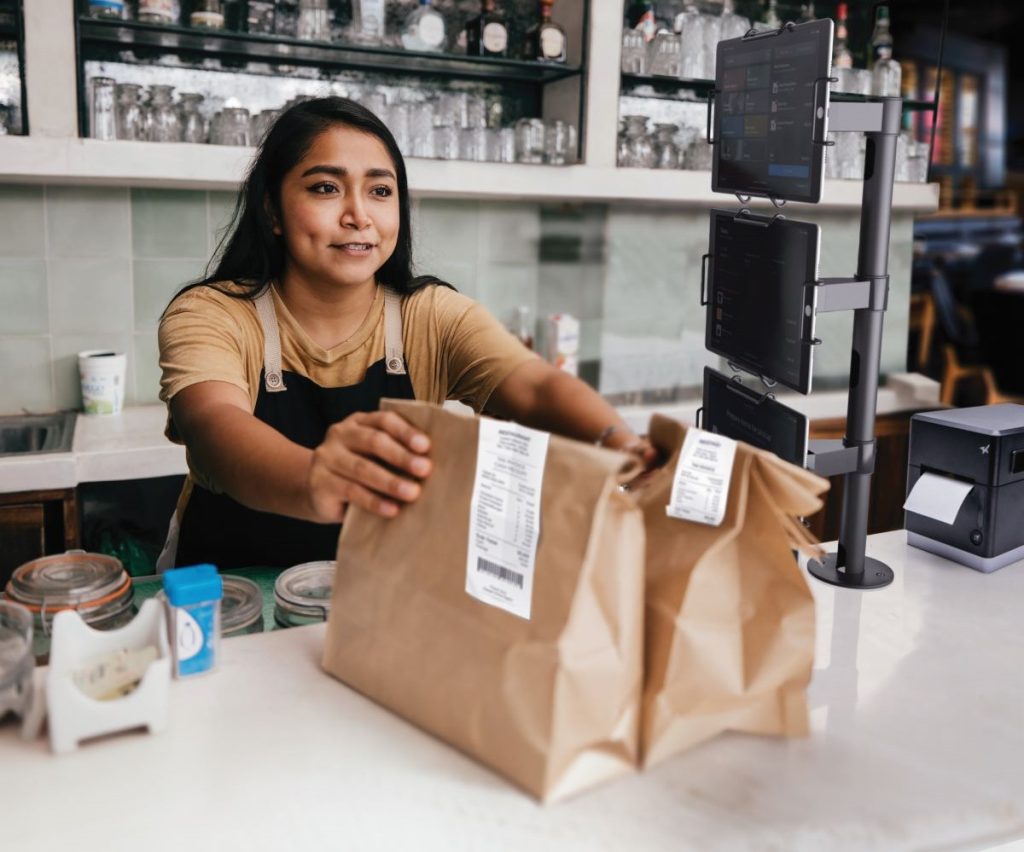
The mUnite Tri-Mount and mC-Label3 multimedia printer are perfect for online orders.
Seizing the Social Commerce Wave with Star Micronics
It’s clear that embracing social commerce is essential for retailers aiming to thrive in today’s digital-first marketplace. This digital revolution, powered by the fusion of social media and ecommerce, offers a platform for brands of any size to enhance engagement, drive sales, and solidify their market presence.
Star Micronics offers innovative hardware solutions for every industry, including CloudPRNT technology and the versatile mC-Label3 multimedia printer. These solutions are designed to streamline online orders and enhance operational efficiency. By incorporating these tools into your omnichannel strategy, you can ensure a seamless, engaging shopping experience that aligns with the rising demands of mobile commerce and social media shopping.
Retail is going places – get there first with the support of Star Micronics.
Welcome to another exciting edition of the Rising Stars Podcast! In episode 38, “RMH’s Blueprint on Retail Software Success,” we had the pleasure of hosting Israel Morrison, Director of Sales & Marketing at Retail Management Hero (RMH), with our own Kate Orara, Partner Development Manager at Star Micronics.
This episode dives into the innovative world of RMH’s tailor-made software solutions for small- to medium-sized retailers. Israel Morrison brings over a decade of experience in point-of-sale (POS) technology to the table, sharing valuable insights into the company’s RMH Store and RMH Central software systems.
These solutions are not just revolutionizing retail management but are also driving efficiency and growth for a variety of industries, including grocery, liquor, apparel, and specialty retail.
Israel Morrison’s perspectives on the evolving POS landscape.
RMH’s strategies for tackling the rise of tablet-based POS systems.
The significance of adapting to fast-evolving technologies like cloud computing, e-commerce, AI, and online ordering.
The importance of these technologies for businesses aiming to stay competitive.
RMH’s collaborative methods with hardware manufacturers and resellers for all-encompassing solutions.
Future predictions for the retail industry over the next decade.
How Value-Added Resellers (VARs) and software companies can prepare for or lead industry changes.
A Must-Listen for Retail Enthusiasts and Professionals
This episode is a must-listen for anyone in the retail sector, from VARs to software enthusiasts and business owners. Israel’s expertise and RMH’s forward-thinking approach are a beacon for those navigating the complex retail technology landscape.
Take advantage of this informative and engaging episode! Listen now and join us as we explore the future of retail with RMH. Check out the Rising Stars Podcast for more episodes on the latest trends and innovations in the POS and retail industry.
Immerse yourself in the ever-evolving world of point-of-sale (POS) with the Rising Stars Podcast by Star Micronics, hosted by industry pro, Kate Orara. Twice a month, we dive into the fascinating journeys of innovators and businesses navigating the challenges of technology’s rapid pace.
In every episode, Kate Orara, Star Micronics’ Partner Development Manager, takes listeners on an exploration of emerging retail technology trends and strategies with global industry giants. She’s spent her entire career meeting all the right people, and now listeners everywhere can benefit from this vast network of channel gurus.
Always leading and always innovating, Star Micronics, a pioneer in POS and customer experience technology for over 60 years, welcomes you to join us in shaping a brighter future in the retail, hospitality, and cannabis industries.
In an age of heightened environmental awareness, businesses increasingly seek eco-friendly alternatives in all aspects of their operations. From reducing waste to minimizing carbon footprints, sustainability has become a crucial consideration for modern enterprises. Among the innovative solutions making a positive impact is the adoption of linerless sticky labels.
Whether permanent linerless or repositionable linerless, these versatile labels offer a greener alternative to traditional labels, aligning with businesses’ commitment to eco-conscious practices. But why are they the greener choice, and are there any issues that need further consideration?
In this article, we will explore the many eco-friendly advantages of linerless sticky labels and why they are an essential addition to any environmentally-conscious business that uses labels.
Why Linerless Sticky Labels are the Greener Choice
Waste Reduction
First and foremost, linerless sticky labels eliminate the need for backing paper, a significant source of waste with traditional labels. Silicone backing paper, also known as liner waste, contributes to the bulk of discarded materials in labeling processes.
With linerless labels, this waste is drastically reduced during production and application, leading to less environmental strain and landfill usage. By adopting linerless sticky labels, whether repositionable or permanent, businesses can demonstrate their commitment to waste reduction and a circular economy.
Recyclable Materials
Linerless sticky labels can be made from eco-friendly, fully recyclable, and even biodegradable materials. These materials can be chosen to ensure minimal environmental impact throughout their lifecycle. As businesses aim to meet their sustainability goals, opting for eco-friendly sticky labels becomes an essential step toward reducing their environmental impact.
Improved Material Efficiency
The absence of backing paper with linerless labels translates to optimized efficiency in printing processes. Linerless labels have more labels per roll, reducing the frequency of roll changes and ultimately saving resources. Plus, businesses don’t need to change the sticky paper roll as often.
Star Micronics Labeling Solutions Brochure
Ideal for self-ordering, Star Micronics kiosk label printers have a small footprint and are easy to incorporate.
The higher number of labels per roll and the elimination of liner waste contribute to significant space-saving advantages. Businesses can store and transport more sticky labels at once, reducing storage space requirements and logistic costs. This space-saving feature also extends to retail environments where compact label rolls allow for more products on display, enhancing visual appeal.
Versatility in Applications
Linerless sticky labels are incredibly versatile and can be used for a wide range of applications. Whether you need labels for food and beverages, retail items, shipping, or any other purpose, these labels offer a convenient all-in-one solution.
By using linerless labels, businesses can simplify inventory management and reduce the need for multiple label types, resulting in less material consumption and a more efficient labeling process.
When it comes to linerless labels, understanding their potential environmental advantages requires careful consideration of critical factors:
Adhesive Selection: Linerless labels rely on specialized adhesives that eliminate the need for liners. The environmental impact of these adhesives may vary, making it crucial to opt for eco-friendly options that align with your application requirements.
Label Application Process: Efficient application techniques and equipment are vital for minimizing waste and reducing environmental impact when working with linerless labels. Ensuring streamlined processes can contribute to sustainable practices.
Responsible Disposal: Maximizing the environmental benefits of linerless labels necessitates proper disposal or recycling. Educating consumers about recyclability and providing clear disposal instructions can encourage eco-friendly habits.
As with any labeling solution, the overall environmental impact of linerless labels depends on factors like material choices, manufacturing practices, and end-of-life disposal. Collaborating with knowledgeable suppliers or sustainability experts can assist in evaluating specific linerless label options and understanding their environmental implications.
Sustainability is a top priority for many businesses, so opting for eco-friendly solutions like linerless sticky labels makes perfect sense. Not only do these labels help reduce waste and minimize carbon footprints, but they also offer cost-effective benefits and can be used in a variety of applications.
By making the switch to linerless labels, businesses showcase their dedication to environmental responsibility, attracting eco-conscious customers and playing their part in building a greener future. Take a leap toward sustainability and enhance your business’s environmental profile by embracing linerless sticky labels today.
The mC-Label3 Multimedia Printer
The latest innovation by Star Micronics, the mC-Label3 Multimedia Printer, prints across a wide array of media types, including repositionable linerless sticky label paper.
Star Micronics is a leading provider of sustainable labeling solutions tailored to meet your unique business needs. Learn more about our eco-friendly printer and label options and how we can help your business make a positive impact on the environment: